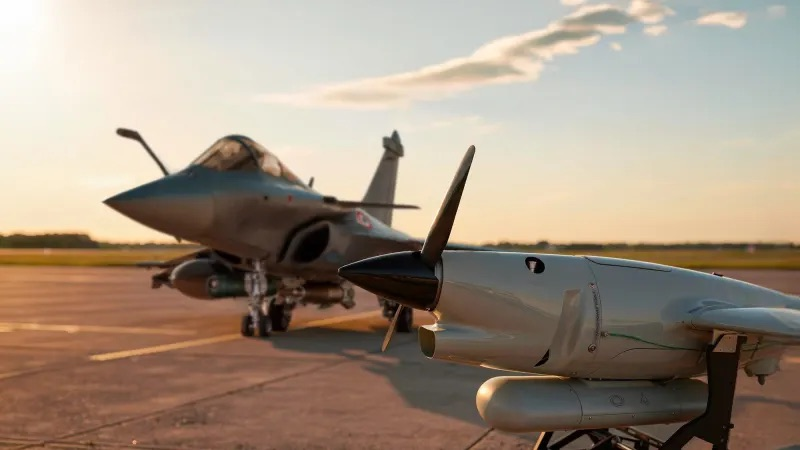
Dassault Aviation and Harmattan AI have demonstrated a collaborative electronic warfare mission involving a Rafale F4 combat aircraft and an autonomous uncrewed platform carrying the NAMIB payload.
During the exercise, the uncrewed aircraft detected, identified, and geolocated radar emissions from a target positioned several dozen kilometres away. Coordinates were then transmitted to the Rafale, allowing its crew to conduct a simulated engagement using information collected by the remote system.
NAMIB has been developed jointly by the two companies as a lightweight electronic warfare payload for uncrewed aircraft. Moving the sensor away from the crewed platform allows it to operate closer to an emitting radar and collect signals from another position, potentially improving location accuracy while reducing exposure for the Rafale.
The demonstration combined radio frequency sensing, signal classification, autonomous navigation, data processing, communications, sensor fusion, and transfer of targeting information into the combat aircraft’s mission system. Each function had to operate as part of one timed sequence rather than as a collection of separate demonstrations.
Electronic warfare systems must distinguish relevant emissions from background activity and identify signals that may be intermittent, mobile, deceptive, or deliberately altered. Sufficient bandwidth and sensitivity are required, but processing must also be rapid enough to prevent the target from changing state or position before the information can be used.
An uncrewed platform allows sensing capability to be distributed across a wider area. Several lower-cost aircraft could eventually approach from different directions, compare measurements, and construct a more detailed electronic picture than one crewed aircraft carrying all of its sensors internally.
The flight sequence and operational role are also examined in specialist analysis of the Rafale and NAMIB teaming demonstration. Converting the concept into a deployable system will require repeatable manufacturing, qualification, secure software, and a support model capable of handling frequent updates.
Communication resilience will be central because radar suppression is likely to take place where data links are jammed, monitored, or attacked. The uncrewed system must continue operating safely if contact is interrupted, while the Rafale crew needs confidence that incoming coordinates remain current and correctly classified.
Autonomy can reduce the communications burden by allowing the remote aircraft to navigate, position its sensors, and respond to changing conditions without continuous control. Greater autonomy also increases the software assurance requirement, particularly where the system contributes information used during targeting.
Manufacturing the payload will demand consistent radio frequency performance across antennas, receivers, processors, enclosures, power supplies, and cooling systems. Small variations can affect sensitivity or direction-finding accuracy, while military operation introduces stringent requirements for vibration, temperature, electromagnetic compatibility, and secure component sourcing.
The host aircraft imposes further constraints through payload weight, electrical demand, heat rejection, endurance, speed, and signature. A capable sensor provides limited operational benefit if the platform cannot carry it far enough, remain airborne long enough, or manoeuvre safely within the required area.
Rafale F4 provides the networked mission environment needed to receive and use external sensor data. Future combat air programmes are expected to extend that model by linking crewed aircraft with several collaborative platforms carrying sensors, communications systems, electronic effects, or weapons.
As those architectures develop, more of the system’s value will move into processors, software, antennas, data links, secure electronics, and rapid upgrade processes. Conventional aerospace manufacturing will remain essential, but aircraft performance will depend increasingly on how quickly digital and electronic subsystems can be improved.
Qualification will have to cover a broader range of conditions than those used during the initial demonstration. Different emitters, moving targets, congested radio environments, contested communications, several uncrewed aircraft, and active countermeasures will place heavier demands on both hardware and software.
Support arrangements must also account for rapid changes in threat systems. Electronic warfare libraries, classification algorithms, and mission software may require frequent updates, which means secure data management and controlled configuration will form a permanent part of the operating model.
Dassault and Harmattan have completed the chain from detection to simulated action using a crewed and uncrewed team. Repeating that performance under more representative conditions will determine how quickly NAMIB can progress from a successful demonstration into a qualified and supportable capability.