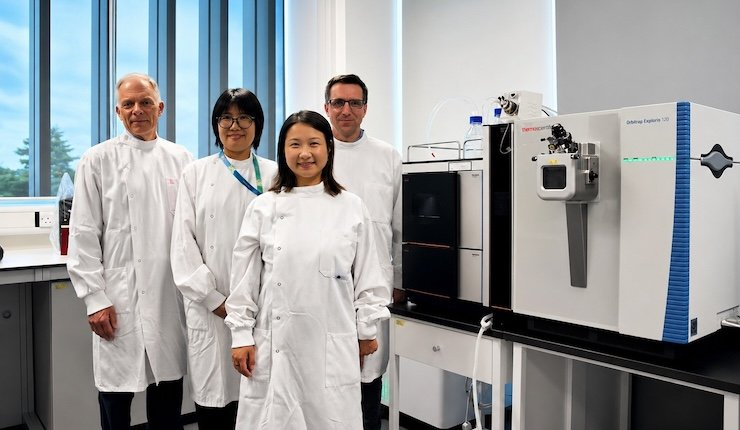
Novogene Europe has launched an untargeted metabolomics service from its Cambridge Omics Centre, expanding the analytical capacity available to biotechnology, pharmaceutical, clinical research, and academic organisations.
The service combines Thermo Scientific Vanquish ultra high performance liquid chromatography equipment with Orbitrap Exploris 120 high resolution accurate mass spectrometry. A metabolite reference library will support compound identification and interpretation.
Untargeted metabolomics is designed to detect a broad range of small molecules within a biological sample without restricting analysis to a predetermined panel. The resulting profile can reveal changes in metabolic pathways associated with disease, microbiome activity, treatment response, environmental exposure, or biological production processes.
Where targeted analysis quantifies a defined group of compounds against validated standards, an untargeted workflow seeks to capture the widest practical chemical profile. That breadth supports discovery work but also produces complex datasets containing known metabolites, partially characterised compounds, and signals that may not initially be assigned to a particular molecule.
Chromatographic separation divides the sample before compounds enter the mass spectrometer, after which accurate mass measurement, fragmentation data, retention behaviour, and reference comparisons contribute to identification. Instrument performance, sample preparation, and data processing must remain tightly controlled because small variations can alter the recorded metabolic profile.
Locating the service in Cambridge gives European customers access without sending samples to more distant laboratories. Shorter transport routes can be useful for unstable biological material, although collection methods, temperature control, preservatives, storage duration, and freeze-thaw cycles still need to be managed consistently.
Novogene plans to use the capability alongside its existing genomics, transcriptomics, proteomics, and related omics services. Combining those datasets can connect genetic variation and gene expression with protein activity and downstream metabolic change, producing a more complete account of a biological system than any single measurement layer.
The investment adds to the expansion of specialist life sciences infrastructure in Britain. Capacity is also increasing further downstream, including new radiopharmacy manufacturing and distribution facilities intended to support growing demand for diagnostic and therapeutic products.
Metabolomics can contribute at several stages of pharmaceutical development. It may support biomarker identification, investigation of a candidate’s mechanism of action, detection of off-target effects, patient stratification, or examination of how a production process influences the characteristics of a biological product.
Exploratory data cannot move directly into a regulated decision. Candidate biomarkers must be confirmed using targeted methods, reference standards, independent sample sets, and statistically appropriate study designs before they can support clinical or manufacturing specifications.
An unidentified signal that changes consistently may be scientifically useful during discovery, but its identity and measurement performance must be established before it can form part of a validated control strategy. That transition from broad screening to defined measurement is where analytical development becomes particularly demanding.
Reproducibility is complicated by the length and scale of metabolomics studies. Large sample sets may run over days or weeks, during which instrument sensitivity, column behaviour, ion source condition, and laboratory environment can change.
Quality control samples, internal standards, randomised run orders, blank injections, and defined maintenance procedures are therefore needed to separate biological variation from analytical drift. Without those controls, apparent differences between sample groups may reflect the order in which they were analysed rather than a genuine biological effect.
Data processing creates a comparable source of variation. The same raw measurement can produce different feature lists depending on peak detection, alignment, normalisation, filtering, and library matching parameters, which makes transparent pipelines and controlled software versions essential.
Within biopharmaceutical manufacturing, the technique could complement established process analytical and product characterisation methods. Changes in cell culture conditions, raw materials, nutrient consumption, or microbial activity may produce metabolic signatures before they become visible through conventional end point testing.
Untargeted analysis is unlikely to replace validated release assays because its breadth and data complexity are better suited to investigation and development. Its role is to reveal patterns that can be converted into narrower, robust methods once the most relevant compounds have been identified.
Novogene’s Cambridge service increases regional capacity for that work, but industrial adoption will rest on consistent sample handling, instrument control, reference coverage, and the ability to translate exploratory datasets into measurements that can withstand pharmaceutical development and manufacturing requirements.