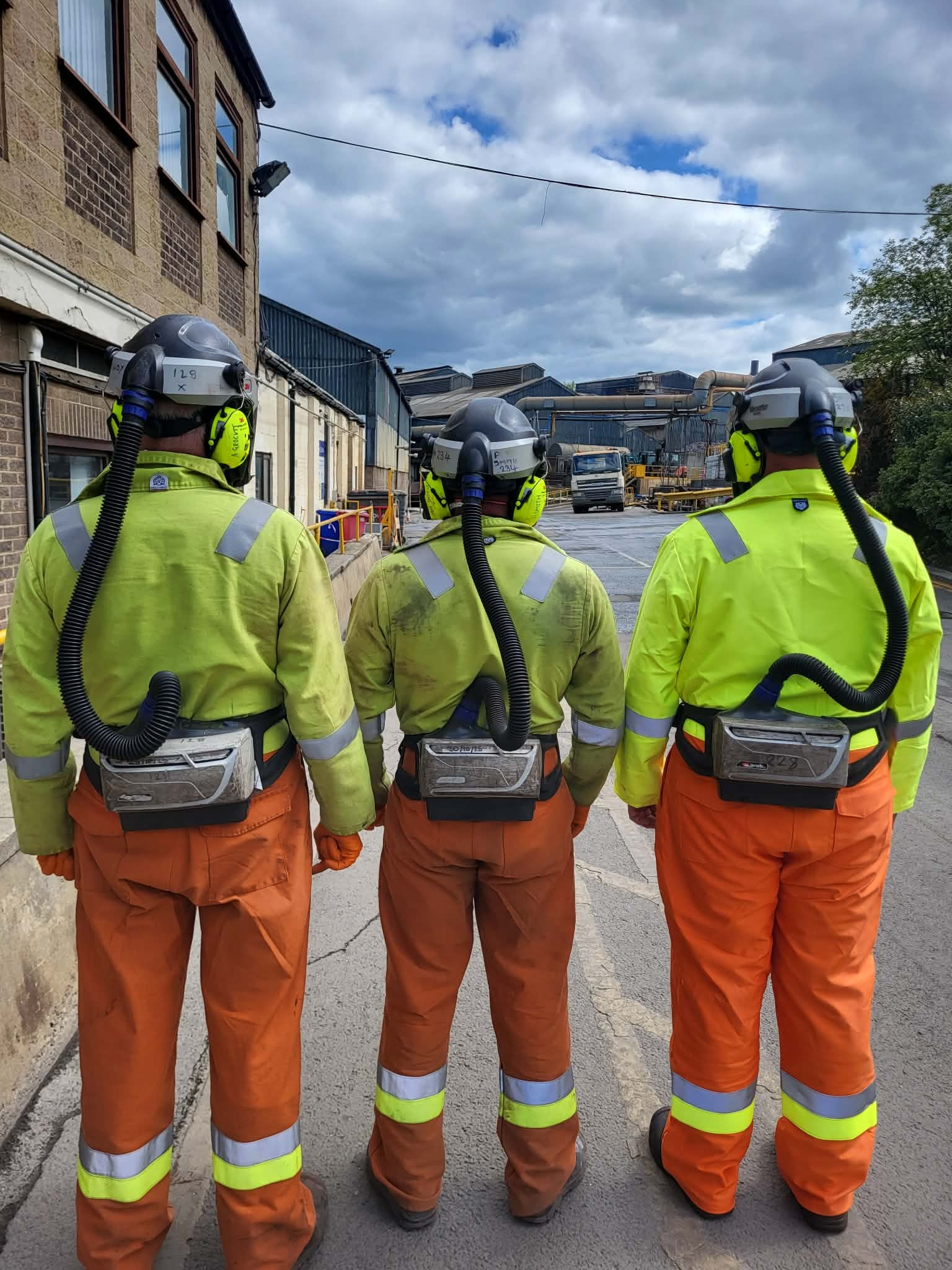
HJ Enthoven has deployed 28 custom communications headsets that allow maintenance personnel to speak with colleagues without removing or adjusting protective equipment inside its lead processing operation.
The battery recycling and lead refining company developed the system with ANT Telecom and Safer Hearing after identifying a conflict between routine telephone use and the personal protective equipment required in areas where airborne lead particles may be present.
Employees working in those locations wear respiratory protection and visors to reduce exposure to contaminated air. Although HJ Enthoven already used a Digital Enhanced Cordless Telecommunications system across the site, conventional handsets could require workers to lift a visor or disturb their protective equipment when making or receiving calls.
The custom headsets integrate with the existing DECT phones while remaining compatible with the equipment worn by the maintenance team. Calls can therefore be handled without creating the temporary loss of protection associated with moving a visor away from the face.
Maintenance personnel may need to coordinate isolations, request tools, confirm permits, describe faults, or communicate during time-sensitive interventions. When those exchanges occur repeatedly during a shift, even brief adjustments to protective equipment can create avoidable exposure.
Carly Henman of HJ Enthoven said: “Communication is essential for our teams, but we realised that the simple act of taking a phone call could mean people lifting their visors and potentially exposing themselves to lead particles in the air. We didn’t want to accept that as unavoidable.”
She added: “By working closely with ANT Telecom and Safer Hearing, we were able to find a practical solution that allows our teams to communicate without compromising their PPE.”
Lead exposure is controlled in Britain through the Control of Lead at Work Regulations 2002 and associated Health and Safety Executive guidance. Employers must assess exposure, prevent it where reasonably practicable, and use engineering controls, working methods, protective equipment, hygiene measures, and medical surveillance where required.
HSE figures covering the three years from 2021/22 to 2023/24 recorded 5,094 workers under medical surveillance for occupational lead exposure and 11 suspensions. Smelting, battery recycling, metal processing, construction, and work involving lead-containing coatings remain among the activities requiring close control.
HJ Enthoven said it had observed a reduction in blood lead levels among maintenance personnel following deployment. Those results sit within a wider system of exposure control that includes ventilation, respiratory protection, housekeeping, hygiene, training, work planning, and occupational monitoring.
No single item of equipment can account for changes in exposure across a complex industrial operation, but eliminating a repeated reason to disturb PPE strengthens the overall control arrangement. Communication becomes part of the protective system rather than an activity that temporarily works against it.
Tim Booth, specialist adviser at Safer Hearing, said: “In hazardous environments, communication equipment has to work alongside personal protective equipment — not against it. This project was about designing a solution that enabled workers to stay fully protected while still communicating clearly and safely.”
The same conflict appears across industrial sites where respirators, face shields, helmets, hearing protection, chemical hoods, and protective clothing interfere with telephones or radios. Poor audio can encourage workers to adjust equipment, move into an unsafe position, or rely on hand signals during noisy or urgent work.
Suitable equipment must account for more than sound quality. Headset geometry, clamping pressure, compatibility with mask seals, contamination control, cleanability, battery life, glove-friendly controls, and resistance to the surrounding environment all influence whether workers can use it consistently.
Maintenance introduces additional demands because employees move between locations and may enter hot, noisy, confined, or restricted spaces. Communications equipment needs to remain accessible without catching on machinery, interfering with tools, or compromising mobility.
Integrating the headsets with the existing DECT infrastructure reduced the need to replace the wider communications network. Development could therefore concentrate on the interface between the worker, the headset, and the protective equipment rather than introducing a new operating system across the site.
Klaus Allion, managing director of ANT Telecom, said the installation combined HJ Enthoven’s operational knowledge, Safer Hearing’s protective equipment expertise, and ANT Telecom’s communications integration capability. That combination allowed the equipment to be designed around the conditions encountered by maintenance teams rather than adapted from a generic office or warehouse product.
Interest from other departments has prompted HJ Enthoven to consider whether the approach can be extended into additional operational areas. Any wider deployment will require assessment against the PPE, noise, contamination, and communications requirements of each location.
The project removes a small but repeated weakness from a wider occupational hygiene system. By designing communications around the protective measures already in place, HJ Enthoven has reduced the need for employees to choose between receiving information and maintaining their protection.