DMG Mori will present 20 largely automated machine tools at AMB 2026 in Stuttgart, combining machining, additive manufacturing, robotics, production software, and lifecycle services across a 2,100-square-metre exhibition area.
The display will cover five-axis simultaneous machining, six-sided turn-mill production, grinding, measurement, laser deposition, powder-bed additive manufacturing, pallet handling, and robotic workpiece automation.
Running from 15 to 19 September, AMB will provide the setting for a portfolio organised around process integration, automation, digital production, and manufacturing efficiency. Several machines will be presented in configurations intended to shorten specification and commissioning work.
The equipment includes the DMV 160 vertical machining centre, CLX 450 turning platform, and DMX 80 U five-axis machine. Selected models will be offered through the company’s Best Fit Machines programme, which uses predefined options to reduce configuration complexity and provide more predictable pricing.
Most of the machines can be supplied with the CELOS X control and production platform and are prepared for later automation. Customers can begin with a conventional configuration and add handling equipment as volumes, staffing, or production patterns change.
Process integration will be demonstrated through machines capable of completing operations that would traditionally require several pieces of equipment. The DMC 80 FDS duoBLOCK and NTX 2500 combine turning, milling, grinding, and measurement within a single working area.
Completing more operations in one clamping can reduce work in progress and improve geometric accuracy because the component is not repeatedly removed, transported, and relocated. The machine and programme become more complex, but fewer transfers reduce the number of points at which alignment or handling errors can enter the process.
Gear production will be represented through the Gear Package ALL IN 2.0, which contains eight technology cycles. Suitable turn-mill centres can use the package to produce gear features without transferring the component to a dedicated gear-cutting machine.
Additive manufacturing will appear through LASERTEC systems covering powder-bed selective laser melting and directed energy deposition. Hybrid configurations can deposit material and machine the resulting surface within a connected production route.
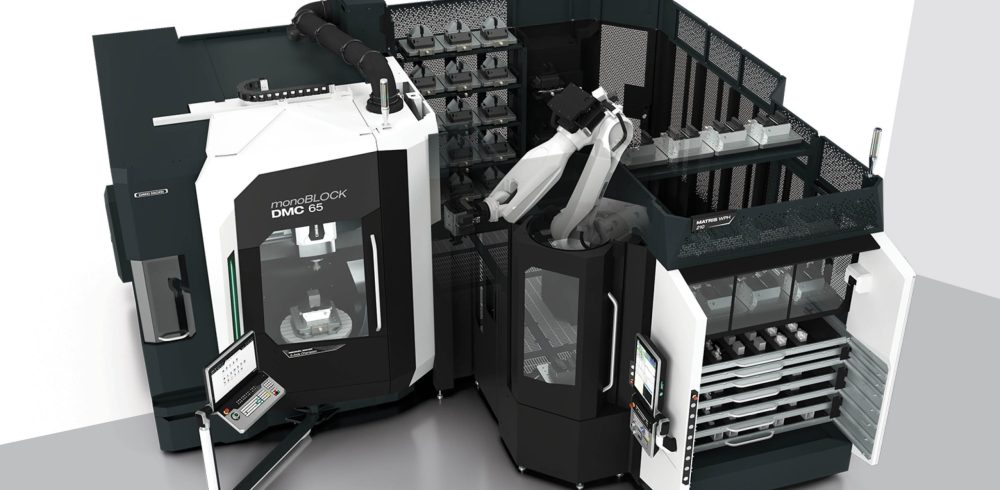
The automation programme includes a DMU 60 eVo paired with a MATRIS WPH 70 robotic system capable of handling both pallets and workpieces. A Robo2Go installation using the easyFIX function will demonstrate automated vice repositioning on a DMU 40.
Machine-tool automation is increasingly specified at the beginning of a capital project rather than added after commissioning. Labour availability, shorter batches, rising costs, and pressure to extend operating hours have altered the calculation around robotic handling and pallet systems.
German machine builder Grob is pursuing a similar direction for AMB, connecting machining centres with robotic handling, production software, and tool management. Competition is consequently moving beyond the isolated cutting specification towards the output and stability of the complete manufacturing cell.
Spindle power, accuracy, and metal-removal capability remain essential, but manufacturers increasingly compare setup time, unattended hours, inspection integration, tool management, energy use, and the ease with which work can be transferred between machines.
Unattended production places stricter demands on process stability. Tool life, chip evacuation, material variation, workholding, measurement, and fault recovery all have to remain predictable when an operator is not available to intervene immediately.
Software becomes part of the available capacity because programming time and setup knowledge can restrict the use of advanced equipment. DMG Mori says its technology cycles can reduce programming time by as much as 60% for suitable operations.
The actual saving will vary with component complexity and existing skill levels, but controlled cycles can reduce the amount of specialist code required for recurring tasks. They also allow proven methods to be transferred between operators and machines rather than recreated for every job.
CELOS X connects machine functions, applications, production information, and service data through a common environment. Manufacturers will assess how effectively it exchanges information with existing planning, quality, and factory systems, particularly where the installed base includes equipment from several suppliers.
The Best Fit Machines programme addresses the time consumed by specification work. Highly customised equipment can closely match a particular component family, but prolonged option selection, engineering reviews, and supplier discussions can delay ordering and complicate commissioning.
Predefined configurations may shorten that route where the production requirement fits within a standard envelope. Buyers will still need to ensure that the simplified specification retains enough spindle, axis, tooling, measurement, and automation capability for future work.
Machine tools commonly remain in service far longer than the products for which they were originally purchased. Equipment that combines several processes, accepts later automation, and shares a common digital environment can accommodate a broader range of work as demand changes.
That flexibility carries greater dependence on software maintenance, supplier support, and trained personnel capable of managing integrated systems. A failure within a combined machine or automated cell may also interrupt several operations that would otherwise have been distributed across separate equipment.
DMG Mori’s AMB portfolio sets out an approach in which machining, handling, inspection, and software are designed as one production system. Its industrial value will depend on whether that integration delivers stable utilisation across changing batch sizes rather than concentrating additional complexity within an already expensive machine.