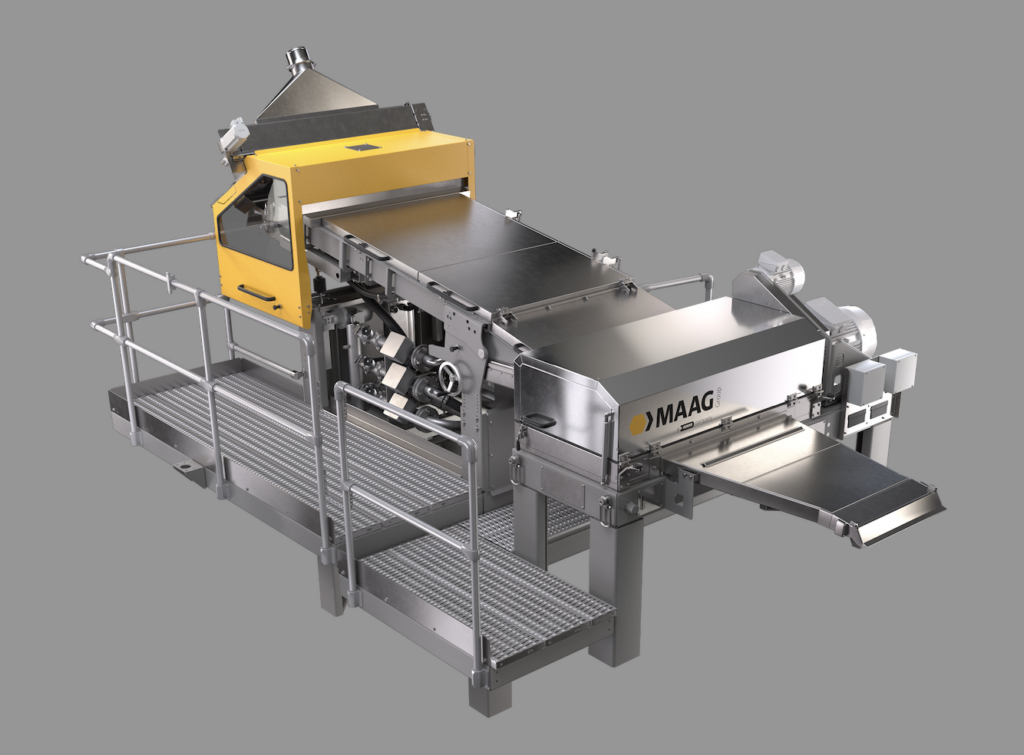
MAAG has introduced a new generation of M²-USG underwater strand pelletizers designed to improve process stability, throughput, system availability, and pellet quality in polymer production.
The new system is aimed at processors that need more reliable pelletising performance with less downtime and lower scrap. MAAG says the design supports system availability above 99% OEE while delivering more consistent cylindrical pellets with minimal fines.
At the centre of the development is a redesigned M²-USG cutting head intended to simplify operation and maintenance. The cutting head has been made more compact and includes improved sound insulation. Its rotor diameter has increased from 162.5mm to 200mm, while the number of blades has risen from 30 to 36, supporting higher throughput and a claimed 20% increase in service life.
The system has also been designed to reduce cleaning times and support tool-free maintenance procedures. In pelletising operations, cleaning and maintenance time affects more than the pelletizer itself, because upstream extrusion, melt handling, die plate operation, cooling, strand transfer, cutting, drying, and downstream conveying all depend on stable coordination.
Underwater strand pelletising creates exacting process control demands. Polymer melt passes through a die plate, is cooled, and is automatically guided into the pelletizer. Poor control of process parameters can cause strand adhesion, unstable cutting, inconsistent pellet geometry, higher fines, and production interruptions.
MAAG has addressed the start-up phase with a newly developed scraper that combines high operating speed with gentler strand handling. During start-up, polymer strands must be transferred reliably into the guide system. The scraper cuts strands sequentially at the die plate and feeds them into the strand guide and cutting head with a controlled time delay, supporting smoother operation and higher availability.
Sensor integration has also been added to support more stable production. Mechanical improvements in process equipment are increasingly being paired with better monitoring, diagnostics, and control data, since small deviations in temperature, pressure, strand behaviour, cooling, cutting geometry, or wear can quickly create quality losses.
The launch fits a wider push in process industries to improve utility efficiency and production stability rather than simply chase headline speed. Work on PET bottling air efficiency has shown similar thinking in another part of the sector, with equipment architecture being redesigned to increase output while reducing compressed air demand.
Pellet quality carries operational consequences beyond the pelletising line. Uniform pellets improve handling, feeding, drying, compounding, moulding, extrusion, and downstream process consistency. Excess fines can disrupt conveying systems, increase dust levels, affect dosing accuracy, and create housekeeping or quality problems.
Scrap reduction has also become more important as material costs, sustainability targets, and waste reporting requirements tighten. Polymer processors are handling more demanding blends, more recycled content, tighter customer specifications, and greater pressure to document waste performance. Stable pelletising becomes part of that broader quality and resource efficiency picture.
High availability is especially important in plants running continuous or high-volume production. A pelletizer stoppage can interrupt upstream extrusion and create material losses beyond the immediate machine. Maintenance-friendly design can therefore reduce restart time, operator error, wasted material, and schedule disruption.
The redesigned cutting geometry and strand handling also respond to the skills challenge in process plants. Equipment that is less sensitive to set-up error can help maintain consistency across shifts, particularly where experienced operators are scarce or production teams are running lean. Process knowledge remains essential, but machinery that reduces avoidable interruptions helps protect output.
MAAG’s new M²-USG generation is a practical process engineering development rather than a cosmetic product refresh. Higher throughput, easier maintenance, improved start-up behaviour, sensor-supported control, and more consistent pellet output all sit within the same objective: keeping polymer production stable as materials, quality demands, and cost pressures become harder to manage.