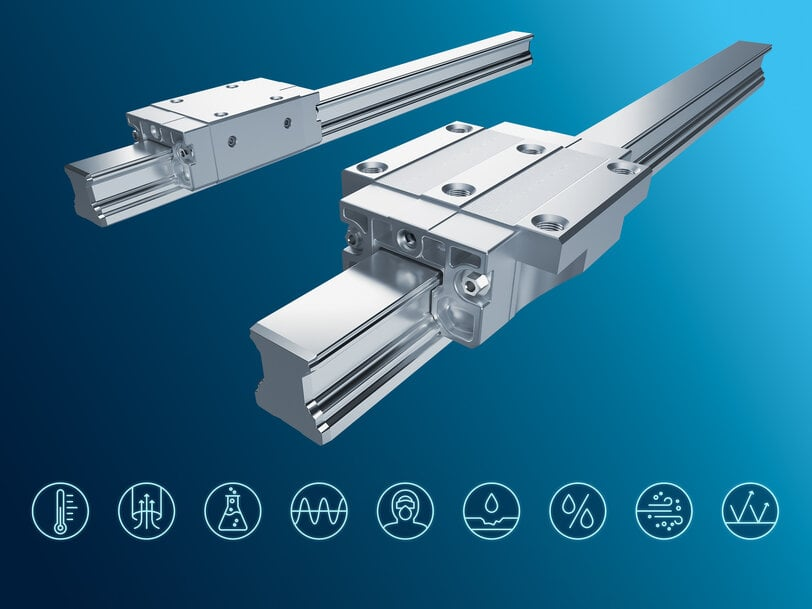
Bosch Rexroth has introduced the NRTVG runner block for BSHP ball rail systems, extending its linear motion portfolio into high-vacuum, extreme-temperature, and chemically aggressive industrial environments.
The size 25 runner block is manufactured entirely from corrosion-resistant steel and is designed for applications where standard plastic components, conventional materials, or ordinary sealing arrangements can become limiting. Semiconductor manufacturing, display production, deep-freeze logistics, glass production, foundries, and plants exposed to aggressive media are among the intended environments.
The NRTVG runner block supports an operating temperature range from -30°C to 200°C. It can also operate in high-vacuum atmospheres down to 10⁻⁷ mbar, a requirement in production environments where outgassing, trapped air, contamination, and material compatibility can affect process quality.
To support vacuum operation, the runner block includes two vent holes on each side, allowing trapped air from installation to escape more quickly and helping to prevent virtual leaks. In high-vacuum systems, small mechanical design details can affect pump-down time, chamber integrity, and contamination control.
The system contains no plastic components and uses metal injection moulding for the ball guide. The all-metal architecture is suited to cleanroom and vacuum processes where plastics can outgas or degrade under temperature and chemical exposure. Optional fluororubber seals are available for aggressive media, with constant temperature resistance up to 150°C and compatibility with industrial oils and chemicals.
Bosch Rexroth also offers a pre-fitted cover plate wiper made from corrosion-resistant steel to protect the internal ball recirculation paths from coarse contamination such as metal chips. The modular BSHP design allows the runner block and guide rail to be replaced independently, reducing maintenance complexity where only one element needs to be changed.
Linear motion components are often treated as standard mechanical choices, but in harsh production environments they can become process-critical. Machines that depend on repeatable positioning, smooth movement, and long-term stability cannot tolerate guide systems that degrade through heat, contamination, vacuum exposure, or chemical attack.
Semiconductor and display manufacturing provide clear examples. Vacuum chambers, wafer handling systems, deposition tools, inspection equipment, and precision stages all depend on materials that will not contaminate the process. As chip production pushes tighter tolerances, mechanical systems inside and around production equipment face stricter performance requirements.
Recent investment in advanced semiconductor metrology scale-up has shown how process control and measurement are becoming central to chip manufacturing economics. Motion systems sit within that same production environment. Precision is required not only in measurement, but in every movement that handles, positions, inspects, or processes substrates.
Extreme-temperature performance extends the use case beyond electronics. Foundries, glass production, heat treatment, and specialist process plants all expose mechanical components to conditions that can quickly degrade standard guides, lubricants, seals, and polymer parts. At the other end of the temperature range, deep-freeze logistics and cold process environments introduce material, lubrication, contraction, and sealing constraints.
Corrosive media create another set of problems. Many industrial environments involve chemicals, washdown, vapours, cutting fluids, or particulate contamination. Machine builders and maintenance teams have to balance performance, cleanability, service life, and cost, particularly when standard motion hardware would require protective workarounds or frequent replacement.
Maintainability is also part of the design calculation. Modular replacement of the rail and runner block can reduce downtime and parts cost when damage or wear is localised. In production environments where shutdown windows are short or machine access is difficult, replacement time becomes part of equipment performance.
The NRTVG runner block reflects a wider shift in industrial motion hardware. As manufacturing moves into cleaner, hotter, colder, more corrosive, and more tightly controlled environments, standard automation components are being redesigned for conditions that once belonged to specialist machines. Venting, materials, seals, wipers, modularity, and process compatibility now carry as much weight as load rating or travel accuracy.