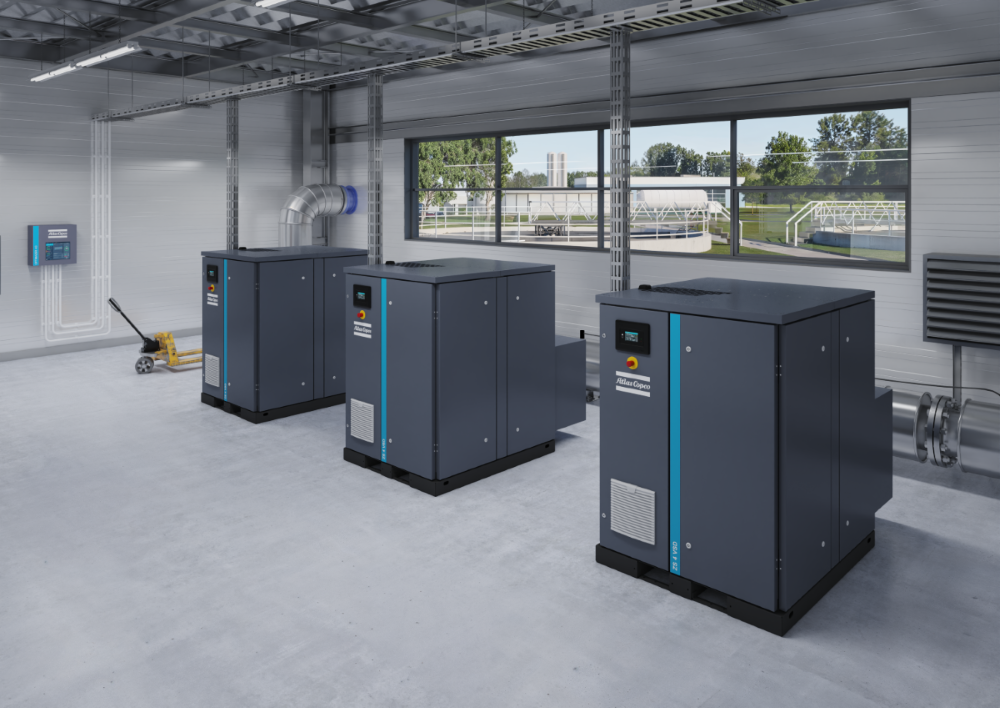
Atlas Copco has launched the ZS 4 (VSD) oil-free screw blower range, extending its low-pressure blower portfolio for wastewater aeration, pneumatic conveying, and wider industrial process applications.
The new range builds on the ZS blower platform and incorporates variable speed drive technology to improve energy efficiency, pressure performance, lifecycle cost, and noise levels. It is available in a 37kW to 90kW power range, with low-pressure elements below 800mbar for applications such as wastewater aeration and high-pressure elements for pneumatic conveying and other industrial duties.
The ZS 4 (VSD) uses a smart pressure split design to support operation across varying pressure demands. Atlas Copco says high-efficiency IE4 and IE5 motor technology helps reduce energy consumption while maintaining stable airflow and consistent output. Class 0 oil-free compression supports applications where process air quality is critical, and the range offers noise levels as low as 75dB(A) through acoustic refinement and internal damping.
Atlas Copco says the new blower can deliver up to 35% greater energy efficiency compared with traditional lobe blowers, alongside a 3% improvement in specific energy requirement. The company is also offering a warranty of up to five years on the screw element, or up to 60,000 hours, subject to the use of Atlas Copco genuine parts and certified service.
Wastewater treatment is a key market for low-pressure blower efficiency. Aeration is one of the largest energy demands in many treatment plants because biological processes depend on controlled oxygen supply. If blowers are oversized, poorly controlled, or unable to follow demand efficiently, electricity consumption rises quickly.
Kirk Lyons, National Sales Manager – Low Pressure at Atlas Copco Compressors UK, said: “With AMP8 driving increased investment across the UK water sector, energy efficiency and whole-life cost reduction remain key priorities for wastewater operators. The ZS 4 (VSD) has been developed to help utilities meet these challenges through lower energy consumption, reduced maintenance requirements and reliable long-term operation.”
The reference to AMP8 places the blower range directly inside the UK water sector’s next investment cycle. Utilities are under pressure to improve environmental performance, reduce leakage, manage ageing assets, and control operating costs. Equipment installed during this period will influence energy use and maintenance demand for years, making blower selection a whole-life cost decision rather than a plantroom purchase.
The same energy efficiency pressure is affecting wider manufacturing. High electricity costs are forcing industrial companies to scrutinise systems that previously received limited board-level attention. Compressed air, low-pressure blowers, pumps, fans, and drives are all becoming targets for practical efficiency work because they often run continuously and can waste energy quietly if poorly matched to process demand.
For pneumatic conveying and industrial air duties, stable flow and pressure control are equally important. Food, chemical, cement, textile, beverage, and pharmaceutical plants all depend on air movement for material handling or process support. Variability can affect throughput, product handling, dust control, or line reliability. Oil-free operation also reduces contamination risk where air comes into contact with process streams or sensitive environments.
Noise reduction also affects plant integration. Blowers are often installed close to process areas or plant rooms where maintenance teams work regularly. Lower acoustic output can improve working conditions, reduce the need for additional enclosures, and simplify installation in space-constrained facilities.
The ZS 4 (VSD) range reflects a broader shift in process equipment design, where industrial users expect energy performance, serviceability, compact layout, digital control, and reliable operation under variable demand. Efficient equipment has to remain serviceable and adaptable, otherwise operating complexity can erode the gains promised at purchase.