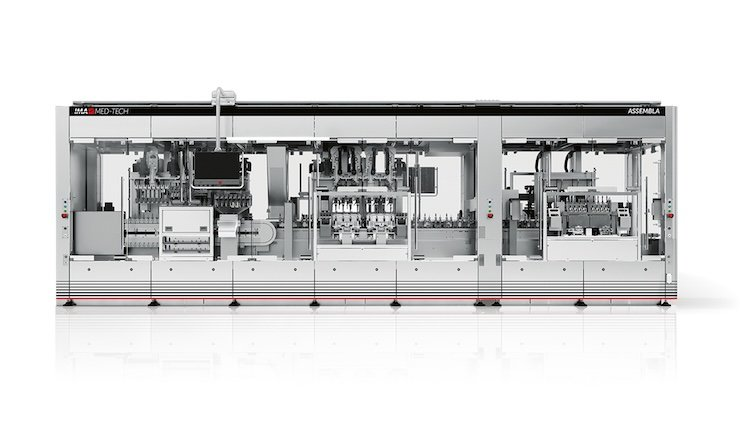
IMA MED-TECH has introduced ASSEMBLA, a modular engineer-to-order platform for medical device assembly, following its debut at Interpack 2026.
The platform has been developed to support projects from clinical and early functional builds through to high-performance industrial production. It can be configured for applications including injectables, inhalers, diagnostics, wearable devices, and ophthalmic inserters, with output ranging from around 20 parts per minute to more than 500 parts per minute depending on the final configuration.
ASSEMBLA uses modular process units that can be combined around product and production requirements. The system also includes advanced monitoring, IoT connectivity, and data capabilities to support quality control, process visibility, and production scale-up.
Medical device assembly has become one of the more demanding areas of manufacturing automation because many products now combine moulded components, electronics, drug-delivery functions, sensors, packaging interfaces, and strict regulatory requirements. Assembly systems must provide speed and repeatability while supporting validation, traceability, and controlled change management.
Products moving from clinical development into industrial production create particular pressure on equipment design. Early builds need flexibility, rapid modification, and small-batch capability. Commercial production needs validated processes, higher throughput, reliable inspection, and stronger documentation. A platform that can support both phases can reduce the risk of redesigning a product around a different manufacturing concept later.
IMA MED-TECH’s engineer-to-order model reflects the direction of regulated manufacturing. Standard machines work well where formats are stable, but many medical technologies require tailored feeding, assembly, testing, inspection, and handling. The engineering challenge is to customise enough to suit the product while avoiding slow, one-off machine projects that are difficult to validate and maintain.
The Interpack launch places ASSEMBLA within a broader shift in packaging, processing, inspection, and digital production. Factory priorities around automation, inspection, digitalisation, and materials are converging, and medical device assembly is one of the clearest examples of that convergence. Production lines now have to manage physical components, regulated data, and quality evidence in the same operating sequence.
Pharmaceutical manufacturers are also seeing device assembly become more strategically important as drug delivery shifts towards prefilled, self-administered, and connected formats. Injectable therapies, combination products, diagnostics, and home-use devices require production systems that can control mechanical assembly while protecting product integrity.
The boundary between pharmaceutical packaging and medical device manufacturing is therefore becoming less distinct. Equipment suppliers must provide modularity, but manufacturers still require validation-ready systems. They want flexibility without open-ended engineering risk, and throughput without weakening inspection, traceability, or data integrity.
European regulated manufacturing capacity is also under renewed scrutiny. Certification, quality systems, and packaging capability are part of that discussion, with Croatia-based pharmaceutical packaging certification work showing how supply chains are strengthening capacity within Europe. Assembly platforms sit within the same industrial question: how quickly regulated production can scale without compromising compliance.
Automation can also reduce pressure from labour and skills constraints. Medical device assembly requires trained operators, quality specialists, maintenance engineers, and validation teams. As products become more complex, manual assembly becomes harder to scale without increasing error risk. Well-designed automation reduces variation while allowing skilled staff to focus on exceptions, process improvement, and compliance.
ASSEMBLA’s performance will be judged on live projects: changeover, validation, uptime, data capture, maintenance, and long-term support. In regulated manufacturing, a platform is not judged only by its speed at launch. It is judged by how reliably it supports a product through design changes, market expansion, and years of controlled production.