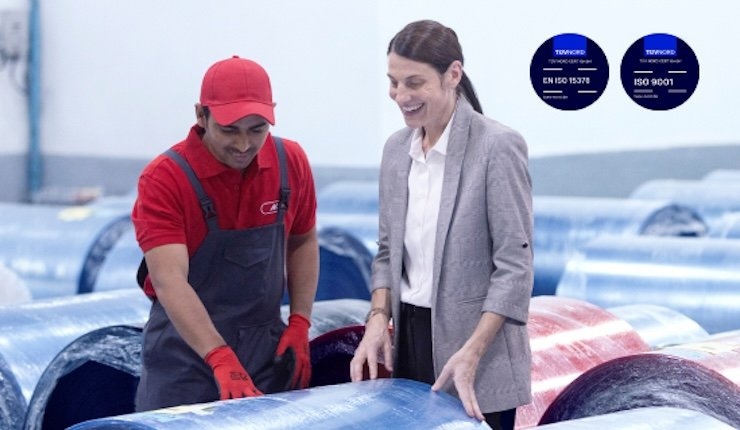
ACG Packaging Materials has secured ISO 9001:2015 and EN ISO 15378:2017 certification for its Croatia warehouse and slitting facility.
The certifications apply to the company’s European site in Koprivnica and confirm that the facility meets internationally recognised quality-management requirements and standards for primary packaging materials for medicinal products. EN ISO 15378 incorporates requirements specific to pharmaceutical primary packaging, including quality management principles linked to Good Manufacturing Practice.
ACG said the approval reinforces its ability to support customers with reliable, compliant, and high-quality supply-chain solutions across Europe. The site provides warehouse and slitting capability for pharmaceutical packaging materials, giving the company a stronger regional position as manufacturers seek shorter supply routes and more responsive support.
Jochen Scheil, ACG Packaging Materials vice president global sales and business development, said: “By securing these certifications, we are reinforcing our commitment to providing safe, reliable and high-quality supply chain solutions to our partners across Europe, at a time when demand continues to grow for trusted packaging partners.”
He added: “Our Croatia facility brings us even closer to our customers, enabling us to provide faster response times, stronger local support and greater continuity of supply, while ensuring we meet the highest quality and regulatory standards expected by the industry.”
The certification also supports ACG’s sustainability work, with the facility connected to its EU-compliant sustainable packaging portfolio. The European footprint gives customers access to localised support as they navigate regulatory complexity and environmental requirements.
Pharmaceutical packaging is often treated as a secondary manufacturing detail, although primary packaging is part of the regulated product environment. Materials that come into direct contact with medicines influence protection, contamination control, stability, traceability, and patient safety. Certification, documentation, supplier control, and material consistency therefore sit close to the centre of pharmaceutical manufacturing assurance.
EN ISO 15378 is specifically relevant because it focuses on primary packaging materials for medicinal products. It links ISO 9001 quality-management principles with requirements that reflect pharmaceutical GMP expectations, including process control, risk management, validation, hygiene, documentation, corrective action, and customer assurance.
The Croatia certification comes as European pharmaceutical manufacturers pay closer attention to supply-chain resilience. The pandemic exposed vulnerabilities in global supply routes, but the structural issues go further: long lead times, limited qualified suppliers, regulatory divergence, energy costs, environmental rules, and growing demand for more transparent sourcing.
Packaging is part of that resilience equation. A medicine cannot be released without a compliant packaging system, and changes to packaging suppliers or materials can require validation, documentation, and regulatory work. Manufacturers therefore value suppliers that can provide consistent regional availability, quality evidence, and responsive technical support.
ACG’s European investment also fits the wider reassessment of regulated manufacturing capacity. Automated cell therapy manufacturing, distributed Smart Factory networks, and regionalised production models are all being shaped by the need to keep validated systems closer to market. The detail differs between pharmaceutical packaging and advanced therapies, but both rely on controlled processes, documentation discipline, and qualified supply chains.
Packaging sustainability adds another layer. Pharmaceutical companies face growing environmental expectations, but they cannot trade away product protection, sterility, stability, or compliance. Sustainable materials must operate inside validated packaging systems, withstand handling and transport, and meet regulatory requirements. Certified suppliers with suitable documentation and technical support become more important as environmental claims encounter product-safety obligations.
The Croatia facility gives ACG a more local European supply platform at a time when customers are looking for assurance as well as materials. The value of certification will be judged in response times, batch consistency, audit readiness, technical support, and continuity when demand or regulation shifts.
Quality systems are not optional infrastructure in pharmaceutical packaging. They are the basis on which manufacturers decide whether a supplier can be trusted inside a regulated product chain.