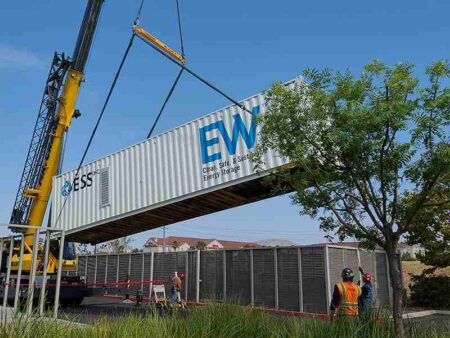

ESS Energy Warehouse. Image credit: ESS Tech, Inc.
ESS Tech has commissioned an energy storage system at Schiphol Airport in Amsterdam, which will be used to phase out diesel ground power units that supply electrical power to aircraft while parked at airport gates.
These power units will be replaced with Electric Ground Power Units (E-GPUs). The electrification of ground operations will reduce carbon emissions and provide a model for airports worldwide seeking to reduce the climate impacts of air transportation.
The project aims to demonstrate how Long Duration Energy Storage (LDES) can enable the electrification of ground support equipment, such as the E-GPUs, while reducing the need to upgrade regional grid infrastructure.
Have you read?
Beach battery powers Dutch coast smart grid project
Battery-led storage deployments need to sextuple globally says IEA
ESS Tech claims that its iron flow technology is ideal for applications that require up to twelve hours of flexible energy capacity. Also, its inherent fire safety makes it suitable for use in close proximity to passenger aircraft.
The project will support the Royal Schiphol Group’s ambitious climate targets and is supported by the TULIPS consortium. TULIPS is an EU-funded consortium of airports across Europe seeking to accelerate the deployment of renewable energy within Europe’s aviation sector.
“Schiphol intends to be a zero-emission airport by 2030 across our buildings, assets and equipment,” said Oscar Maan, Royal Schiphol Group manager of innovation.
“Cutting edge, clean technology such as ESS’ iron flow battery system enables us to decarbonise ground operations and is a vital step for us to progress towards this sustainable future. As leaders of the TULIPS consortium, we hope this project demonstrates how clean technology can be implemented in the aviation industry throughout Europe.”
Eric Dresselhuys, CEO of ESS commented: “This pioneering project will encourage other European airports to follow the TULIPS lead and deploy technologies to achieve climate targets and accelerate air industry decarbonisation.”
Originally published on Power Engineering International.