Unicrimp adds Metal Cable Cleats to the Q-Fire range

Unicrimp adds Metal Cable Cleats to the Q-Fire range

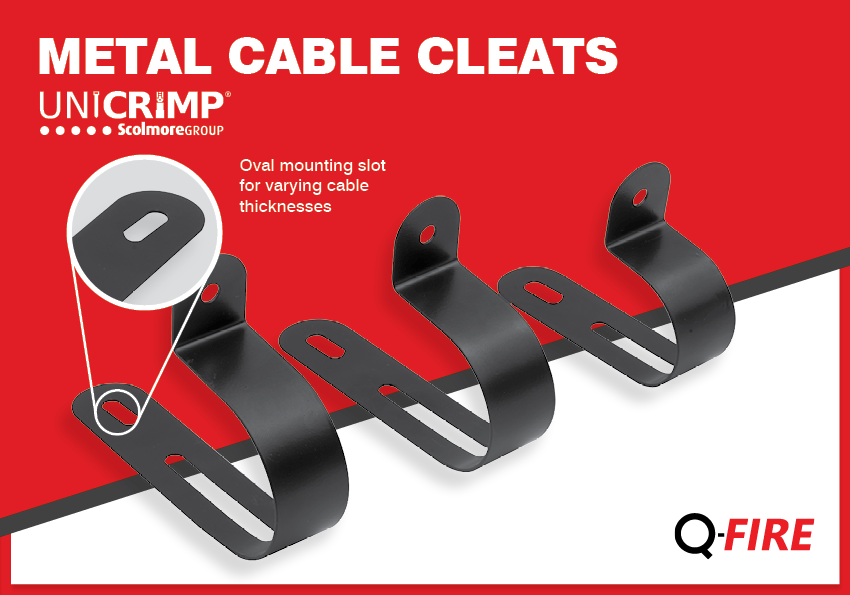
Unicrimp has added a range of Metal Cable Cleats to its growing Q-Fire portfolio of fire-rated cable accessory products. The new Metal Cable Cleats meet BS 7671 (18th Edition) requirements and are designed to prevent cables from premature collapse during a fire, keeping emergency services and the public safe. The 18th Edition wiring regulations stipulate that…


Unicrimp has added a range of Metal Cable Cleats to its growing Q-Fire portfolio of fire-rated cable accessory products.

The new Metal Cable Cleats meet BS 7671 (18th Edition) requirements and are designed to prevent cables from premature collapse during a fire, keeping emergency services and the public safe.

The 18th Edition wiring regulations stipulate that cable support systems must be constructed with materials that will withstand premature collapse caused by direct exposure to heat. There are no applications excluded – trunking, conduit and cabling fixed to surfaces of the building or attached to cable support systems must all have fire-resistant supports in place.

Unicrimp’s fire-rated black Metal Cable Cleats are available in 14 different size options suitable for cable sizes from 5mm up to 50mm. The key feature is an oval fixing hole which allows for cable diameter tolerances. To install the metal cable cleat, the electrician needs to bend the cleat around the cable and fix it in place to the designated wall.

Stories for you


  • Hytera brings broadband communications systems to CCW

    Hytera brings broadband communications systems to CCW

    Hytera will bring new broadband critical communications systems to London. Its CCW 2026 line-up includes HyTalk MC 6.1, PoC dispatch, fast-deployment systems, and robot-assisted reconnaissance.


  • Baker Hughes secures marine hydrogen turbine approval

    Baker Hughes secures marine hydrogen turbine approval

    Baker Hughes has secured marine approval for its hydrogen-capable turbine. RINA certification for the NovaLT™16 gives vessel designers another propulsion option as fuel rules tighten and alternative fuel architectures move into practical ship design.