
Nestlé is making further headway in shaping a waste-free future after reducing its packaging, creating better packaging, and improving waste management.
Since signing up to the Global Commitment on plastic waste five years ago, the company and other leading signatories have significantly outperformed the market at large in reducing virgin plastic and increasing recyclability, according to the latest report from the Ellen Macarthur Foundation.
“We are continually pursuing better packaging solutions where we can have a direct impact,” said Antonia Wanner, Nestlé’s head of ESG strategy and deployment. “With our in-house packaging experts and scientists, we are developing the next generation of packaging materials as well as redesigning packaging for the circular economy. In addition, we promote better infrastructure systems for waste management, advocate for harmonized regulation, and encourage behavioural change.”
Nestlé says it has reduced its amount of virgin plastic packaging by 10.5% since 2018, and it is on track to get to one-third less virgin plastic by the end of 2025. Last year, for example, it launched new Nescafé Dolce Gusto capsules that have less plastic weight and will save more than 2,500 tonnes of polypropylene.
The company cut the weight of its total product packaging by 200,000 tonnes in 2022, and with that, reduced its greenhouse gas emissions by 280 000 tonnes. It also reduced its number of packaging pieces by 14 billion last year. Nestlé notes that its historic total packaging footprint was down from 4.7 million metric tons in 2018 to 3.6 million metric tons in 2022.
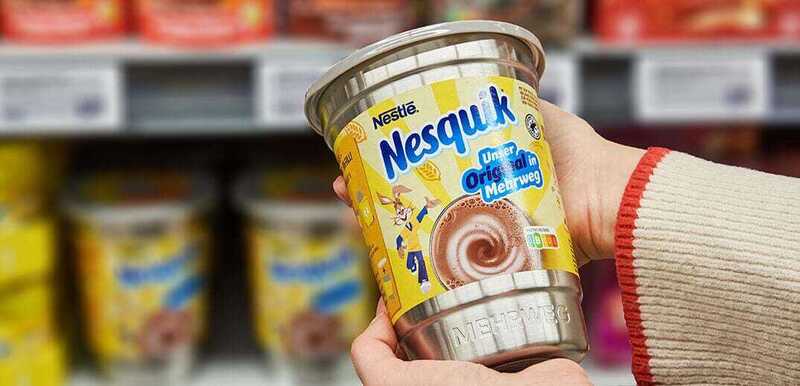
Nestlé is additionally testing packaging alternatives by piloting reuse and refill solutions. Since 2018, it has run over 20 reuse and refill pilots in 12 countries. In Germany, for example, Nestlé, in collaboration with start-up Circolution, has piloted reusable stainless-steel containers for Nesquik. Building on its learnings, the company continues to test different reuse and refill solutions around the world and advocate for the necessary enabling conditions.
At the same time as reducing its packaging, Nestlé is also increasing the use of recycled plastics in its packaging, contributing to the circular economy for plastics. At the end of 2022, 7.7% of the company’s plastic packaging was recycled content, and it aims to get close to 30% by the end of 2025. In the UK, for instance, Nestlé’s waters business has moved its entire Buxton Natural Mineral Water range to 100% recycled PET.
The company is also committed to designing 100% of its packaging for recycling systems. To date, 81.9% of Nestlé’s total plastic packaging is already designed for recycling. Nestlé aims for more than 95% of its plastic packaging to be designed for recycling by the end of 2025.