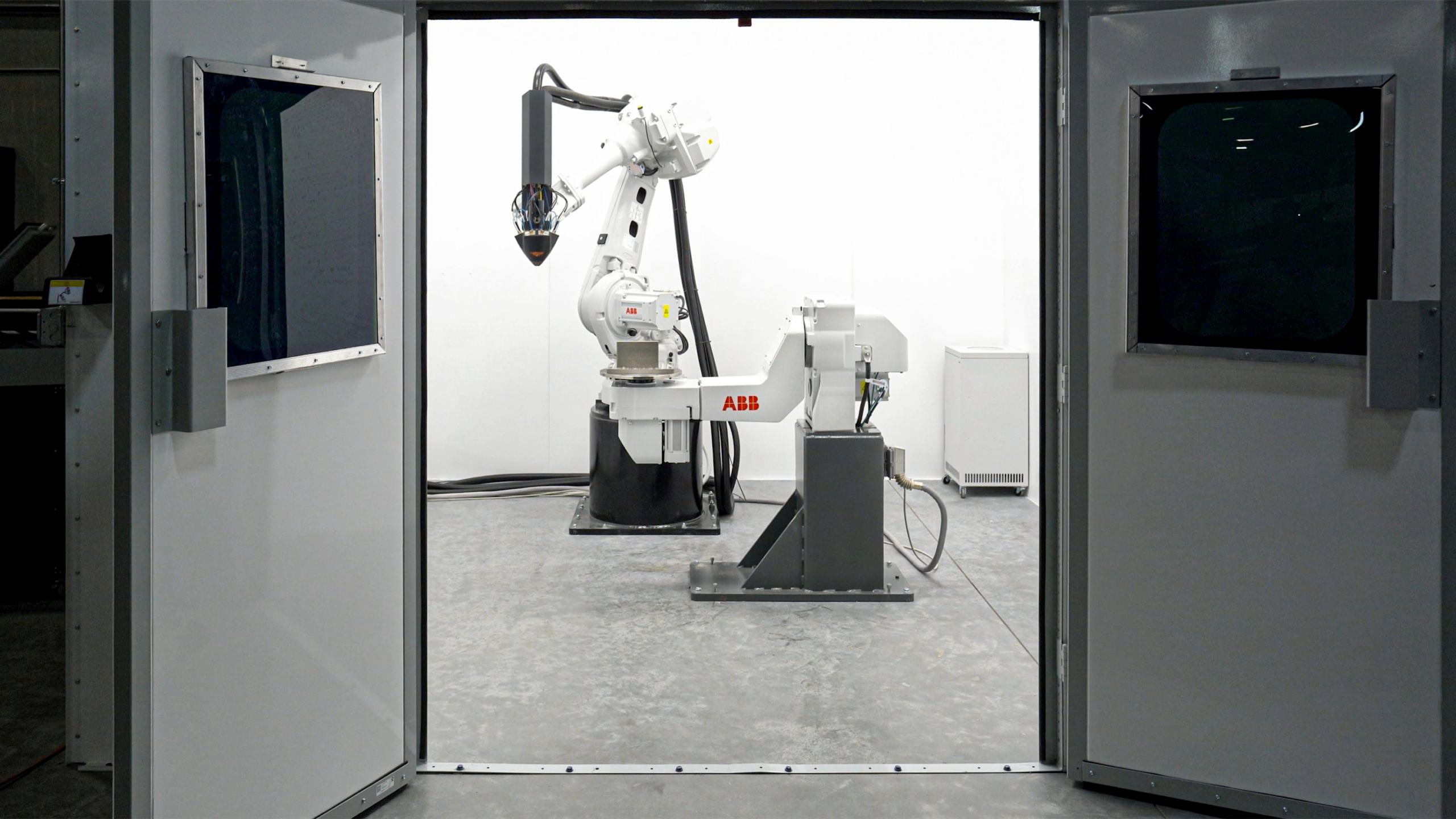
3D Systems has received an additional $9 million from the US Air Force for its GEN-II DMP-1000 large-format metal additive manufacturing demonstrator, taking total programme funding to $27.4 million and extending development work for another two years.
The latest award is the next planned phase of a programme that 3D Systems has been executing since 2023. Work will continue at the company’s San Diego, California, and Rock Hill, South Carolina, facilities, with the programme focused on large-scale, high-temperature, flight-relevant metal 3D printing.
The industrial challenge is larger than increasing the dimensions of a printer. Large metal parts introduce greater thermal loads, longer build times and more opportunities for distortion or defects to accumulate. A process that produces acceptable material properties in a small test coupon still has to demonstrate that the same level of control can be maintained across a much larger component.
3D Systems refers to the project as the Large-Format Metal 3D Printer Advanced Technology Demonstrator. The aim is to mature direct metal printing technology for flight-critical components at scale, particularly for aerospace and defence applications where conventional production can involve specialised forgings, castings and extensive machining.
Large-format additive manufacturing can reduce the amount of material removed from an oversized starting billet and can consolidate geometries that would otherwise be assembled from several components. Those benefits are application dependent. Printing does not eliminate heat treatment, machining, surface finishing or inspection, and a large printed structure can still require substantial downstream work before it meets a flight specification.
Build failure also becomes more expensive as scale increases. A defect detected late in a long print cycle can waste significant machine time and high-value metal powder, while a part may already have accumulated considerable cost before it reaches final inspection. Process monitoring and repeatable parameter control therefore become more important as the build envelope grows.
The Air Force programme is intended to address those issues through a technology demonstrator rather than a production order for finished aircraft parts. That distinction matters because the latest funding does not mean the DMP-1000 has completed qualification for operational hardware. The programme is still developing and demonstrating the manufacturing capability needed before specific flight applications can be approved.
The current $9 million phase follows earlier Air Force funding that began in 2023. 3D Systems says the cumulative award value has now reached $27.4 million, and the new phase is intended to complete the technology demonstration programme. The company has not disclosed a production order or a timetable for a commercial DMP-1000 product.
High-temperature and high-speed flight applications place demanding requirements on materials. Components may face severe thermal and mechanical loads, so engineers need confidence in density, microstructure, dimensional stability and repeatability across the complete build. Additive manufacturing can create complex internal features and shapes that are difficult to machine, but those geometric advantages are useful only if the material produced by the process remains predictable.
Scale also affects the supporting manufacturing system. Powder storage and handling, build preparation, inert-gas management, part removal and inspection all have to accommodate larger components. Post-processing equipment may become a bottleneck if the printer can make a part that the available furnace, machine tool or inspection system cannot handle efficiently.
That is why a large-format additive programme has to be considered as a production chain rather than a single machine. The printer establishes the near-net shape, but qualification depends on everything that happens before, during and after the build. Material batches, software settings, machine condition and post-processing records all contribute to the traceability required for flight hardware.
The programme also has potential consequences beyond one Air Force application. Technologies developed for a large demonstrator can influence smaller commercial systems through improvements in process monitoring, controls, thermal management or materials handling. 3D Systems has described the programme as part of a broader effort to advance metal additive manufacturing, although the company has not identified specific commercial products resulting from the latest phase.
For aerospace manufacturers, the attraction of additive manufacturing remains strongest where it changes the economics or performance of a particular component rather than replacing conventional production indiscriminately. Low-volume, complex parts with expensive material and long conventional lead times can justify a different process route. Simpler high-volume components may still be cheaper to forge, cast or machine.
The US Air Force funding therefore supports an engineering question rather than a foregone conclusion. Can a much larger direct metal printing platform produce high-temperature, flight-relevant structures with the repeatability needed for serious aerospace manufacturing? The additional two years and $9 million give 3D Systems more room to answer it.
If the programme succeeds, the useful result will not be the headline build volume of the machine. It will be evidence that large printed parts can move through production, post-processing and inspection with controlled material properties and acceptable yield. If that control cannot be demonstrated, a bigger printer simply creates a larger and more expensive route to a rejected component.