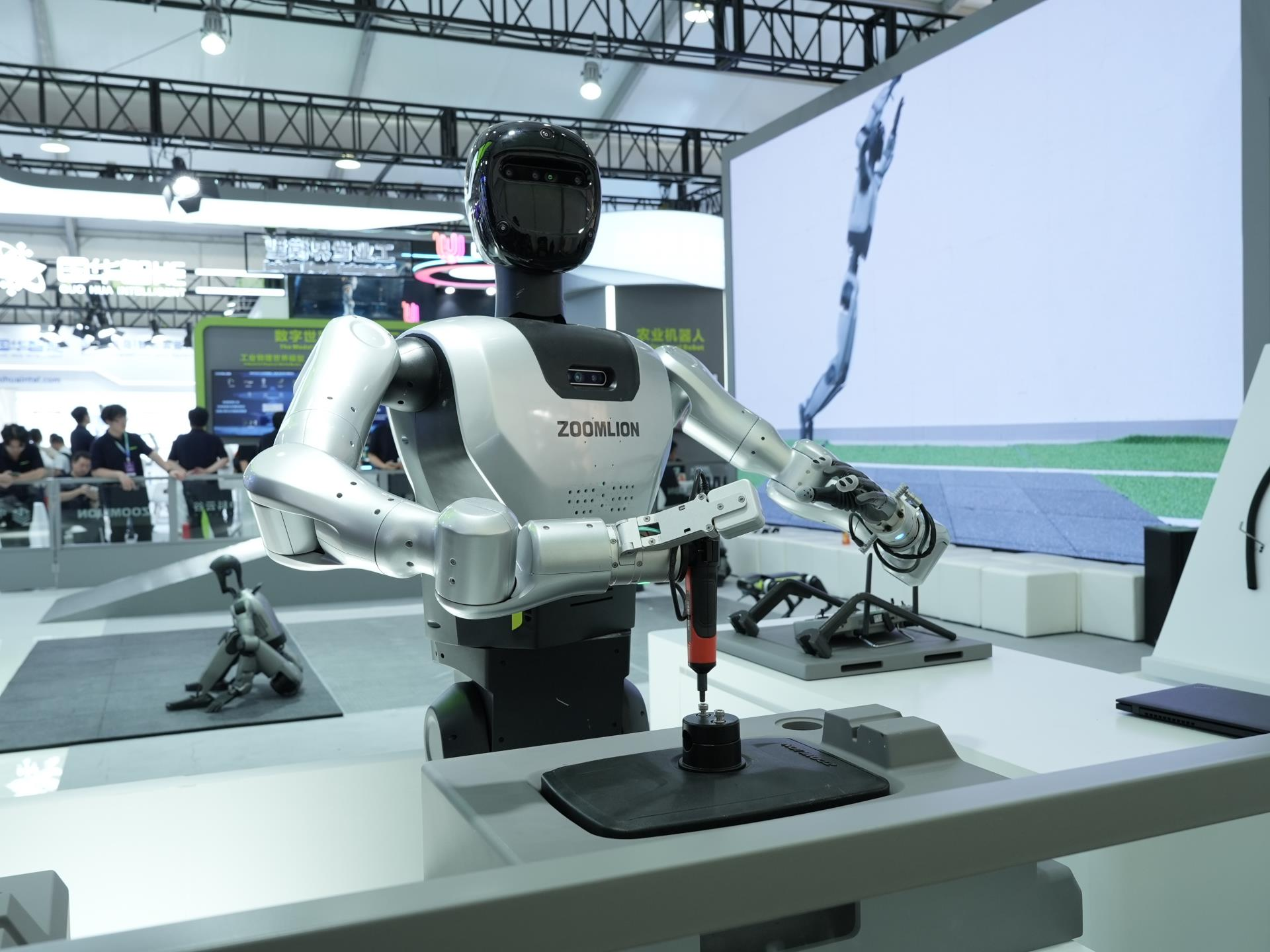
Zoomlion is demonstrating humanoid and embodied-intelligence systems on practical manufacturing tasks at the 2026 World Robot Conference in Beijing, including component pre-assembly, wire-harness handling, irregular-part sorting, and coordinated materials movement.
The equipment includes the bipedal Z01 humanoid, wheeled Z03 humanoid, D15 and D40 quadruped robots, and self-developed joint modules. The company is presenting the hardware alongside Robot Ops, its embodied-intelligence development platform, and ZBrain, a system intended to add sensing and task-planning capability to conventional industrial robots.
The industrial demonstrations are more informative than the synchronised dancing that still accompanies many humanoid exhibitions. Z03 picks materials, sorts irregularly shaped objects, and completes rear-view-mirror pre-assembly, while Z01 handles and organises wire harnesses.
Zoomlion says its robots have been validated across nearly 20 manufacturing scenarios at its Smart City production complex, where the systems have operated in active factory environments. That internal test base gives the developer access to production data and repeatable tasks without relying entirely on laboratory trials.
Factory deployment imposes a different standard from a successful exhibition cycle. Industrial systems must repeat tasks for long periods, recover predictably from faults, interact safely with people and machinery, and produce measurable improvements in labour content, cycle time, quality, or flexibility.
Conventional industrial robots already perform extremely well where workpieces, fixtures, tooling, and process sequences remain tightly controlled. Welding, painting, palletising, and machine tending can all be automated efficiently when the robot knows where the part will be and what movement should follow.
High-mix production creates a different problem. Objects arrive in variable positions, flexible components deform, product variants change frequently, and operators may need a machine to interpret what it sees before selecting the next action. Engineering a separate fixed sequence for every variation can consume enough time and cost to weaken the automation case.
ZBrain is intended to give conventional robots more of that adaptive behaviour. Zoomlion says an operator can issue a task instruction and the system then performs detection, planning, execution, and verification rather than relying entirely on a pre-programmed sequence.
The company is positioning the technology for high-mix, low-volume manufacturing, where changeover effort can become a large proportion of total automation cost. Faster task configuration would be commercially useful if it can be achieved without sacrificing process repeatability, safety, or validation.
Robot Ops operates further upstream in the development process. First shown at Hannover Messe in April, the platform combines data collection, model training, simulation, validation, deployment, and operations, with modules for imitation learning, reinforcement learning, basic tools, and task orchestration.
The software itself is therefore not an August launch. The current development is the wider demonstration of systems trained and tested against identifiable factory tasks, including flexible handling and assembly operations that are difficult to automate with fixed-sequence equipment.
Wire harnesses are a useful example. Unlike a rigid machined component, a harness bends, twists, overlaps, and assumes different shapes each time it is presented. A human operator compensates almost automatically, whereas a robot has to perceive the geometry, choose a grasp point, control a flexible object, and verify its final position.
Rear-view-mirror pre-assembly presents a different set of requirements around component orientation, precision, and sequence. Success depends on more than reaching the correct location once; a production system must repeat the process within cycle-time and quality limits across a changing stream of parts.
Those tasks explain why perception and closed-loop verification are attracting more attention in industrial robotics. A robot that can detect whether an operation has completed correctly can respond to variation rather than blindly continuing a sequence after an error.
The harder problem is transferring that capability beyond the developer’s own plant. Customer factories use different fixtures, sensors, safety systems, line controls, product variants, quality procedures, and production schedules. A model that performs well inside Zoomlion Smart City may still require substantial engineering before it can be commissioned elsewhere.
Metrics such as intervention rate, first-pass yield, cycle time, changeover time, hours between faults, and engineering hours per deployment will determine whether embodied AI earns a place alongside established industrial automation. Those figures are rarely the centrepiece of a conference stand, but they decide whether a system can survive a production manager’s scrutiny.
Zoomlion benefits from being both a robot developer and a large machinery manufacturer, because its own factories provide real tasks and environments for repeated testing. The same position also makes internal validation only the first step: commercially useful robotics must remain reliable when the developer no longer controls the surrounding process.
The Beijing demonstrations show a credible direction from generic humanoid motion towards defined production tasks. The next useful evidence will come from repeatable customer deployments and operating data. Industrial robots have never been short of impressive demonstrations; the demanding part is making the demonstration unremarkable after several thousand shifts.