The University of the West of England (UWE Bristol) has secured £774,300 in capital funding to establish a digital engineering learning environment incorporating collaborative robotics, digital surveying, advanced computing, and large-scale concrete additive manufacturing.
Awarded by the Office for Students (OfS), the funding will provide civil engineering students with practical experience of technologies increasingly used across infrastructure design, construction, and industrial production.
The planned facilities will incorporate specialist engineering software, high-performance computing resources, drones, digital surveying equipment, and extended reality technologies alongside equipment for robotic operations and concrete 3D printing.
UWE Bristol’s investment forms part of an £84.5 million capital funding allocation for universities and colleges across England during the 2026–27 financial year, confirmed by the OfS on 24 November.
The university’s project will connect established civil engineering disciplines with digital methods for developing, manufacturing, and assessing physical infrastructure, reflecting changes in the equipment and software used throughout the industry.
Building information modelling (BIM) provides one foundation for these engineering methods, associating geometric representations of infrastructure with information about its components, materials, and design characteristics.
Within a coordinated digital model, structural elements, mechanical services, electrical installations, and other infrastructure components can be represented together. Engineers can examine how individual systems interact and identify some potential conflicts before fabrication or construction begins.
The value of this process depends partly on the completeness and accuracy of the underlying engineering information. Changes introduced during procurement, manufacturing, or installation must be reflected in the relevant models if those representations are to remain useful throughout the development of an asset.
Digital surveying and reality capture equipment provide a means of establishing the relationship between engineering models and physical conditions.
Drones equipped with cameras or other sensors can acquire measurements and imagery across construction sites and existing infrastructure. Photogrammetric processing uses overlapping images to reconstruct three-dimensional information, while other surveying technologies directly measure the positions of surfaces and individual features.
Comparing that information with a digital design allows engineers to investigate discrepancies between intended and actual construction. Measurement accuracy, sensor resolution, equipment positioning, and environmental conditions influence whether individual deviations can be identified reliably.
These capabilities also support the development of digital twins for infrastructure applications. Depending on their intended function, such systems can incorporate inspection records, sensor measurements, material properties, and analytical models alongside geometric information.
The university’s planned investment in computing equipment will provide resources for more demanding engineering analyses, simulations, and artificial intelligence applications. Computational requirements can increase considerably when engineers investigate complex geometries, examine several operating conditions, or process substantial quantities of measurement data.
Extended reality technologies offer another way to interact with digital engineering information. By representing structures, equipment, or construction sequences within immersive or augmented environments, they can support investigation of spatial relationships that may be difficult to interpret from conventional drawings.
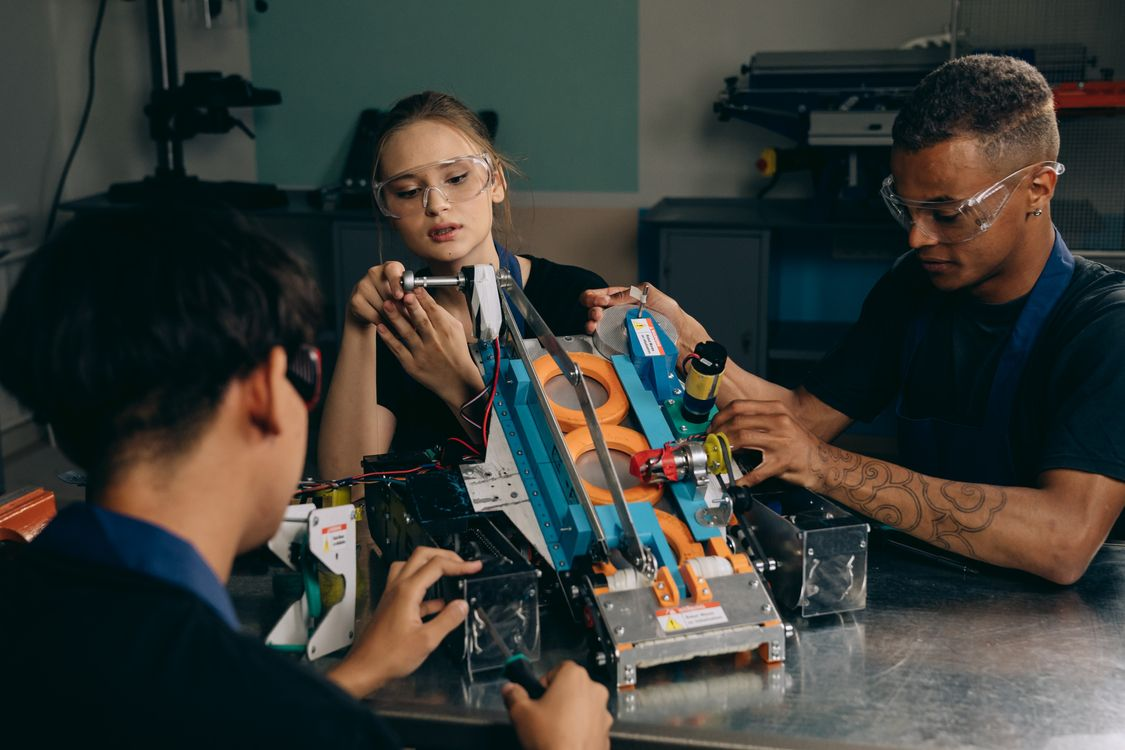
Robotics and additive manufacturing will extend the university’s digital engineering facilities into physical fabrication, introducing students to the relationship between computer-generated designs and material behaviour during manufacturing.
Large-scale concrete printing commonly involves depositing successive layers of a cementitious material through an extrusion system. The movement of the deposition head determines the geometry produced as the material accumulates.
The process must balance the ability of the material to flow through the extrusion equipment with its capacity to support subsequent layers after deposition. Material composition, deposition speed, environmental conditions, and the interval between layers influence the characteristics of the resulting structure.
Engineers designing components for additive manufacturing must consequently account for the production method alongside structural requirements. A geometry that is straightforward to represent digitally may introduce difficulties during fabrication if it exceeds the capabilities of the deposition process or the material being used.
Collaborative robots provide additional opportunities to investigate digitally controlled manufacturing and handling operations. Programming, coordinate systems, tooling selection, and the interaction between machinery and its operating environment are all relevant to applications extending beyond conventional construction activities.
Practical engineering education can bring these elements together through projects requiring students to develop a design, determine an appropriate manufacturing process, operate the necessary equipment, and assess the resulting component against its specified requirements.
The investment complements wider efforts to expand British technical skills provision, including recent engineering education partnerships established by Honeywell.
As digital engineering methods become more closely connected to physical production, employers require personnel capable of evaluating both the information represented within software and the practical constraints associated with implementing it.
UWE Bristol’s funding will support facilities in which students can examine that relationship directly, extending their practical experience from digital design and measurement into robotics, manufacturing, and the assessment of physical engineering results.