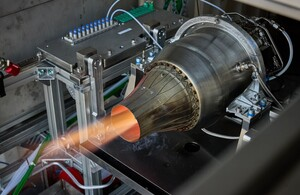
Alloyed has moved a 300N-class turbojet engine into serial production in the UK while a larger 1,100N-class engine has progressed from initial concept to flight-ready status in less than seven months under a Ministry of Defence co-development programme.
The work, led by the MOD’s Strategic Capabilities Office, has produced a family of turbojets spanning 30N to 2,000N of thrust. The engines are designed, built and tested in Britain using digital engineering and manufacturing methods intended to shorten development cycles and allow new variants to be introduced without restarting the design process from scratch.
The 300N-class engine has already completed flight testing and entered serial production. Its larger 1,100N counterpart reached flight-ready status inside seven months, giving the programme two different measures of progress: one engine has crossed into repeat manufacture while another has demonstrated the speed at which a higher-thrust design can move through development.
More than 60 engineering and advanced manufacturing jobs have been created through the programme, with a further 45 expected over the next 12 months as production expands. The MOD also says more than 40 UK suppliers are involved, most of them small and medium-sized companies, creating a domestic supply chain around propulsion design, manufacture, testing and support.
The programme combines MOD investment with matched funding from Alloyed. That model places government and company capital behind the same development effort, while the technical architecture is built around a UK-based digital design and modelling capability that can be reused as propulsion requirements change.
Alloyed chief executive Michael Holmes said: “Working alongside the Ministry of Defence has enabled Alloyed to bring to bear its world-leading metals technologies to mature and demonstrate advanced propulsion systems at remarkable pace while building a lasting capability in the UK.”
The programme’s value will now be tested less by development speed than by production control. Serial engine manufacture introduces requirements around repeatability, inspection, traceability, supplier quality and configuration management that are less visible during a compressed prototype programme but determine whether output can rise without eroding reliability.
The modular architecture is intended to reduce some of that burden when new variants are introduced. Common digital methods and reusable design elements can limit the amount of engineering that has to be repeated for each thrust class, while manufacturing data can be carried forward as the family develops. That does not make scale-up automatic, but it creates a more coherent route between design changes and factory implementation.
Propulsion also has a strategic supply-chain dimension. Small turbojets are increasingly relevant to uncrewed systems and other defence applications where demand can change quickly and where access to imported engines may become a programme constraint. A domestic capability gives the UK more control over design changes, production schedules and through-life support, although individual materials and components may still come from international suppliers.
The 30N to 2,000N span gives the programme room to serve several classes of aircraft without treating each requirement as an unrelated engine project. That breadth could improve the economics of the industrial base if common processes, suppliers and test methods can support several variants, particularly where individual production runs are too small to justify dedicated infrastructure on their own.
The MOD links the work to the Strategic Defence Review and a wider effort to strengthen sovereign industrial capacity. The export potential is also explicit: the programme is intended to support allied customers seeking propulsion systems that can be supplied and adapted outside the larger established engine programmes that dominate conventional military aviation.
Alloyed’s contribution rests on digital manufacturing and metals expertise, which is particularly relevant where turbojet components combine difficult geometries, high temperatures and tight tolerances. Faster digital iteration can reduce the time between a revised requirement and a manufacturable component, but it has to remain tied to validated material behaviour and repeatable production processes as the engines move into service.
The immediate programme has therefore crossed two industrial thresholds at once. The 1,100N engine demonstrates that a flight-ready design can be produced on a compressed timetable, while the 300N engine shows that the work has advanced beyond isolated prototypes into serial manufacture. The next milestones will be production rate, field reliability and evidence that the same development model can be repeated across the wider engine family.