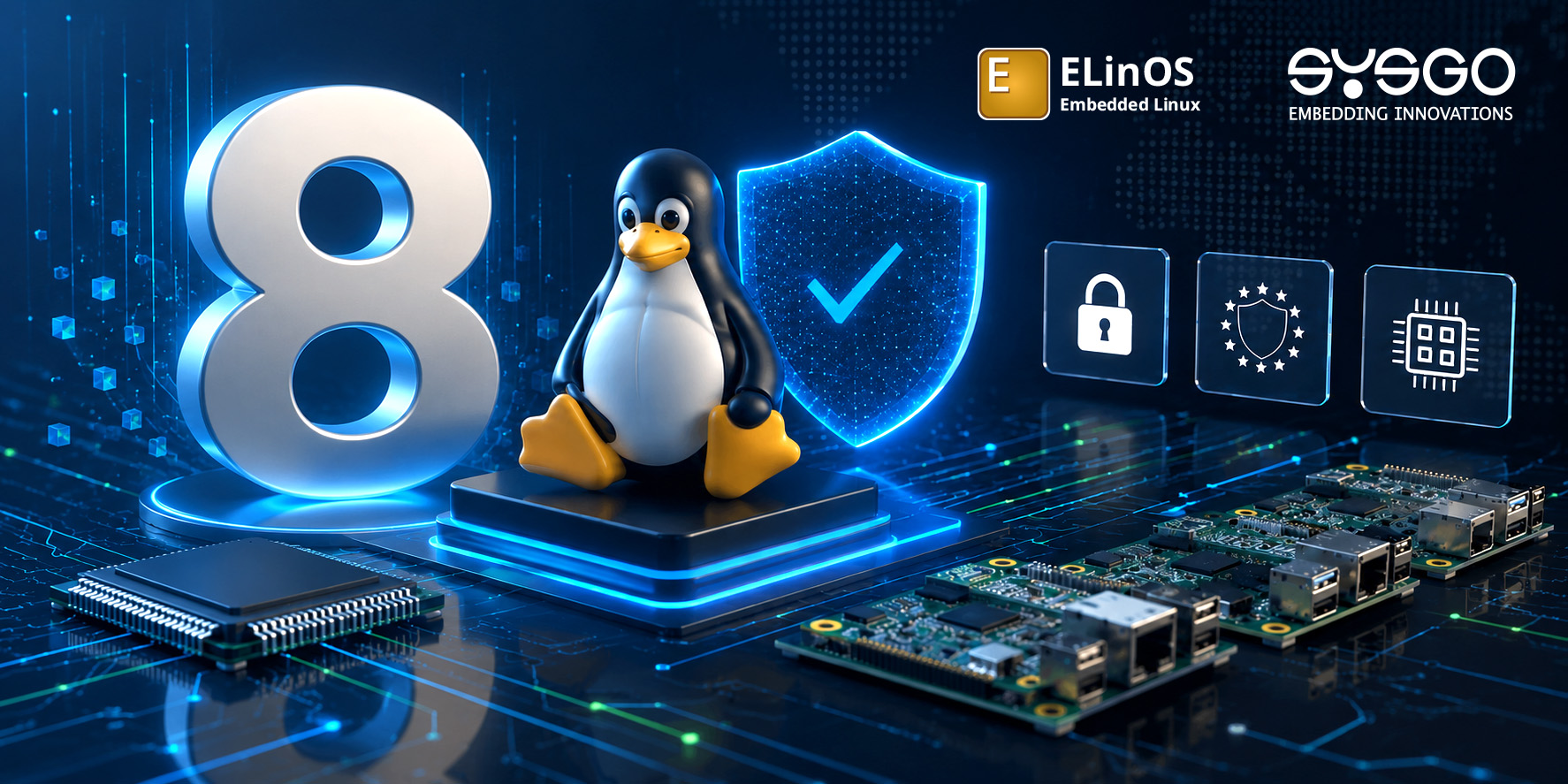
SYSGO has launched ELinOS 8, the latest version of its industrial Linux platform for secure, sovereign, and long-lifecycle embedded systems.
The release adds integrated software bill of materials generation, ANSSI hardening validation, reproducible builds, Linux 6.12 Long-Term Support, and expanded board support packages across embedded hardware platforms. It is aimed at mission-critical and industrial applications where cybersecurity, compliance, and maintenance requirements are becoming more demanding.
ELinOS 8 automatically generates an SBOM during the build process, creating an inventory of software packages, libraries, files, and versions included in the system. The output is delivered in SPDX v3 JSON format and is intended to support vulnerability management, open-source licence compliance, software dependency traceability, and customer or regulatory documentation.
Software transparency is becoming a procurement and compliance requirement for connected industrial products. Embedded systems can no longer be treated as fixed software images that are secure at release and then left unchanged for years. Manufacturers need to know what software is inside a product, how it is maintained, and how vulnerabilities will be assessed across the lifecycle.
ELinOS 8 also introduces a compliance verification test suite aligned with recommendations from ANSSI, the French national cybersecurity agency. The test suite allows developers to evaluate system hardening, validate configurations against established rules, and generate reporting that includes hardening level assessments and security recommendations.
Additional security measures include GCC Fortification Level 3 across target packages, audit support for RISC-V platforms, reproducible kernel and root filesystem builds, and build machine independent timestamps with fixed date and time support. These functions support software integrity and repeatability, both of which are increasingly important in regulated and safety-conscious industrial markets.
The platform is based on Linux 6.12 LTS, giving manufacturers a stable kernel foundation with long-term maintenance and security update potential. Long support windows are critical in industrial automation, transport, aerospace, defence, medical, and critical infrastructure, where products often remain in service long after consumer or enterprise software cycles have moved on.
The hardware support expansion includes new board support packages from vendors including NXP, Toradex, TQ-Systems, and AMD Xilinx. SYSGO has also decoupled vendor BSP maintenance from the core product release cycle, allowing customers to install service releases without disrupting project-specific board adaptations.
Embedded software development is under pressure from two directions. Products need more capability, connectivity, and updateability, while customers and regulators want stronger evidence of security, traceability, and lifecycle control. That combination increases the documentation and maintenance burden for manufacturers that once treated embedded Linux mainly as a flexible engineering base.
Cyber regulation is sharpening that burden. The European Cyber Resilience Act is pushing connected product manufacturers toward stronger vulnerability handling, software transparency, security updates, and supply chain accountability. ELinOS 8’s SBOM and hardening functions provide practical tools for that compliance environment rather than leaving development teams to assemble evidence separately.
The unified development environment across Intel, ARM, and RISC-V also has commercial value. Engineering organisations increasingly support multiple architectures as hardware availability, performance needs, energy use, cost, and supply strategies shift between product lines. A common toolset and configuration approach can reduce duplication, simplify onboarding, and make it easier to move processes between targets.
SYSGO’s feature-driven configuration model and precompiled package base are intended to reduce the burden associated with traditional Linux build systems. The platform includes more than 400 precompiled packages and uses a graphical configuration approach that configures kernel and user space together. The result is a tailored embedded Linux system with only the functionality required for the target product.
Embedded Linux is becoming part of the compliance case, security posture, maintenance strategy, and customer assurance model for industrial products. ELinOS 8 reflects that shift, where engineering speed still matters, but documented control over the software supply chain now sits alongside performance, stability, and hardware support.