Siemens and NVIDIA have demonstrated two industrial AI applications at Siemens’ electronics factory in Erlangen, Germany: virtual preparation of printed circuit board inspection and AI-assisted production planning. Presented on 19 October, the systems use digital models and factory information to evaluate manufacturing tasks before changes are made to equipment or production schedules.
The work follows an expansion of the companies’ partnership announced at CES in January 2026. Since then, their teams have developed and tested the applications in operating manufacturing conditions at Erlangen, combining Siemens’ industrial software and automation knowledge with NVIDIA’s AI, simulation and computing technologies. The announcement identifies demonstrable factory tasks rather than a fully autonomous manufacturing site already operating without human intervention.
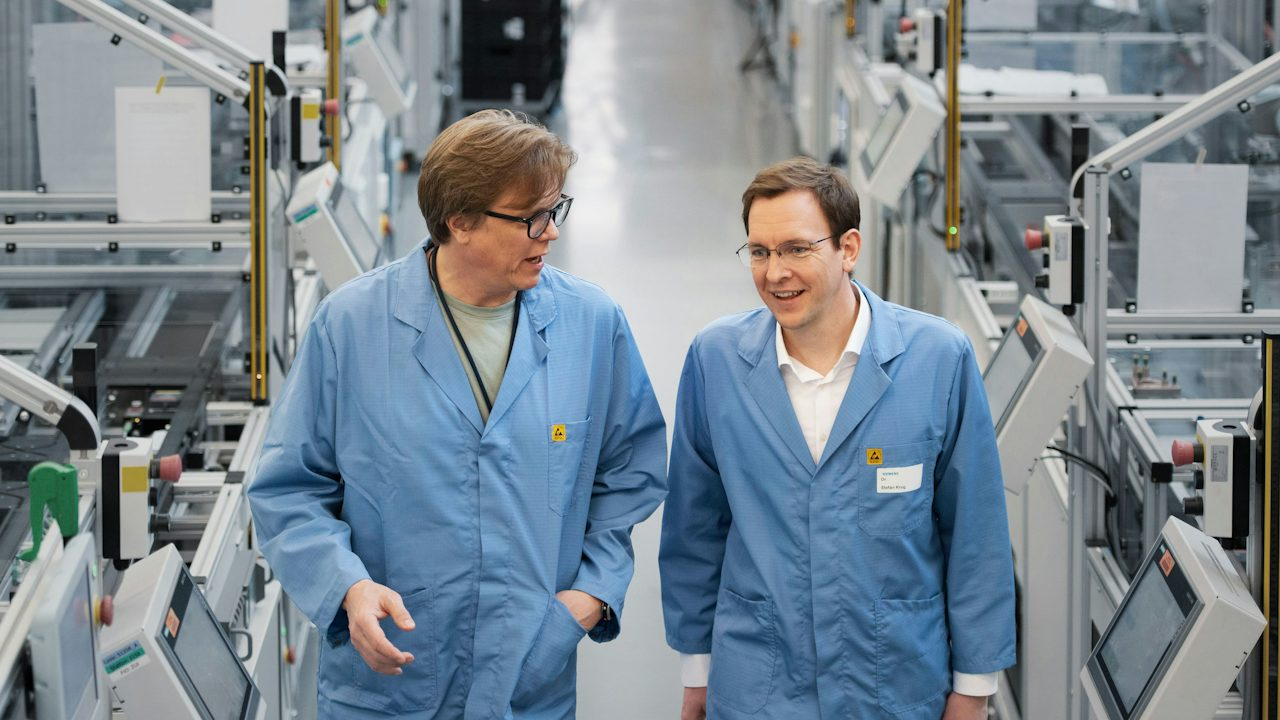
Erlangen produces power electronics and automation products, including printed circuit board assemblies used in drives and frequency converters. The site was established in 1971 and employs approximately 1,000 people. Its production environment provides an established setting in which development teams can test software against the practical requirements of industrial equipment, materials and delivery schedules.
Preparing an optical inspection system for a new circuit board can be time-consuming because engineers need information about component positions, expected appearances and possible faults. Conventional preparation may require physical prototypes before cameras and software can be configured, particularly where the system is expected to distinguish acceptable variations from assembly defects.
The Siemens–NVIDIA workflow starts with a digital representation of the proposed board assembly. NVIDIA Cosmos world models are used to generate realistic images suitable for preparing machine vision systems, allowing engineers to begin the inspection configuration before the first physical examples of a new product are available.
Creating images from a digital product model changes the sequence of engineering work. Instead of waiting for a prototype to collect every training image, developers can investigate inspection requirements while the board design is still being prepared. That can reduce delays between completing a product design and establishing the manufacturing and inspection procedures needed for its introduction.
Siemens says the virtual preparation approach can reduce the associated engineering effort by up to 85% and shorten time to market by up to 40%. The percentages relate to the company’s identified application and potential benefits. They are not measurements of an 85% reduction in total factory labour or a 40% increase in overall output.
Synthetic images also require validation. The appearance of a real board can vary with lighting, solder surfaces, component placement and manufacturing conditions. An inspection model that performs well on generated examples must still be assessed using physical products to establish whether it reliably identifies defects and avoids unacceptable false results.
Inspection requirements also differ between product designs. Some faults are associated with missing components or visible placement errors, while other characteristics may require different measurement methods or additional testing. The virtual workflow is therefore an aid to inspection preparation, not evidence that all quality assurance procedures can be replaced by a single vision model.
The second application concerns production scheduling. When new orders arrive, planners must balance delivery dates against available materials, equipment capacity, production sequences and the constraints of individual lines. A change in one part of a factory may alter the availability of machinery or components needed elsewhere, making the consequences difficult to assess manually.
An AI agent developed for Erlangen generates alternative schedules and presents their expected effects against defined performance indicators. Planners can compare scenarios rather than relying entirely on a manually assembled production plan. The proposed arrangements are then tested using a digital twin of the full production facility before a decision is implemented.
A factory digital twin represents relevant equipment, material flows and operating constraints in a simulation. It allows a proposed sequence to be examined for bottlenecks and conflicts without first changing the physical plant. The value of its predictions depends on the completeness and accuracy of the underlying factory data, including processing times, equipment availability and material inventories.
Siemens identifies potential planning cost savings of up to 20% through the agent-based approach. That is a company-reported potential benefit of the production planning application, not a verified reduction in Erlangen’s total operating expenditure. Actual savings would depend on sustained deployment and the decisions made using the system.
NVIDIA’s Factory Operations Blueprint provides technology supporting the planning agents, while Omniverse libraries enable proposed schedules to be tested virtually with factory information. Cosmos has a different function in the inspection workflow, generating training images from digital representations. The three technologies support related industrial AI applications but should not be described as interchangeable systems.
Planning tools must also work within the factory’s existing control and safety arrangements. A schedule that appears efficient in a simulation still has to respect maintenance requirements, operator availability and equipment limitations. Engineers and planners remain responsible for validating changes against the conditions of the operating site.
Erlangen already uses more than 100 AI algorithms across production, logistics, quality inspection and maintenance, according to Siemens. The company also reports an established annual productivity improvement of approximately 7% at the plant. Those figures describe its wider digital manufacturing operation and must not be attributed solely to the applications unveiled in October.
The factory forms part of a €500 million Siemens investment programme extending to 2030, while around 3,000 customers visit the site each year. These figures provide context for the company’s industrial development activities rather than evidence that the two new applications have generated the investment or visitor numbers.
Extending the methods to other factories will require usable product models, reliable operating data and software interfaces capable of representing production conditions. The Erlangen demonstrations show how inspection preparation and planning decisions can be tested digitally; subsequent deployment will determine whether the reported potential improvements can be reproduced across different equipment, products and manufacturing processes.