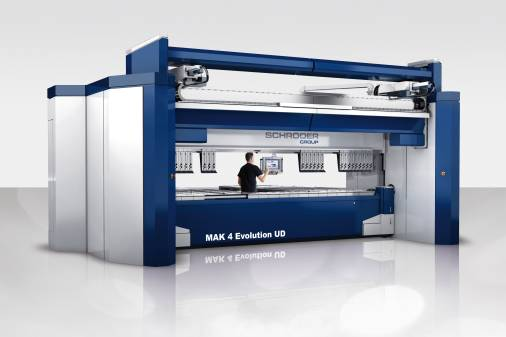
Schröder Group has introduced a gantry-based handling system for its MAK 4 Evolution UD folding machine, extending automation beyond the bending cycle into sheet loading, measurement, unloading, and palletising without requiring a separate industrial robot. The arrangement is intended to support unattended production while allowing the machine to return to manual operation when short runs or individual parts make automation unnecessary.
The system takes sheet blanks directly from pallets before transferring them into the folding process. Each blank is measured optically so that the machine can establish its position automatically, while completed components can be removed and assigned to different palletising patterns through the folding-machine control. Programming remains within the existing machine environment rather than adding a second robot controller and its associated programming workflow.
Schröder has combined the gantry with its Advanced Handling System, which uses a rotating suction-plate gauge to position workpieces during folding. The MAK 4 Evolution UD can fold upwards and downwards, allowing complex sequences to be completed without repeatedly turning a large sheet or partly formed component by hand.
Adding automated loading and unloading addresses a persistent weakness in machine-tool automation. A folding machine may be capable of executing a complete programmed cycle without an operator, but overall utilisation remains limited if somebody still has to place every blank into the machine and remove the finished component before the next cycle can start.
The gantry architecture approaches that problem differently from a conventional six-axis robot cell. Industrial robots offer broad flexibility, particularly where one manipulator serves several machines or has to perform complex movements, but that flexibility brings additional reach studies, guarding, programming, tooling, and integration requirements. A dedicated gantry can use a more constrained motion envelope when the job is simply to move sheet material through a defined sequence.
That does not make one approach inherently better. The commercial choice depends on component variety, batch size, sheet dimensions, handling time, floor space, and whether the automation equipment has to perform tasks beyond loading and unloading. A general-purpose robot can be reassigned more easily; a machine-specific gantry can be simpler to integrate when the production route is unlikely to change.
Optical measurement is important because blanks arriving from laser cutting, punching, or another upstream process are not necessarily stacked with the precision required for immediate forming. Conventional automation still needs a reliable method of finding the workpiece before the bending program can assume its position. Measuring each blank reduces that dependency on exact pallet placement and removes another manual referencing operation.
The same principle applies after folding. An automated machine offers limited benefit if parts simply accumulate beside it until an operator intervenes. Software-controlled palletising keeps material moving out of the cell, although the achievable stack patterns will still depend on component shape, formed geometry, stability, weight, and the risk of damaging finished surfaces.
Those constraints become more significant as automation runs for longer periods without supervision. A component that nests badly, catches during handling, or becomes unstable on the finished pallet can stop an unattended cell even when the folding machine itself is operating correctly. Reliable material handling therefore has to deal with the variability introduced by the parts as well as the repeatability of the machine.
Schröder says manual use remains available, giving manufacturers the option to automate repeat work while retaining direct operator access for prototypes and small batches. That hybrid approach is particularly relevant to subcontract sheet-metal companies, where order books may combine recurring production with one-off jobs that would not justify a fully automated setup.
The company is also using the system to demonstrate a broader shift in sheet-metal productivity. Cutting, bending, and forming machines have become progressively faster, but increasing the speed of a productive stroke has diminishing value when significant time is still consumed by loading, positioning, turning, removing, and stacking material.
Automation is consequently moving towards the intervals between machine operations. Offline programming reduces the time a machine is occupied while a job is prepared; automatic gauging reduces manual positioning; bidirectional folding removes some workpiece handling; and automated loading and palletising attempt to remove labour from the beginning and end of the cycle.
The MAK 4 Evolution UD is not being turned into a general-purpose robotic cell. Instead, Schröder is integrating a tightly defined handling sequence around the folding process and placing control of that sequence inside the machine environment. That can reduce integration complexity for users whose production requirements fit the architecture.
The economic case will still depend on utilisation. A gantry standing idle between occasional batches is difficult to justify, while a machine processing repeat work across extended shifts can recover automation cost through reduced handling labour and increased operating hours. Sheet size matters too: the heavier and more awkward the blank becomes, the greater the ergonomic and consistency advantages of removing manual manipulation.
For manufacturers attempting to increase output without staffing every folding machine continuously, the development offers another option between manual handling and a fully robotised cell. Its significance is less about eliminating robots than recognising that not every automation problem requires one. Where material follows a predictable path from pallet to folder and back to pallet, a purpose-built gantry may provide enough movement without bringing an extra axis of complexity into the factory.