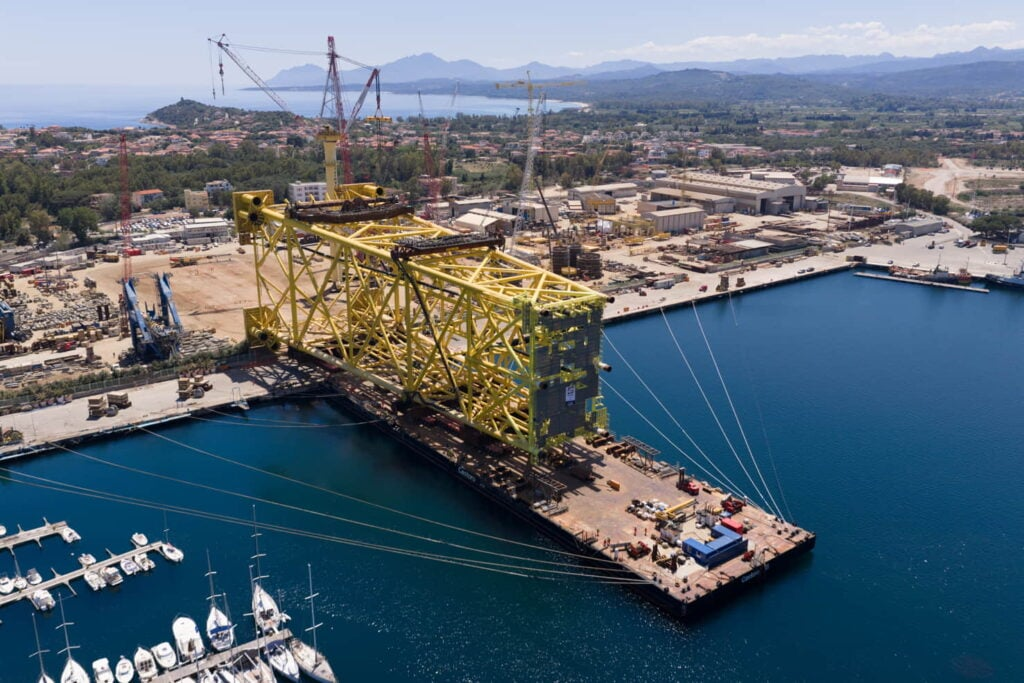
Saipem has completed the sail-away of the jacket for the Neptun Deep gas development in the Romanian Black Sea, marking a major construction milestone for one of the European Union’s largest offshore natural gas projects under development.
The jacket departed Saipem’s Arbatax yard in Sardinia following load-out operations. The structure weighs around 7,500 tonnes and will form part of the offshore platform infrastructure required to bring gas from the deepwater field into production.
Neptun Deep includes offshore facilities, subsea systems, production wells, and a pipeline to the Romanian coast. Once complete, the project is expected to strengthen Romania’s domestic gas position and add a substantial new source of supply within the EU.
Large jackets demand heavy steel fabrication, precision welding, coating, load-out planning, sea fastening, transport engineering, and careful installation sequencing. A fault or delay at this stage can affect the whole offshore schedule, so the departure from the yard represents a meaningful execution point rather than a ceremonial milestone.
The project also highlights the continuing role of European fabrication yards in offshore energy infrastructure. The energy transition has changed the mix of work, but it has not reduced the need for marine engineering, heavy lift planning, subsea expertise, and large steel construction. Offshore wind, gas, carbon capture, subsea power, and interconnectors are all competing for similar engineering and vessel resources.
Neptun Deep sits within a complex energy context. European governments are reducing dependence on Russian gas while also cutting emissions and accelerating renewable power. Domestic or regional gas projects face scrutiny, but they retain strategic weight where they can reduce exposure to higher-risk imports and support security of supply.
That balance is also visible in the North Sea, where ageing offshore assets require modern control and safety systems to remain productive. The automation and control-system upgrade planned for the Buzzard platform shows the same operational pressure from another direction: offshore infrastructure has to be safer, more efficient, and more resilient while remaining commercially useful.
The Romanian Black Sea development also reinforces the importance of subsea engineering. Offshore gas projects increasingly depend on complex seabed infrastructure, long-distance pipelines, digital monitoring, and high-integrity controls. The jacket is the most visible structure, but its value depends on the wider production system being installed, commissioned, and operated reliably.
The next stages will test vessel availability, weather windows, offshore lifting plans, and coordination between fabrication, installation, subsea, and commissioning teams. Once a project moves offshore, delays become more expensive and recovery options narrow. Execution discipline therefore becomes the main route to protecting schedule and cost.
The supply chain reaches well beyond Saipem. Steelwork, coatings, valves, instrumentation, subsea components, controls, pipeline materials, and specialist marine services all feed into a development of this scale. European offshore projects remain important sources of demand for engineering companies even as the energy mix changes.
Energy security is often discussed as a policy issue, but delivery depends on fabricated steel, subsea systems, pipelines, control rooms, vessels, and skilled crews. Neptun Deep’s jacket leaving Sardinia brings the Romanian project closer to that delivery phase, where design confidence and fabrication quality must survive the harsher test of offshore installation.