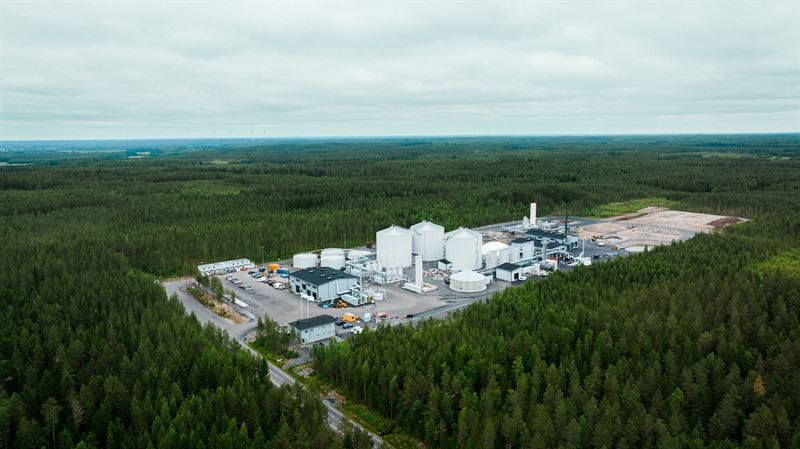
Suomen Lantakaasu has inaugurated its Nurmo biogas plant in Finland after the facility began receiving agricultural feedstock and producing raw biogas. More than 30,000 tonnes of manure have already entered the plant, with liquefaction scheduled to begin later this autumn as commissioning progresses towards approximately 100GWh of annual liquefied-biogas capacity.
The facility was developed by Nurmon Bioenergia Oy, which is majority-owned by Suomen Lantakaasu, with Atria Finland as a minority shareholder. Suomen Lantakaasu itself is a joint venture between St1 Biokraft and dairy group Valio, connecting energy production with agricultural and food-manufacturing feedstocks from the surrounding region.
At full designed output, the plant’s 100GWh annual capacity is equivalent to around 10 million litres of diesel. The comparison is useful for scale, although the facility is not yet at that point: raw biogas production has started, while the upgrading and liquefaction stages still have to move through commissioning before the complete fuel process is operating as intended.
That distinction separates plant inauguration from stable commercial production. Anaerobic digestion is only the first major process stage. Gas emerging from digestion contains methane alongside carbon dioxide, moisture, and other compounds, and it has to be cleaned and upgraded before further cooling can produce a liquefied fuel suitable for storage and distribution.
Liquefaction adds equipment, controls, energy demand, and quality requirements to the process, but it also substantially increases energy density compared with compressed gas. That makes the resulting fuel more practical for applications such as heavy road transport, maritime use, and industrial customers where onboard or site storage volume matters.
Nurmo’s location is equally important to the economics. Manure and food-industry by-products are bulky materials with comparatively low value before processing, making long-distance collection expensive. Placing digestion capacity close to farms and a major food-manufacturing operation reduces some of that transport burden while providing local outlets for residues that already exist in the regional economy.
The plant also produces material intended for use as recycled fertiliser, returning nutrients from the digestion process to agriculture. That creates a second output stream alongside the gas and changes the economics of manure management for participating farms. The usefulness of the fertiliser still depends on nutrient composition, storage, transport, application timing, and agricultural regulation, but digestion can make nutrients easier to manage than untreated material.
Atria’s participation connects the project directly with industrial food production. Agricultural emissions and food-manufacturing by-products sit largely outside the energy use measured inside a factory, yet they still contribute to the environmental footprint of the finished food supply chain. A process capable of converting those materials into fuel and recycled nutrients gives the producer another route for addressing emissions beyond its own production equipment.
For Valio, dairy-farm manure provides part of the feedstock base, while St1 Biokraft brings a route into an expanding Nordic gas market. Suomen Lantakaasu’s wider ambition is to establish a nationwide production ecosystem capable of supplying one terawatt-hour of domestic renewable energy annually, making Nurmo an industrial-scale starting point rather than an isolated demonstration.
Reaching that level would require more than replication of digestion tanks. Feedstock agreements, collection logistics, upgrading equipment, liquefaction, storage, distribution, refuelling infrastructure, and long-term offtake contracts all have to develop together. Gas production without a dependable market leaves an expensive plant underutilised, while vehicle or industrial customers are reluctant to commit without reliable fuel availability.
The Nurmo project has received €9.4 million in energy investment aid from Finland’s Ministry of Economic Affairs and Employment, with a further €101,800 allocated by the Ministry of the Environment towards a biofertiliser loading tank. Public support therefore covers part of infrastructure intended to create both renewable-fuel and nutrient-recycling capacity.
Commissioning will now test whether the various stages operate together as designed. Biological feedstock composition can change, digesters require controlled conditions, gas upgrading has to deliver the required methane quality, and liquefaction equipment must operate reliably enough to support storage and customer deliveries.
Those variations make steady operation more important than nominal capacity. A plant designed for 100GWh a year creates commercial value only when sufficient feedstock arrives, process biology remains stable, downstream equipment stays available, and finished gas can be moved to customers at the rate being produced.
The first of those requirements is already visible at Nurmo: more than 30,000 tonnes of manure have been received and raw gas production is under way. The next significant threshold arrives when liquefaction starts later this autumn.
After that, the more demanding measure will be less ceremonial. Finland’s first industrial-scale liquefied-biogas plant has to turn a network of farms, food-industry residues, biological processing, gas upgrading, refrigeration, fertiliser handling, and fuel distribution into a repeatable production system. The 100GWh figure describes the intended scale; sustained operating data will show how much of it the plant can actually deliver.