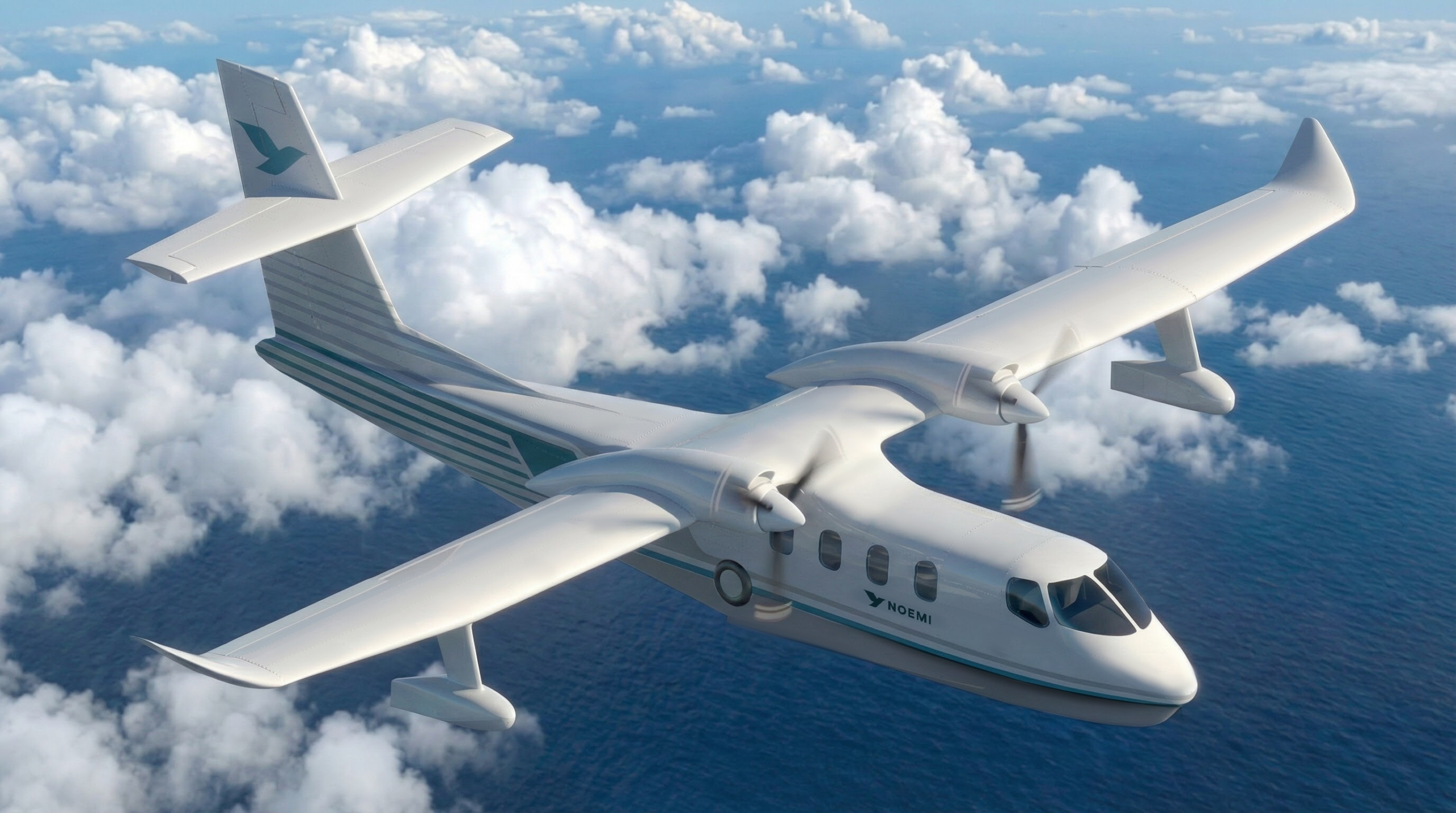
NOEMI Aerospace has expanded its aircraft strategy beyond regional passenger operations, setting out a platform approach for future amphibious, land-based, special mission, and dual-use variants.
The Norwegian company remains focused on developing a fully electric amphibious aircraft for regional passenger transport, while evaluating how the same core architecture could support additional mission profiles. The strategy draws on proprietary intellectual property across aerodynamics, hydrodynamics, composite structures, and propulsion integration.
Common architecture is central to the plan. By reusing development foundations across future derivatives, NOEMI expects to reduce duplication in engineering effort while allowing aircraft variants to be adapted for different operating environments, payloads, and range requirements.
Potential applications under review include land-based passenger and commuter services, cargo transport, government and special mission work, search and rescue, skydiving operations, aerial firefighting, and military dual use. The company has also opened the door to propulsion variants beyond its core fully electric aircraft.
Eric Lithun, Founder and CEO of NOEMI Aerospace, said: “NOEMI was always designed as more than a single aircraft. We are building a platform that can evolve over time and address multiple markets while leveraging shared technology, engineering and certification pathways.”
Hybrid-electric or conventional fuel-based configurations may be considered where mission requirements demand greater range, payload, or flexibility. The fully electric amphibious aircraft remains the core business case, but the broader roadmap gives the company a route to address missions that fall outside the operating envelope of battery-electric propulsion.
NOEMI said programme progress includes preliminary design review completion, prototype development activity, propulsion testing, and work under its Pre-Application Contract agreement with EASA. The company is working toward first flight in 2027 and commercial operations by 2030.