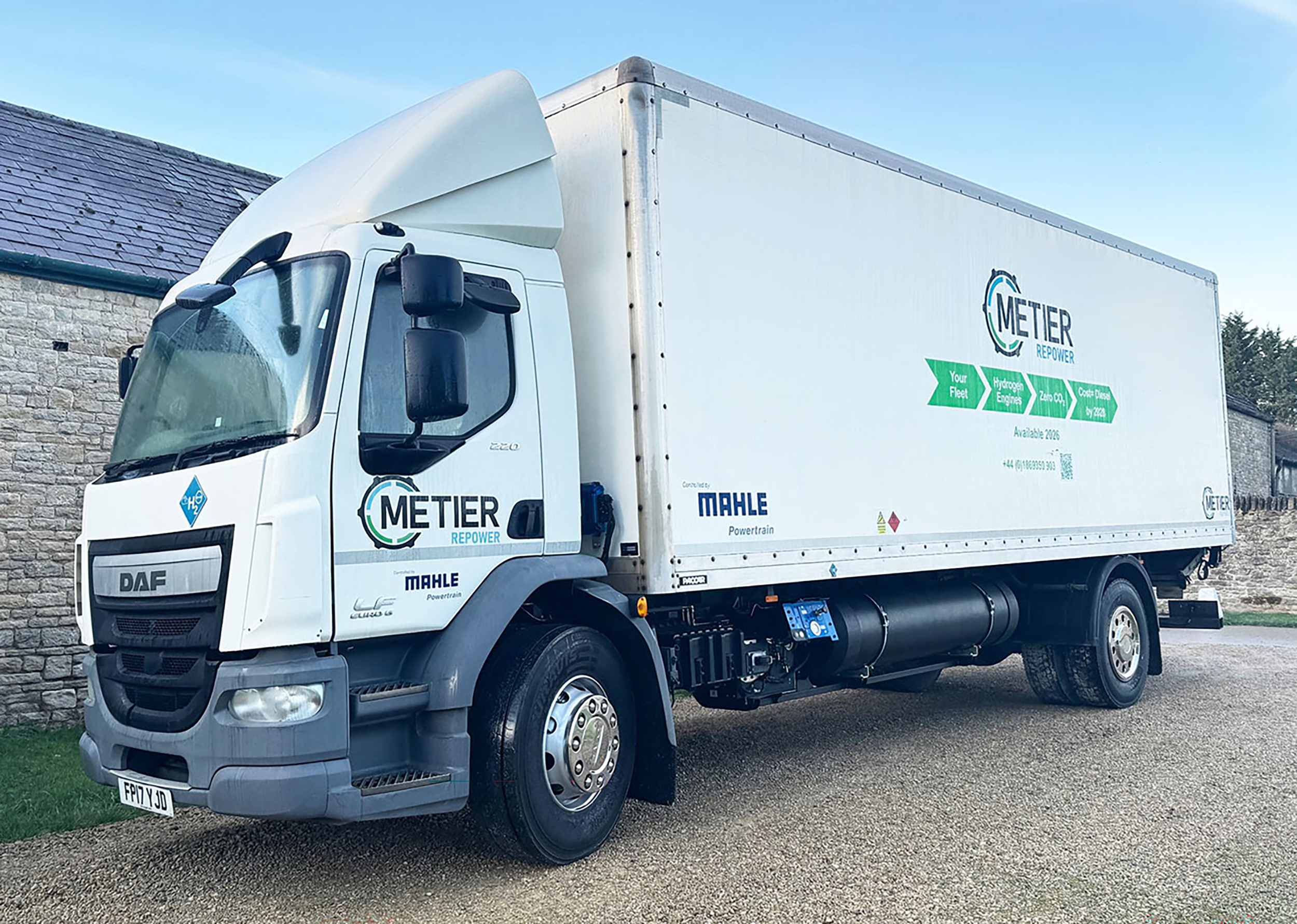
Metier Technologies has secured an MOT certificate for its hydrogen internal combustion engine demonstrator truck, moving the vehicle from prototype status to public road operation.
The demonstrator is based on a DAF LF 18-tonne platform and has been repowered with Metier’s H2ICE technology. The vehicle has also received road certification including a V5 classification confirming zero CO2 emissions, allowing live demonstrations for fleet operators, regulators, and policymakers.
James Budgett, Managing Director of Metier Technologies, said: “This is a defining moment not just for Metier, but for the hydrogen sector as a whole. For years, hydrogen has been discussed as a future solution. By putting an operational, road-legal vehicle on UK roads, we are demonstrating that the technology is here, it works, and it can be deployed at scale.”
The truck currently operates at approximately 130 kW, giving it a performance profile suited to urban and inner-city use. Metier is targeting 170 kW by August 2026, which it says would bring the vehicle to parity with its diesel equivalent for motorway and heavier load applications.
Hydrogen internal combustion uses familiar engine architecture and can be applied through repowering rather than full vehicle replacement. Metier says conversions can be completed in as little as two to three weeks, preserving existing vehicle assets while changing the fuel and emissions profile of the powertrain.
“This is no longer theoretical,” Budgett said. “Having the vehicle on the road is a major step towards demonstrating that hydrogen internal combustion can deliver zero-emission performance in real operating conditions, with minimal reliance on subsidies.”
The company is initially focusing on depot-based rigid truck fleets that return to base, where hydrogen supply can be organised locally without waiting for a national refuelling network. The model gives hydrogen producers and refuelling operators more predictable demand while allowing vehicle operators to address duty cycles where payload, range, and utilisation can make battery-only deployment harder.
Metier is targeting commercial deployment from 2027, capacity to convert at least 1,000 vehicles by 2028, and 10,000 vehicles delivered across Europe by 2031. The company is also exploring hydrogen engine use in zero-emission generator applications, extending the powertrain into off-road and temporary power markets.
Calum Miller, Liberal Democrat MP for Bicester and Woodstock, recently visited Metier’s facility and saw the demonstrator vehicle first-hand. “In an era of unreliable oil and gas supplies and volatile prices, Britain has to broaden its energy mix,” he said. “Seeing a hydrogen-powered heavy-duty truck in operation today shows the technology is ready.”
The MOT certificate gives Metier a road-legal platform for demonstrations, but commercial scale will depend on hydrogen availability, conversion economics, maintenance performance, and fleet scheduling. Those tests now move from the workshop to operating conditions.