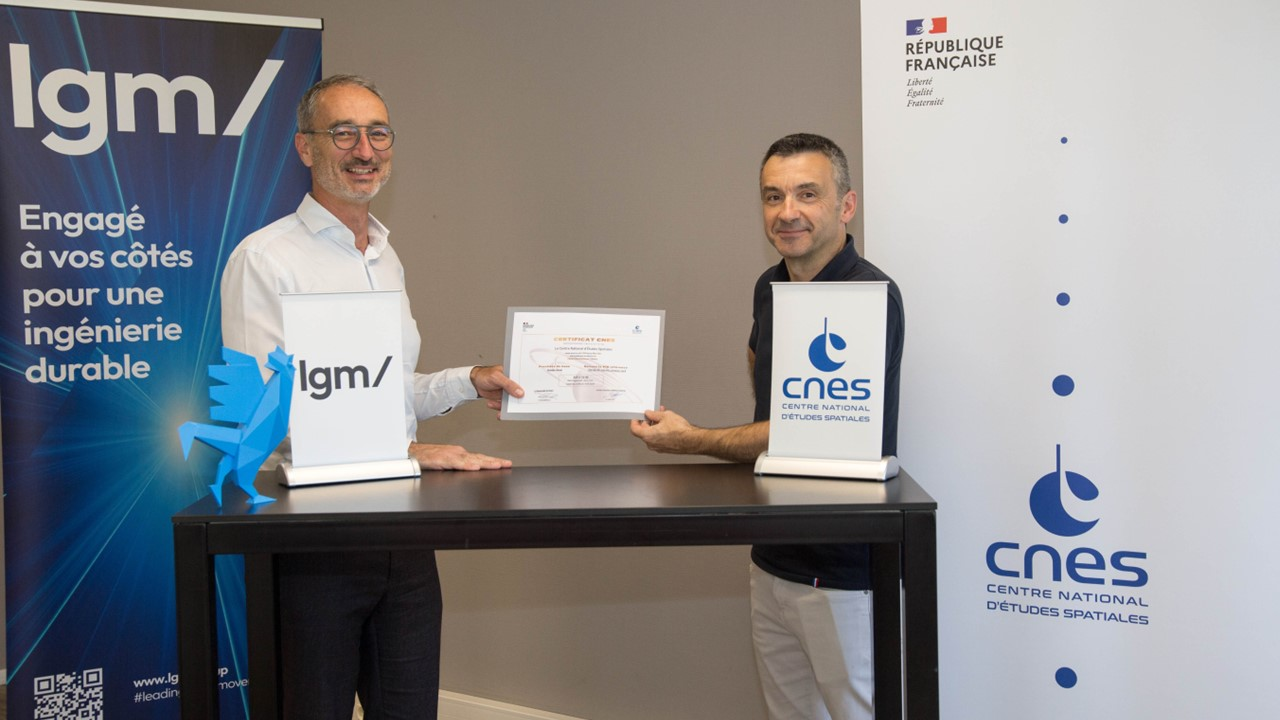
LGM Group has obtained CNES process certification for manual wiring of electronic boards for space-sector applications at its Marville site in Meuse, France.
The certification is compliant with European Cooperation for Space Standardization standards used by the European Space Agency and confirms the company’s ability to perform manual wiring operations on electronic boards intended for space programmes. The approval strengthens LGM’s position in high-reliability electronics manufacturing and opens additional commercial opportunities with space agencies, prime contractors, and equipment manufacturers.
Manual wiring remains a critical capability in parts of the space sector despite the wider automation of electronics production. Space hardware often involves low-volume, high-complexity assemblies where process control, operator skill, inspection, traceability, and documentation are more important than raw throughput. Every connection must withstand launch vibration, shock, thermal cycling, radiation exposure, and vacuum conditions.
CNES oversight gives the approval particular weight. The certification process includes audits, skills assessment, process verification, testing, and expert review against ECSS requirements. Space electronics certification is not limited to proving that a process can work once; it verifies that the organisation can repeat it under controlled conditions, with trained personnel, qualified methods, documented procedures, and auditable evidence.
LGM says the approval validates years of investment in team skills and continuous process improvement at Marville. Guillaume Petit, industrial director of the Marville site, said: “Obtaining this CNES approval is a decisive step for the LGM Group’s electronics production activities. It validates years of investment in upgrading our teams’ skills and in continuous improvement of our processes.”
Demand for qualified space electronics suppliers is growing across Europe as satellite constellations, New Space activity, sovereign communications, Earth observation, navigation resilience, defence-space integration, and European strategic autonomy increase pressure on the electronics supply chain. More spacecraft and payloads mean more assemblies, but not all electronics manufacturing capacity is suitable for space-grade work.
The barrier is not only technical difficulty. Space electronics production is shaped by documentation, reliability assurance, traceability, cleanliness, configuration control, incoming inspection, specialist materials, component screening, operator qualification, and process discipline. Even when board volumes are low, the evidence burden is high. A supplier without the right approvals may be unable to bid for or support programmes despite broader electronics manufacturing experience.
Certification therefore functions as both a quality milestone and a market access requirement. CNES approval gives customers more confidence that the Marville site can support demanding programmes where failure is unacceptable and rework after launch is impossible. Additional qualified capacity also helps European prime contractors reduce bottlenecks and broaden the supplier base as space programmes become more numerous and politically important.
High-reliability sectors are reassessing where critical production steps take place and how supply chains are controlled. Semiconductors, advanced packaging, PCB assembly, cable harnessing, power electronics, and test systems are all becoming part of conversations about sovereignty, resilience, and qualification. European work on chips and AI sovereignty reflects the same industrial concern at a broader policy level: capability has to be manufactured, qualified, and procured through trusted supply chains.
Manual wiring may appear narrow, but small process weaknesses can create large mission risks. Poor wetting, inadequate strain relief, contamination, hidden damage, or insufficient inspection can all compromise reliability. Space qualification treats the human element as part of the process, making training, certification, and repeatability core manufacturing controls.
Automation will continue to expand in electronics production, although growth in space programmes does not remove the need for specialist manual capability. Low-volume, high-reliability work often combines automated assembly, manual operations, inspection, environmental testing, and detailed documentation. Strong suppliers are those able to manage that mix under a coherent quality system.
The certification also strengthens France’s position within the European space manufacturing base. France has long held a central role in European space activity through CNES, ESA programmes, prime contractors, and specialist suppliers. Adding qualified electronics production capacity at Marville supports that ecosystem where programme ambitions meet manufacturing discipline.
LGM’s approval will not remove every pressure on the space electronics supply chain. Component availability, radiation-hardened parts, test capacity, documentation workload, and programme scheduling remain persistent challenges. The certification does, however, add a qualified process route for a production step where competence is difficult to develop and costly to replace. In space manufacturing, trust is built through evidence, certification, and repeat performance.