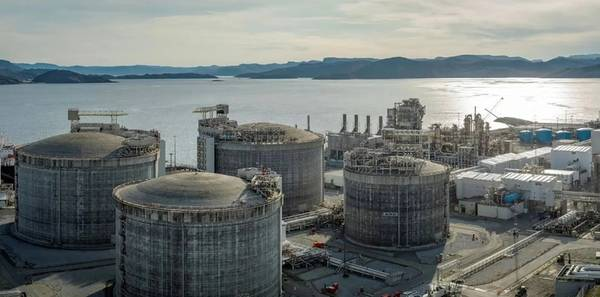
Equinor has postponed the start of a planned annual maintenance outage at Norway’s Hammerfest LNG export terminal until 13 June, keeping attention on the operational reliability of one of Europe’s most important gas processing assets.
The Hammerfest LNG plant, also known as Melkøya LNG, receives gas from the Snøhvit field in the Barents Sea and processes it for export as liquefied natural gas. The facility is widely described as Europe’s largest LNG export terminal and has a daily processing capacity of about 18.4 million cubic metres of gas.
Planned maintenance at LNG plants is a routine part of safe operation, but scheduling carries market and engineering weight. Facilities of this scale involve compression, refrigeration, liquefaction, power systems, process safety equipment, storage, loading infrastructure, control systems, and marine interfaces. Scheduled outages allow operators to inspect, repair, modify, and verify systems that cannot be fully accessed during normal operation.
A short delay to maintenance does not necessarily point to a major technical problem, although LNG assets now operate inside tightly balanced energy systems. Norwegian gas has become a critical part of Europe’s supply picture since Russian pipeline flows were reduced after the invasion of Ukraine. Hammerfest LNG serves global LNG markets, while its availability still affects perceptions of Norwegian supply flexibility and export reliability.
The plant has experienced outages in recent years, including a mechanical fault in a valve earlier this year and previous delays linked to compressor-related work. That operating history reinforces the need for disciplined maintenance planning and asset integrity at complex process facilities. LNG plants depend on refrigeration and rotating equipment operating under conditions that leave little room for weak maintenance regimes.
The Snøhvit development is also distinctive because gas is produced offshore in the Barents Sea and transported to shore for processing at Melkøya. Offshore production, subsea systems, onshore processing, LNG storage, and vessel loading form one integrated chain. A constraint at one stage can affect the rest of the system, requiring maintenance schedules to account for offshore operations, plant readiness, shipping, customer commitments, and market conditions.
Energy security often depends on conventional reliability work: compressors, valves, heat exchangers, control systems, inspection regimes, spare parts, and experienced maintenance teams. Large energy assets are frequently discussed in policy or market terms, but their availability is determined by equipment condition and operational execution.
Hammerfest LNG also sits within Norway’s wider energy and industrial strategy. Norway has become Europe’s largest pipeline gas supplier and remains a major offshore producer, while also investing in electrification, carbon management, and low-carbon industrial projects. Hammerfest LNG is both a hydrocarbon export asset and a focal point in debates over emissions, regional power demand, and long-term industrial policy.
Earlier this year, Norway’s parliament rejected a challenge to the plan to electrify Hammerfest LNG from the regional power grid. Supporters see electrification as a route to reduce direct emissions and extend the facility’s operating life. Critics argue that drawing power from the regional grid could create pressure on electricity supply, pricing, and local interests. The maintenance delay is separate from that policy dispute, although both issues show how LNG infrastructure is now evaluated through reliability, emissions, energy security, and regional impact at once.
The same multi-layered pressure is visible across the UK and wider North Sea. Gas infrastructure remains central to supply security while offshore engineering capability is being redirected toward carbon storage, decommissioning, and low-carbon infrastructure. Analysis of gas system balancing shows how conventional gas assets still sit beneath electricity, heating, and industrial resilience as policy pushes toward electrification and lower-carbon supply.
Maintenance timing becomes especially sensitive during periods of market tightness or geopolitical instability. A plant outage once treated mainly as an operational schedule can influence trading sentiment, shipping patterns, storage expectations, and customer procurement. Operators have to communicate clearly while retaining the flexibility required to manage technical realities on site.
The engineering discipline behind LNG reliability is not glamorous, but it is essential. Rotating equipment, cryogenic systems, valves, instrumentation, safety systems, corrosion management, and human competence all determine whether capacity exists on paper or in practice. In a market where energy security is routinely discussed at national level, the physical availability of assets such as Hammerfest LNG remains a hard constraint.
Equinor’s revised maintenance start date keeps the plant in focus as Europe continues to rely heavily on Norwegian gas infrastructure. The immediate change is a scheduling adjustment. The broader industrial issue is durable: LNG export capacity depends on complex assets being maintained, inspected, and operated with precision, because the energy system has little tolerance for avoidable downtime.