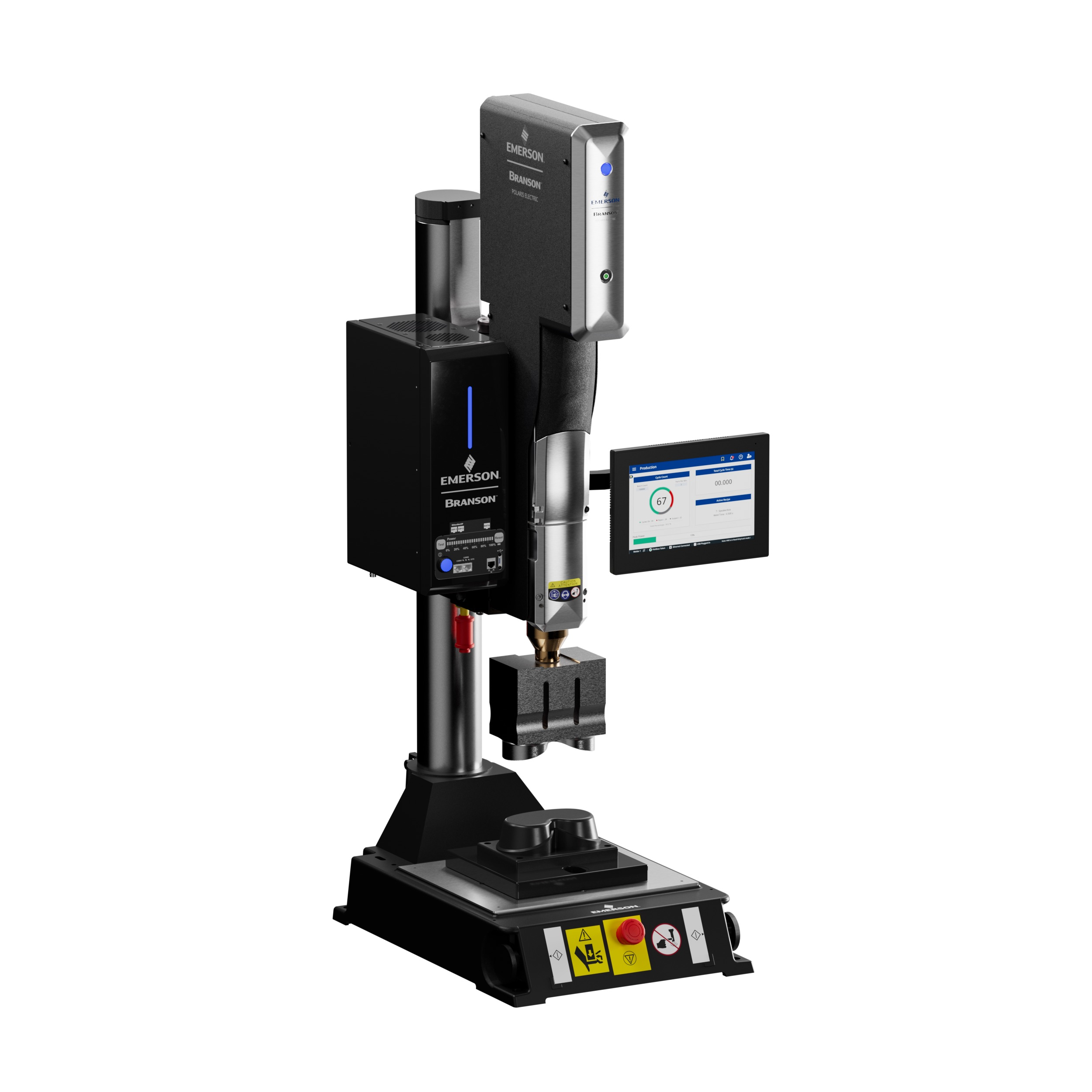
Emerson has launched the Branson Polaris ultrasonic welding platform as a configurable system designed to move from benchtop development through to automated production. The platform combines power supplies, controllers, and actuators that can be selected to suit different applications and expanded without shifting to a separate hardware base.
Emerson is positioning Polaris across automotive, medical devices, consumer electronics, food packaging, appliances, bioplastics, and textiles. That range reflects the pressures now shaping equipment specification in joining processes, where manufacturers are looking for systems that can handle evolving product mixes, tighter traceability requirements, and closer integration with digital production environments.
The platform is built around modularity in both software and hardware. It can be configured as a benchtop machine for development work, laboratory trials, and proof-of-concept activity, then scaled for use in a fully automated line. Optional features allow manufacturers to reduce footprint, expand data storage, and strengthen secure connectivity across wider factory and enterprise networks.
Polaris can also connect to higher-level control systems and PLCs, giving operators access to real-time performance data and allowing process parameters and recipes to be adjusted during operation. In regulated environments, that level of monitoring and control can support validation requirements while improving visibility over performance consistency, line efficiency, and overall equipment effectiveness.
The launch also points to a broader shift in welding and joining equipment. Purchase decisions are increasingly being shaped by integration, lifecycle support, upgradeability, and data access, rather than by weld quality alone. Manufacturers want systems that can be commissioned for development work, transferred into production, and updated as the wider line evolves, without rebuilding the process around a different machine architecture.
Emerson says customers can specify individual components or work with its specialists to build a custom system. The company is pitching Polaris as a long-life platform rather than a fixed machine, with the emphasis placed on adaptable deployment across sectors where throughput, control, and documentation requirements continue to tighten.