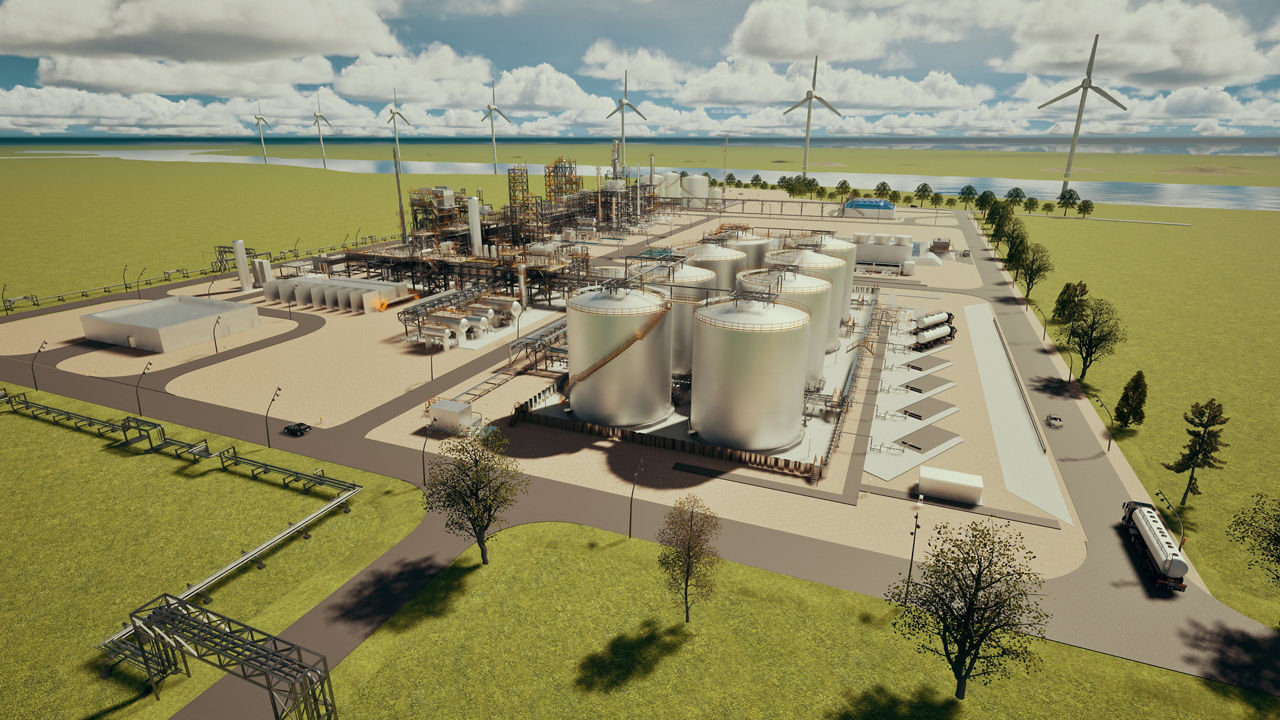
Emerson has been selected by Technip Energies to provide the integrated control and safety architecture for SkyNRG’s sustainable aviation fuel plant at Delfzijl in the Netherlands, giving the first dedicated greenfield SAF production facility in Europe a common automation platform across its main process units.
The plant is under construction and is expected to produce approximately 100,000 tonnes of sustainable aviation fuel annually once fully operational in 2028. It will convert residual fats and greases into fuel that can be blended with conventional jet fuel without requiring changes to aircraft or existing airport fuelling infrastructure.
Emerson will deploy its DeltaV integrated control and safety system across the facility. The architecture combines the DeltaV distributed control system with a DeltaV safety instrumented system covering process control, emergency shutdown and fire and gas functions, bringing several safety-critical and operational layers into a common engineering environment.
The greenfield nature of the project gives the automation system an unusually important role from the start. Rather than fitting new controls around an established process plant, Technip Energies and SkyNRG can design instrumentation, control logic, communications and operating interfaces alongside the production units themselves.
That should reduce some of the integration work that often accumulates late in complex process projects. SAF production involves several packaged and continuously operated systems, and the control architecture has to coordinate their behaviour during commissioning, start-up, changes in feedstock quality and normal operating disturbances.
The Delfzijl plant will use a hydroprocessed esters and fatty acids process to produce the fuel. It will also include an advanced feedstock pretreatment unit and an on-site hydrogen plant based on Technip Energies’ high-efficiency steam methane reforming technology.
Those units place different demands on the automation system. Pretreatment has to prepare variable residual fats and greases for the main conversion process, while hydrogen production introduces its own combustion, reforming, pressure and safety requirements. The SAF production section then has to maintain the temperatures, pressures and flows needed to deliver a fuel that meets the required specification consistently.
Emerson’s AMS Device Manager will provide another layer around commissioning and maintenance by collecting configuration, health and diagnostic information from intelligent field devices. That gives engineering teams a way to identify instrumentation problems without relying solely on process behaviour to indicate that a sensor, valve or other device is deteriorating.
Device diagnostics can be particularly useful during start-up. First-of-a-kind process plants routinely encounter issues that are individually minor but collectively consume commissioning time: incorrect ranges, wiring errors, valve configuration, communications faults and devices that behave differently from the original engineering assumptions.
Finding those problems through a common asset-management environment should allow some of them to be corrected before they become visible as process instability. The same data can then pass into the maintenance organisation once the plant moves from project delivery into routine operation.
Emerson will also use DeltaV Electronic Marshalling with distributed CHARMs. The technology reduces the dependence on conventional fixed I/O cabinet arrangements by allowing field signals to be assigned more flexibly within the control architecture.
That flexibility is valuable during a greenfield construction programme because detailed equipment designs continue to change after major engineering decisions have been made. Additional signals, package modifications or changes in field-device type can otherwise trigger alterations to wiring, marshalling cabinets and control-system drawings late in the project.
SkyNRG site director Bart Rosendaal said experienced partners were important to delivering a safe and reliable plant from its first day of operation. The challenge is heightened by the fact that the facility is not simply another conventional refinery unit assembled from decades of identical operating references.
The automation platform cannot remove the underlying process risk, but it can make plant behaviour more visible and give operators a consistent route to control it. Feedstock composition, hydrogen availability, heat integration and equipment condition will all influence throughput and product quality, and the control system has to keep those variables within an acceptable operating envelope.
SAF projects also face a regulatory timetable outside the factory gate. ReFuelEU Aviation requires fuel supplied at EU airports to include a minimum 2% share of SAF from 2025, with the requirement rising progressively to 70% by 2050. That creates mandated demand, but it does not guarantee that individual production facilities will commission on schedule or operate at their intended output.
As a result, the industrial challenge is shifting from proving that sustainable aviation fuel can be made to building plants that can produce it reliably at substantial volumes. A 100,000-tonne annual facility is large enough for commissioning delays, unplanned outages or persistent process instability to have a material effect on supply.
The Delfzijl project will therefore provide a useful test of whether digital project execution and integrated automation can reduce some of the uncertainty around first-generation SAF capacity. The DeltaV platform will sit across the fuel process, pretreatment and hydrogen plant from commissioning onwards, giving SkyNRG a single automation architecture through which the plant can be started, stabilised and then pushed towards its designed production rate.