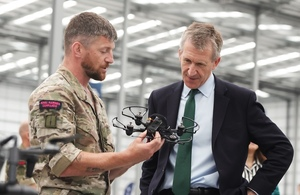
The Ministry of Defence has opened the Uncrewed Systems Centre at DroneTEX in Swindon, creating a major UK facility for drone testing, autonomy development, and rapid military technology evaluation.
Based at DroneTEX, the centre brings together controlled test space, military users, technology developers, investors, and industrial partners. It has been created to help accelerate the development and fielding of uncrewed systems at a time when drones are reshaping battlefield requirements and shortening defence technology cycles.
Defence Secretary Dan Jarvis opened the facility, which is intended to support faster testing and development of uncrewed platforms and related systems. The centre gives suppliers a place to move beyond demonstrations and into repeated test-and-improve cycles, which are essential for technologies that depend on the interaction between airframes, software, sensors, payloads, communications links, and operator interfaces.
Recent conflicts have shown that drone capability is not defined only by the aircraft. Operational performance depends on batteries, electronics supply, software updates, radio-frequency resilience, autonomy functions, payload integration, launch methods, and maintainability. Those elements need to work together as a system, and small changes in one area can affect reliability elsewhere.
The Swindon facility gives the UK industrial base a larger physical environment in which those interactions can be tested. Access to representative conditions is especially important for smaller suppliers, which often have strong technical products but limited routes into structured military evaluation. Test infrastructure can determine whether promising technology becomes a deployable capability or remains stuck at prototype stage.
The centre also gives Swindon a new role in an industrial market that is expanding quickly. The area has already moved through major shifts in automotive, logistics, and technology-led redevelopment. Large-scale uncrewed systems testing introduces another layer of industrial activity, connecting engineering, electronics, autonomy software, data handling, and systems integration.
Aerospace development is increasingly dependent on representative test environments before final designs are frozen. Flight testing, hardware-in-the-loop rigs, digital modelling, synthetic environments, and controlled failure trials all reduce integration risk. The same discipline is visible across combat air, where GCAP’s first international work package is binding design, manufacturing, and systems engineering into a shared industrial programme.
Uncrewed systems move faster than traditional aerospace programmes, but they cannot escape manufacturing discipline. Defence users want rapid fielding, yet production still needs repeatable build standards, component traceability, software configuration control, reliability evidence, and maintainability. Scaling drone capability therefore requires the methods of aerospace, electronics, and automotive manufacturing as much as the culture of rapid experimentation.
Counter-drone technologies sit alongside the same growth in uncrewed platforms. As drones become cheaper, more capable, and more widely available, demand rises for detection, classification, tracking, and defeat systems. Radio-frequency sensing, radar, electro-optics, AI-enabled classification, resilient communications, and electronic warfare are increasingly part of the same engineering conversation.
DroneTEX gives the UK a practical route to test those technologies in combination. The centre’s value will depend on whether it helps suppliers move from field trials to repeatable production, and from isolated products to integrated systems that can be supported in service.
Swindon now has a facility that could sit between experimentation and industrial scale. The decisive measure will be how quickly the companies using it can turn tested autonomy into reliable, manufacturable capability.