SinterCast expects Daimler Truck to become a minority shareholder as the Swedish process control specialist pursues a commercial agreement with Atlantis Foundries, the South African casting manufacturer owned by the German vehicle producer. The proposed investment supports cooperation on high-volume production of compacted graphite iron (CGI), a material widely used in heavy-duty engine manufacture.
Under the proposed equity arrangements disclosed on 24 November, Daimler Truck would subscribe for 785,300 newly issued shares at SEK 101.53 each. It would also receive 461,912 warrants permitting further share subscriptions under specified conditions. SinterCast has convened an extraordinary general meeting for 18 December to seek shareholder approval.
The contemplated commercial agreement concerns future serial production at Atlantis Foundries. The companies have also identified scope for further technical cooperation, linking the development of casting processes more closely with the engineering requirements of a vehicle manufacturer. No new component production volumes have been disclosed.
CGI is distinguished from conventional grey iron and ductile iron by the morphology of its graphite inclusions. The flake-shaped graphite in grey iron creates stress concentrations within the metallic matrix, limiting its tensile and fatigue properties. CGI has shorter, thicker graphite particles with rounded ends and an interconnected structure. Its strength and stiffness can exceed those of grey iron, while its thermal and casting characteristics differ from those of fully nodular ductile iron.
The combination is useful in engine structures, where cylinder pressure, temperature variation, and cyclic loading place considerable demands on the casting. Higher stiffness can help control deformation around cylinder bores and other highly loaded sections. Designers may also be able to reduce wall thickness or alter reinforcing features, provided the revised geometry meets requirements for heat transfer, fatigue life, and casting quality.
These benefits depend on controlling the microstructure throughout the casting. Magnesium treatment influences the form in which graphite develops during solidification, while inoculation affects graphite nucleation. Too little active magnesium can allow flake graphite to develop; excessive treatment can produce a higher proportion of nodular graphite. Temperature and the elapsed time between treatment and pouring affect the process, making it difficult to rely on fixed treatment additions alone.
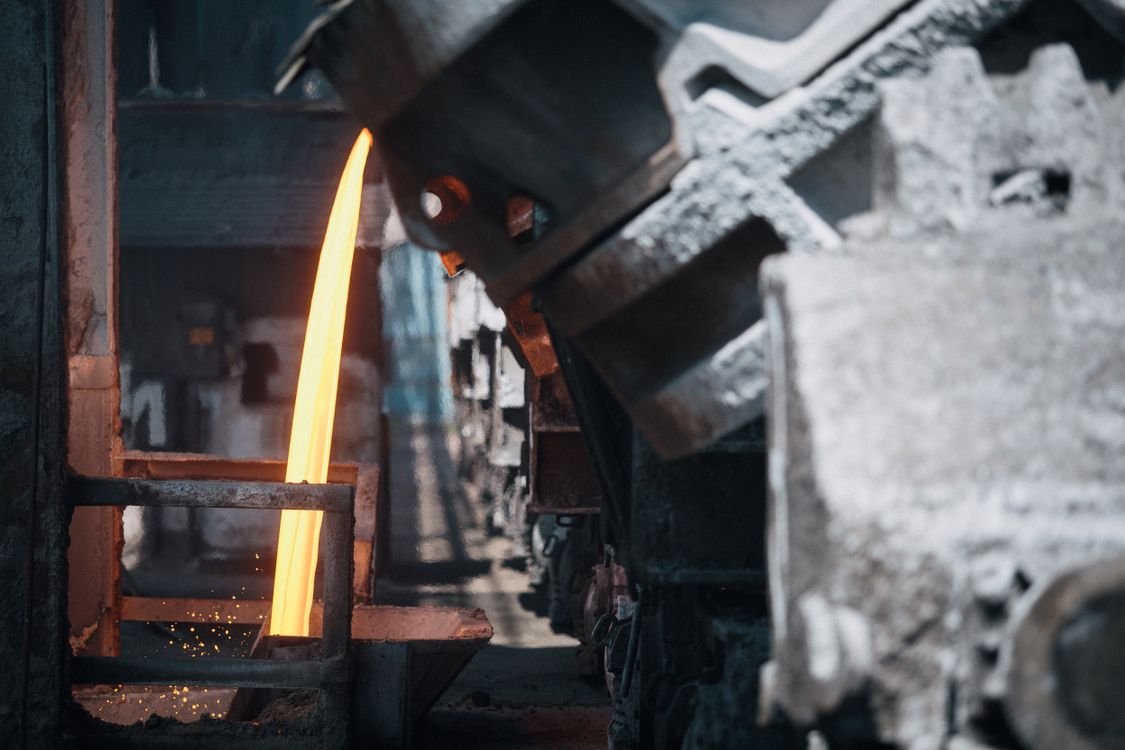
SinterCast addresses that variation by measuring a sample of the treated molten iron before casting. Its thermal analysis system records the temperature response as the sample solidifies, using the cooling characteristics to assess the treatment condition. A reactive coating in its sampling cup simulates the loss of active magnesium that occurs while molten iron is held before pouring.
The analysis informs corrective additions to the ladle. SinterCast’s software calculates the quantities of magnesium and inoculant required, and the associated feeding equipment delivers those materials using cored wire. Adjustments can therefore be tailored to the condition of each batch rather than based entirely on the initial composition of the charge.
At production scale, the timing of those measurements and additions must be integrated with the foundry’s existing handling and moulding operations. Delays between sampling, correction, and pouring can change the treatment condition. The process must deliver repeatable metallurgy while maintaining the cadence of the casting line, particularly when the foundry supplies components against established vehicle production schedules.
Consistency also affects downstream machining. Engine castings typically require numerous machined interfaces, including bores, mating faces, and mounting features. A change in microstructure or hardness can affect tool wear, dimensional control, and process capability. Foundries and component engineers therefore need to establish acceptable casting properties together with the machining parameters used in series production.
SinterCast has previously secured another European heavy-duty engine foundry order, reflecting demand for controlled CGI manufacturing. The proposed Atlantis Foundries cooperation is a separate development, with an equity investment intended to accompany the commercial relationship.
Daimler Truck continues to serve applications with different powertrain requirements. Heavy-duty combustion engines remain part of that portfolio alongside electrified alternatives, and foundry investments must accommodate the expected production volumes and lifecycle requirements of individual programmes. Establishing dependable casting processes gives component engineers greater scope to use material properties as part of the original design rather than compensating for variability later in manufacturing.
SinterCast has set a milestone of eight million annualised engine equivalents by 2031. Its management regards the prospective Daimler Truck relationship as an important contribution towards that objective. The target remains a company ambition rather than a committed output figure for Atlantis Foundries; the December shareholder vote is the next formal step in the proposed investment.