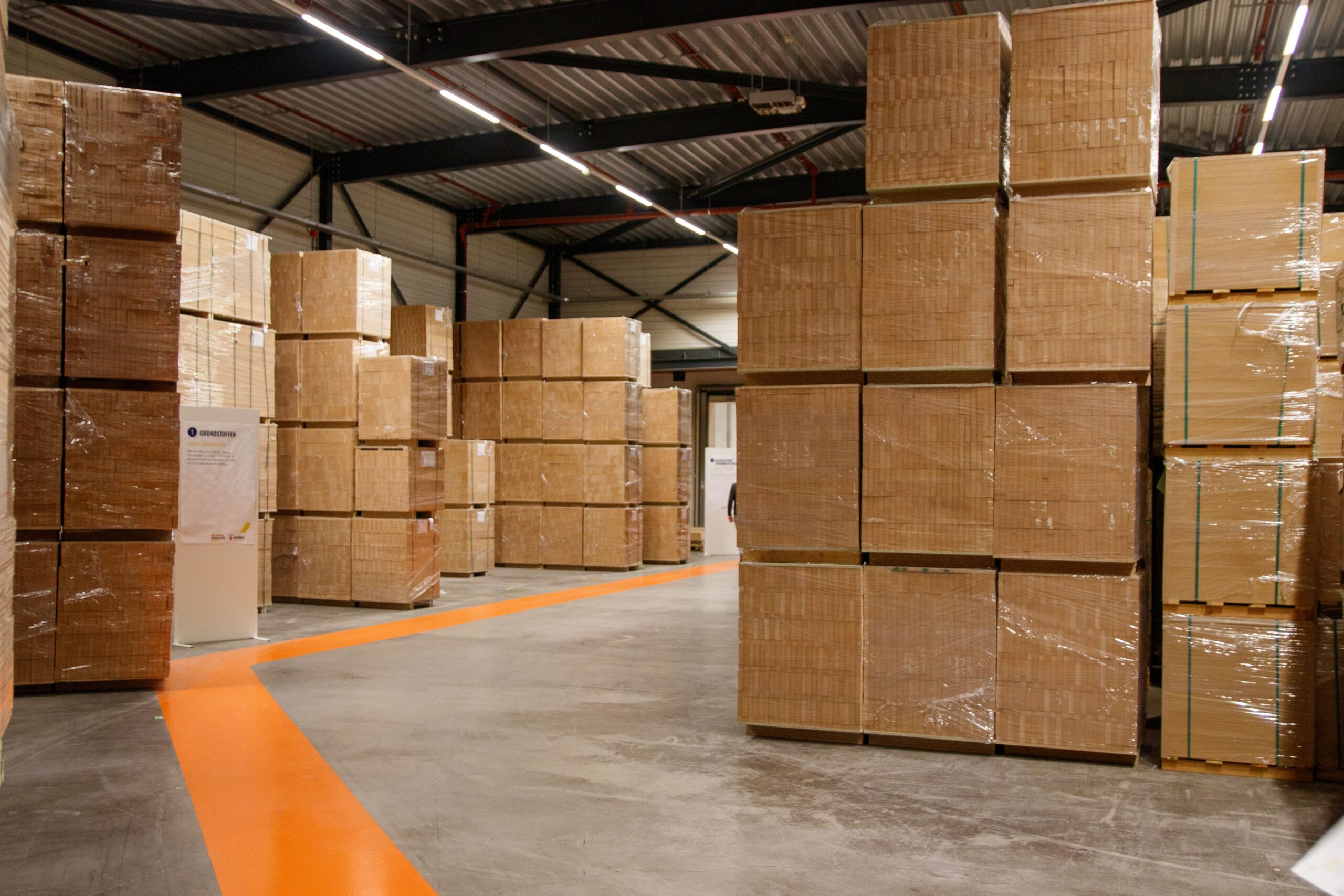
CorrBoard UK has completed a £60,000 programme of factory improvements at its Scunthorpe corrugated board operation, reorganising warehouse space, vehicle movements and pallet storage as it prepares to serve more independent packaging manufacturers.
The work included painting the warehouse floor to create a more structured environment, changing the internal traffic layout to improve safety and reorganising the shopfloor to provide additional storage capacity. CorrBoard says the changes have improved workflow and released usable space at its existing plant.
The investment is an operational layout project rather than the installation of another corrugator or a confirmed increase in machinery output. The company has not disclosed an increase in tonnes produced, pallets stored or manufacturing throughput as a consequence of the changes.
CorrBoard operates a purpose-built corrugated sheet manufacturing facility at Normanby Enterprise Park in Scunthorpe. It supplies board to independent sheet plants that convert the material into boxes and other packaging formats for their customers.
Its customer mix places particular demands on specification control and order handling. Sheet plants may require different board grades, flute combinations, dimensions and quantities, with deliveries coordinated around their own converting operations.
A corrugator combines paper liners with a fluted medium to produce sheet board with stiffness and cushioning characteristics suited to the application. Paper grade, the geometry of the flute, adhesive performance and the number of layers affect the mechanical properties of the finished material.
A single production facility can manufacture numerous combinations. CorrBoard markets more than 230 board grades and a range of flute profiles, making identification and movement of work in progress important alongside the speed of the production line itself.
The Scunthorpe site includes a Fosber fast order change corrugator. That equipment provides manufacturing flexibility, but an efficient order change does not remove the need to collect, inspect, stack, store and dispatch the board produced.
Finished sheets have a substantial physical footprint, particularly when orders involve large dimensions or quantities. Storage areas must accommodate different formats while allowing handling equipment to retrieve the correct stack without unnecessarily moving other material.
Changing pallet positions and the arrangement of working areas can improve access and reduce congestion. The useful capacity achieved depends on vehicle clearances, stack stability, floor loading and the routes that must remain available for personnel and emergency access.
CorrBoard says its revised layout creates room for more pallets and stored material. It has not specified the additional number of pallet positions, so the scale of that improvement should not be converted into a numerical capacity claim.
The same distinction applies to handling efficiency. A shorter or more direct movement route can reduce unnecessary travel, but productivity changes depend on the number of journeys, handling equipment, order mix and the way operators use the new arrangement.
Internal traffic management is particularly important where lift trucks and pedestrians operate near the same production and storage areas. Vehicle movements can involve raw paper, completed sheet stacks and materials being prepared for loading.
A revised traffic layout provides an opportunity to separate movement patterns, manage crossing points and improve sightlines. The effectiveness of such measures depends on the physical layout and the operating controls applied after the work is completed.
Warehouse floor painting may also support the designation of routes, working zones and storage locations. CorrBoard has not published detailed drawings or confirmed the specific markings installed, so the project cannot be described as a particular safety system beyond the measures it has disclosed.
Managing director Matthew Miller says the improvements have already released space and made workflows more efficient. Those are the company’s reported observations rather than independently measured reductions in vehicle movements, incidents or order cycle time.
The £60,000 programme follows a separate investment of more than £10,000 in quality testing facilities, confirmed in September. CorrBoard upgraded the laboratory’s conditioning equipment and doubled the size of the space available for testing activities.
The conditioning unit is intended to provide better control of the environment in which board samples are prepared for measurement. Moisture and temperature can influence the mechanical performance of paper-based packaging, so comparable tests depend on consistent conditioning and agreed methods.
Different tests address properties including compression, resistance to deformation and the behaviour of material under specific loading conditions. Their usefulness depends on appropriate sample preparation, test procedures and interpretation against customer specifications.
Greater laboratory space can support simultaneous testing and the retention of reference samples, but the September project was not part of the £60,000 floor and traffic investment. The two developments affect separate stages of production assurance and material handling.
Corrugated sheet manufacturers also need to maintain traceability between customer orders, production runs and material supplied. The correct grade and dimensions must reach the intended converter in a suitable condition, particularly where several specifications are manufactured during the same shift.
Handling and storage arrangements have a direct bearing on that task. A correctly produced stack can still create problems if it is misplaced, damaged during movement or delayed behind other stock.
CorrBoard’s changes are intended to reduce such friction within the existing operation, supporting expansion of the company’s business with non-integrated sheet plants across the UK. The company has not announced a new production line, an extension to the factory building or additional jobs linked to this particular expenditure.
The completed work provides more organised manufacturing and warehouse space, while the earlier laboratory investment strengthens the systems used to assess board quality. Future capacity claims will require production or delivery measurements that have not been released with the latest factory update.