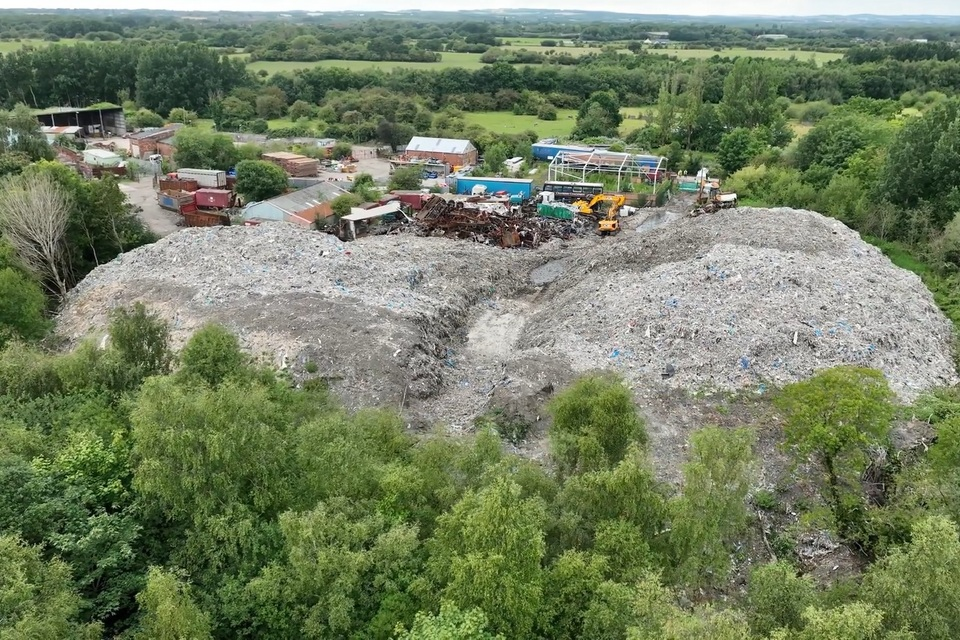
Acumen Waste Services has begun preparatory work at the illegal waste site on Bolton House Road in Bickershaw, Greater Manchester, after Wigan Council signed the contract covering removal of an estimated 18,000 tonnes of deposited material.
Equipment is being brought to the site and vegetation cleared to improve access before the main waste removal operation. The council confirmed this mobilisation on 23 October, following completion of a procurement standstill period. Bulk clearance was expected to begin in the following weeks; the council had not confirmed that the waste itself was already being removed.
The 23 October milestone is distinct from September, when Acumen was named the preferred contractor subject to completion of the procurement process. The signed agreement and the start of site preparation establish that work has moved beyond contractor selection, although they do not constitute completed remediation.
Wigan Council’s procurement documentation estimates the deposited waste at approximately 18,000 tonnes, based on a LiDAR survey recording a volume of 23,086 cubic metres. The material is located at the main Bolton House Road site and extends to land adjoining Diggle Flash, part of Bickershaw Country Park.
Those figures are estimates used to plan the removal programme. The final quantity taken off site will depend on measurements during handling, the actual material composition and how the deposits are classified and processed. A survey-derived volume cannot be converted into a precise tonnage without assumptions about density and the proportion of different materials.
The clearance programme follows years of concern among residents, intensified by a major fire at the illegal waste site in July 2025. Fire risk, potential environmental harm and the consequences for surrounding communities informed the council’s decision to procure an urgent integrated clearance contract.
After the fire, a multi-agency group worked to assess the site and prepare for removal. Partners have included the Environment Agency, UK Health Security Agency, Defra, United Utilities, Greater Manchester Police and Greater Manchester Fire and Rescue Service. Independent organisations have also sampled waste, water and odour to support the assessment of risks and disposal routes.
The handling challenges differ from those at a conventional waste transfer station. Incoming loads at a regulated facility are normally subject to defined acceptance and handling procedures, whereas an illegal deposit may contain mixed materials whose origin, composition and condition are uncertain. The effects of prolonged weather exposure and previous fires can introduce further uncertainty.
Before removal, the contractor must establish appropriate working access, decide how material can be safely handled and coordinate the transfer of waste to facilities permitted to receive it. The selected methods must reflect site conditions and the information available from assessment and sampling.
Waste classification influences the treatment options available. Material identified as hazardous may need different containment, handling and disposal arrangements from other waste streams. No detailed public inventory has yet established the classification of every part of the Bickershaw deposit, so individual treatment or disposal destinations should not be assumed.
The main operation will require equipment suitable for moving large quantities of material within a constrained site. Vehicle routing, loading areas and safe working arrangements are part of the preparation because machinery movements can introduce further hazards if access routes or ground conditions are unsuitable.
Transfer operations must also control the escape of waste and prevent contamination being carried outside the working area. The precise protective measures will follow the contractor’s site-specific assessment and the requirements imposed by relevant authorities, rather than a single arrangement applicable to all deposits.
The extension of waste onto land associated with Diggle Flash adds a further operational constraint. Work near a nature reserve must consider the distribution of deposited material and the potential effects of access, clearance and movement on surrounding land. The council has not published a final restoration design for those areas.
Acumen’s appointment through a single integrated contract provides one principal organisation responsible for coordinating the clearance programme. In procurement documents, Wigan Council explained that dividing the work into separate lots would be unsuitable given the urgent, interconnected requirements and the need for consistent accountability.
The original procurement notice estimated the contract value at £7m before VAT. That figure was an estimate for tendering and should not be treated as the final agreed contract price. The award information and council statements also need to be distinguished from the cost of any subsequent land restoration work.
The procurement notice specified an anticipated contract period running from late October 2026 to early April 2027. That programme provides an indicative delivery window, rather than a guarantee that every clearance and acceptance activity will finish on a particular date.
Conditions encountered during waste removal may influence the sequence of works. Material might require separate handling once uncovered, while weather, site access and the capacity of receiving facilities can affect operations. These possibilities are standard constraints for waste projects, not evidence of a delay already reported at Bickershaw.
Alongside clearance, the Environment Agency continues a criminal investigation into the illegal waste activities. Wigan Council has committed to supporting that process and maintaining engagement with residents. Remediation and enforcement serve different purposes: the former addresses the material and site conditions, while the latter concerns responsibility for the illegal activity.
The council has not stated that the site has been cleaned, that all contamination has been removed or that the land is available for unrestricted future use. Such conclusions would require completion of the appropriate removal and subsequent assessment work.
Acumen’s immediate task is to progress from equipment mobilisation and access preparation to the removal and lawful transfer of the estimated waste inventory. The next substantive measures will be quantities actually removed, their treatment destinations and evidence that the remaining site conditions meet the objectives of the clearance programme.