Comau has delivered a flexible battery cell formation and testing system to Slovenia’s National Institute of Chemistry, bringing industrial process control, safety measures, and repeatable testing conditions into a laboratory used by academic and commercial researchers.
The turnkey installation in Ljubljana supports pouch, cylindrical, and prismatic cells on a common platform, allowing users to work across different cell dimensions, chemistries, and applications without dedicating the laboratory to a single battery architecture. Comau has designed the system to cover work ranging from early laboratory prototypes to higher-power cells closer to industrial deployment.
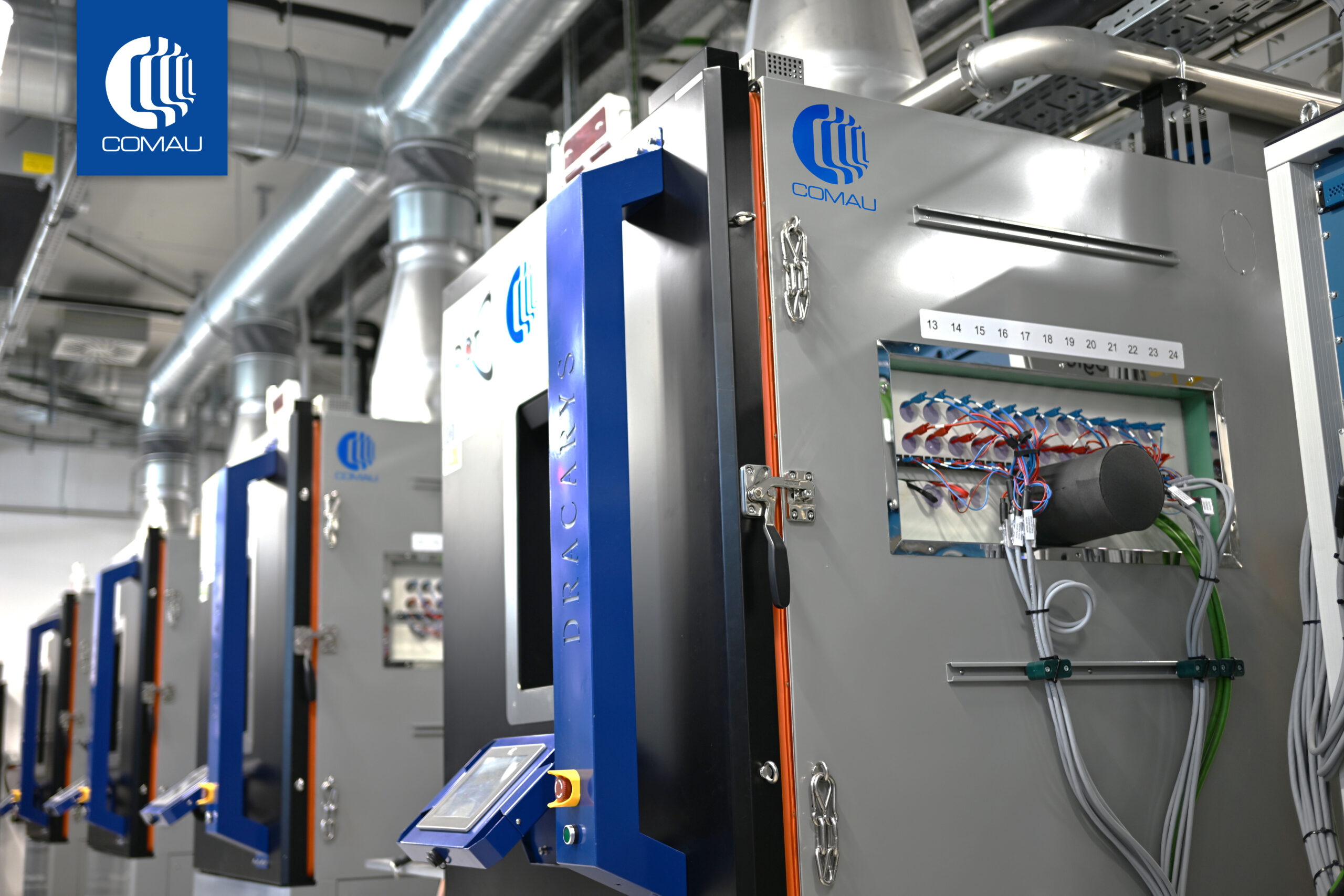
Ten climatic chambers provide controlled environments for formation and testing between -20°C and +60°C. Separate room-temperature walk-in areas support longer-duration cycle-life work, giving the institute a combination of environmental testing and extended operation without forcing every programme through the same fixture or chamber configuration.
The equipment addresses a recurring gap between battery research and industrial production. A chemistry can perform well in a small laboratory cell while proving difficult to reproduce once dimensions, current levels, thermal behaviour, and manufacturing tolerances move closer to commercial conditions.
Formation is particularly sensitive to that transition. Newly assembled cells are subjected to controlled charging and discharging sequences that establish their electrochemical behaviour and influence later capacity, efficiency, and service life. Temperature, current, voltage limits, connection quality, and handling therefore have to remain sufficiently consistent for results from different cell designs to be compared meaningfully.
Comau’s system uses standardised tray positioning, industrial cabling, and remotely operated cell connections within the thermostatic chambers. Reducing manual intervention during connection and test sequences is intended to improve repeatability while limiting operators’ exposure to electrical hazards.
Adaptable 3D-printed fittings allow trays and fixtures to be modified for different cell sizes without rebuilding the underlying test platform. That mechanical flexibility is important in a research environment where the next programme may use a different geometry from the previous one but still require the same electrical, environmental, and safety controls.
The installation also includes fire suppression and is designed to meet EUCAR safety requirements. Battery-development facilities have to account for failure modes that may be deliberately explored during testing, particularly where researchers are evaluating unfamiliar chemistries, high-power cells, or operation at temperature extremes.
Containment, detection, remote connection, and controlled chamber conditions therefore form part of the experimental infrastructure rather than sitting around it as ancillary safety equipment. A test system that produces useful data but exposes operators to avoidable electrical or thermal risk would not provide a credible bridge towards industrial validation.
Long-term cycling places different demands on the laboratory. Cells may remain connected for weeks or months while charge and discharge behaviour, degradation, efficiency, and capacity retention are recorded. NIC’s room-temperature environment uses flexible fixtures with independent channel control so individual cells can be monitored without tying an entire group to one test programme.
The ability to handle three physical formats also reflects the lack of convergence around a single battery design. Cylindrical cells remain attractive where established automated manufacturing and mechanical robustness are important, while prismatic and pouch formats offer different compromises around packaging efficiency, thermal management, assembly, and system integration.
A shared research facility serving several companies and institutes therefore needs more flexibility than a production line designed around one commercial cell. The practical challenge is retaining that adaptability without introducing enough manual variation to weaken test repeatability.
Comau first disclosed its work with the National Institute of Chemistry as part of a wider effort to industrialise flexible cell formation and testing. The company also supplies equipment for module and pack assembly, cell handling, end-of-line testing, and other battery manufacturing processes, placing the NIC installation at the development end of a broader production chain.
“Battery innovation increasingly depends on the ability to move promising technologies out of the laboratory and evaluate them using processes and conditions that reflect industrial reality,” said Aldo D’Ambrosio, Battery & Fuel Cells Segment Leader at Comau. “By supporting different cell formats and testing requirements on the same platform, we are helping NIC create an important link between research and the next stages of battery development.”
NIC opens the facility to both academic and industrial users, allowing companies developing materials, cells, or battery applications to test designs under controlled conditions before committing to more expensive pilot or production-scale trials.
That does not remove the need for pilot manufacture, process qualification, or later validation on production equipment. It does allow weaknesses in cell design, thermal behaviour, formation parameters, or cycle performance to emerge earlier, when changes are generally cheaper to make.
The value of the installation will therefore depend on how quickly it can move between programmes without sacrificing consistency. If NIC can accommodate materially different cell formats while maintaining repeatable electrical, environmental, and safety conditions, the laboratory will cover the difficult middle ground where battery concepts stop being experiments and start becoming manufacturing projects.