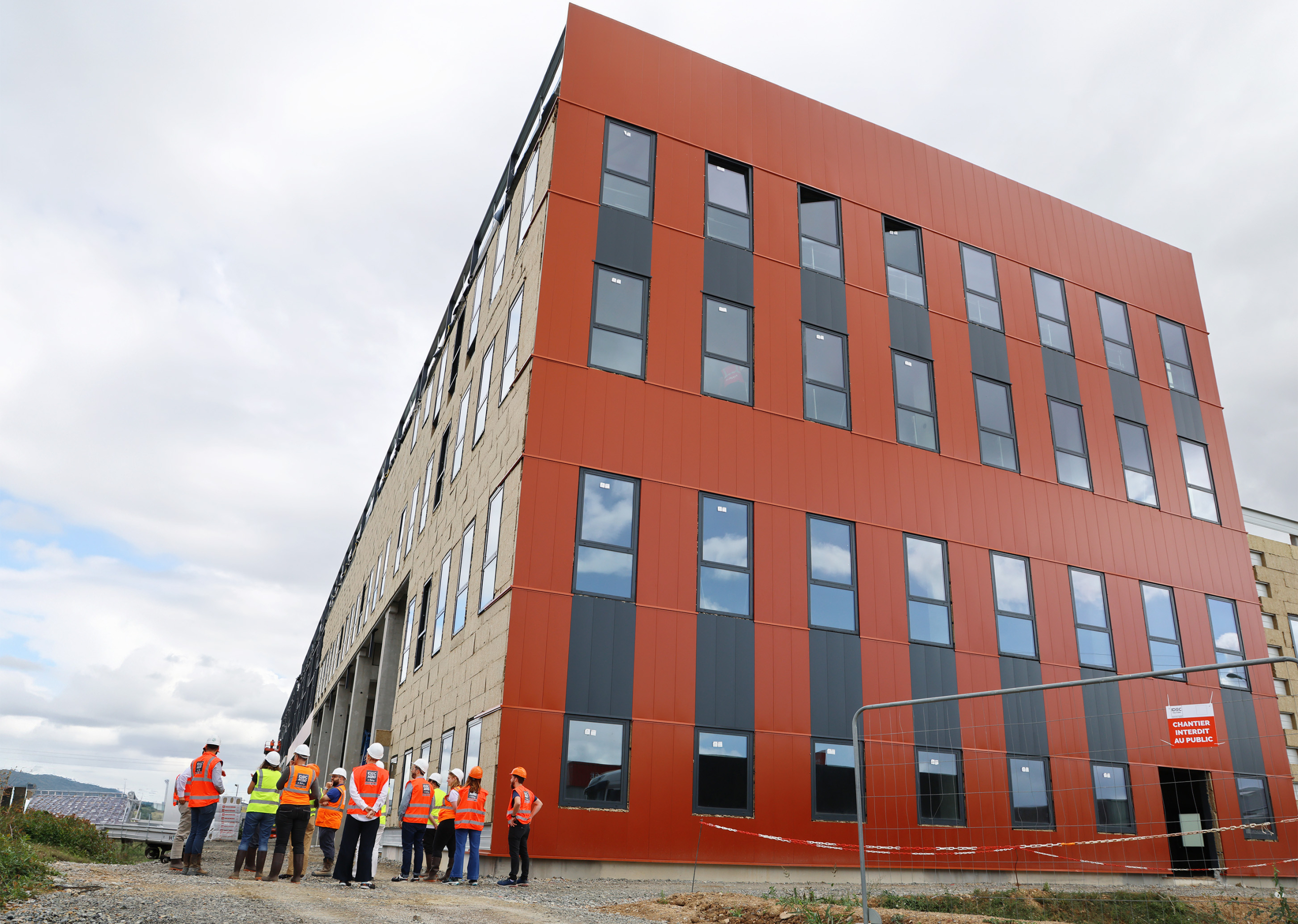
Cailabs is progressing construction of a 10,000m² manufacturing facility in Rennes designed to raise production capacity for optical ground stations to as many as 50 systems annually by 2028. Factory 27 will combine production, integration, assembly, and testing as the French photonics company moves from individual system builds towards repeatable industrial manufacture.
The new site is intended primarily to support Cailabs’ growing optical ground-station business alongside other advanced photonic systems. Optical ground stations form the terrestrial end of laser communication links between satellites and Earth, receiving and transmitting tightly controlled optical beams while compensating for atmospheric turbulence that can distort those signals.
Cailabs already has systems deployed internationally and says it has demonstrated bidirectional space-to-ground and ground-to-space laser links. The manufacturing problem changes as deployment numbers increase, however. Producing a small number of specialist systems allows a high degree of individual engineering; building dozens every year requires defined processes, standardised work, controlled suppliers, repeatable calibration, and system testing that can be scaled without losing performance.
Factory 27 is being structured around that transition. Dedicated areas for production, integration, assembly, and testing are intended to reduce the movement of high-value optical and precision-mechanical assemblies between disconnected workshops, while manufacturing engineering and quality functions can be developed around a more consistent production flow.
The company says its current optical ground-station capacity is around 12 units annually, with Factory 27 intended to lift that figure to 50 by 2028. That remains a modest output by mass-manufacturing standards, but these are precision optical systems rather than consumer electronics, combining specialist photonics, tracking equipment, structures, electronics, controls, and environmental protection.
Optical communications are attracting investment because laser links can carry large data volumes without using conventional radio-frequency spectrum. They can also provide characteristics useful for secure satellite communications, although practical availability depends on atmospheric conditions, the number and geographical distribution of ground stations, and the ability of the optical terminal to maintain a stable link.
That makes terrestrial infrastructure an important part of the wider space-communications system. A satellite carrying an optical terminal only becomes operationally useful when compatible ground stations are available where required, making the ability to manufacture and deploy those stations repeatedly almost as important as demonstrating the underlying photonics.
Cailabs employs more than 200 people, including around 40 PhDs, and generates more than 70% of its revenue outside France. Recruitment for Factory 27 has already started across site management, manufacturing engineering, supply chain, quality, and deployment, with around 50 additional operational hires planned to support the opening before further recruitment as production increases.
The factory is being built on a former industrial brownfield and uses a multi-storey design intended to reduce its land footprint. Construction is being led by Faubourg Promotion and Groupe IDEC’s engineering business through IDEC Factory, with Groupe IDEC ENR Solar supplying photovoltaic infrastructure.
Factory 27 is also one of 150 strategic industrial projects benefiting from an accelerated French government procedure for investments considered important to economic sovereignty. The designation fits a broader effort to retain manufacturing capability around technologies associated with space, defence, communications, and data infrastructure rather than allowing the industrial portion of those markets to migrate elsewhere after the research has been completed.
Cailabs intends to use Rennes as the model for a similar operation in the United States. The company says the experience gained in developing teams, methods, production processes, and the supply chain at Factory 27 will inform the American site, giving the second expansion an established manufacturing template rather than requiring the production system to be developed again from first principles.
That transferability will be one of the more useful tests of whether Factory 27 has genuinely industrialised the product. A manufacturing process is easier to scale when its tooling, work instructions, inspection methods, supplier controls, and test requirements can be reproduced at another site without depending excessively on a small number of individuals in the original factory.
The physical building is therefore only part of Cailabs’ investment. The more difficult task is converting specialist photonic expertise into a production system capable of delivering consistent optical performance across growing volumes, then repeating that process on another continent.
By 2028, the meaningful measure will not be whether Factory 27 looks impressive from the road but whether it can produce 50 optical ground stations a year with repeatable quality and predictable lead times. Space communications increasingly depends on sophisticated photonics; somebody still has to work out how to build the hardware repeatedly.