ByteSnap Design reports that 33% of UK electronics and embedded systems professionals surveyed have experienced greater verification, assurance and governance workloads associated with artificial intelligence. The result sits alongside reported gains in data analysis and routine task automation, illustrating the extra testing involved when software-generated outputs must inform the design or operation of physical products.
The Birmingham engineering consultancy commissioned its third annual study through an independent online research platform in August 2026. It questioned 281 UK professionals involved in developing, manufacturing or upgrading electronic and embedded products. Their work covered industrial automation, energy, automotive, medical devices, aerospace, defence, buildings and connected equipment. The figures describe responses from this sample, not an independently measured change in the productivity of UK engineering as a whole.
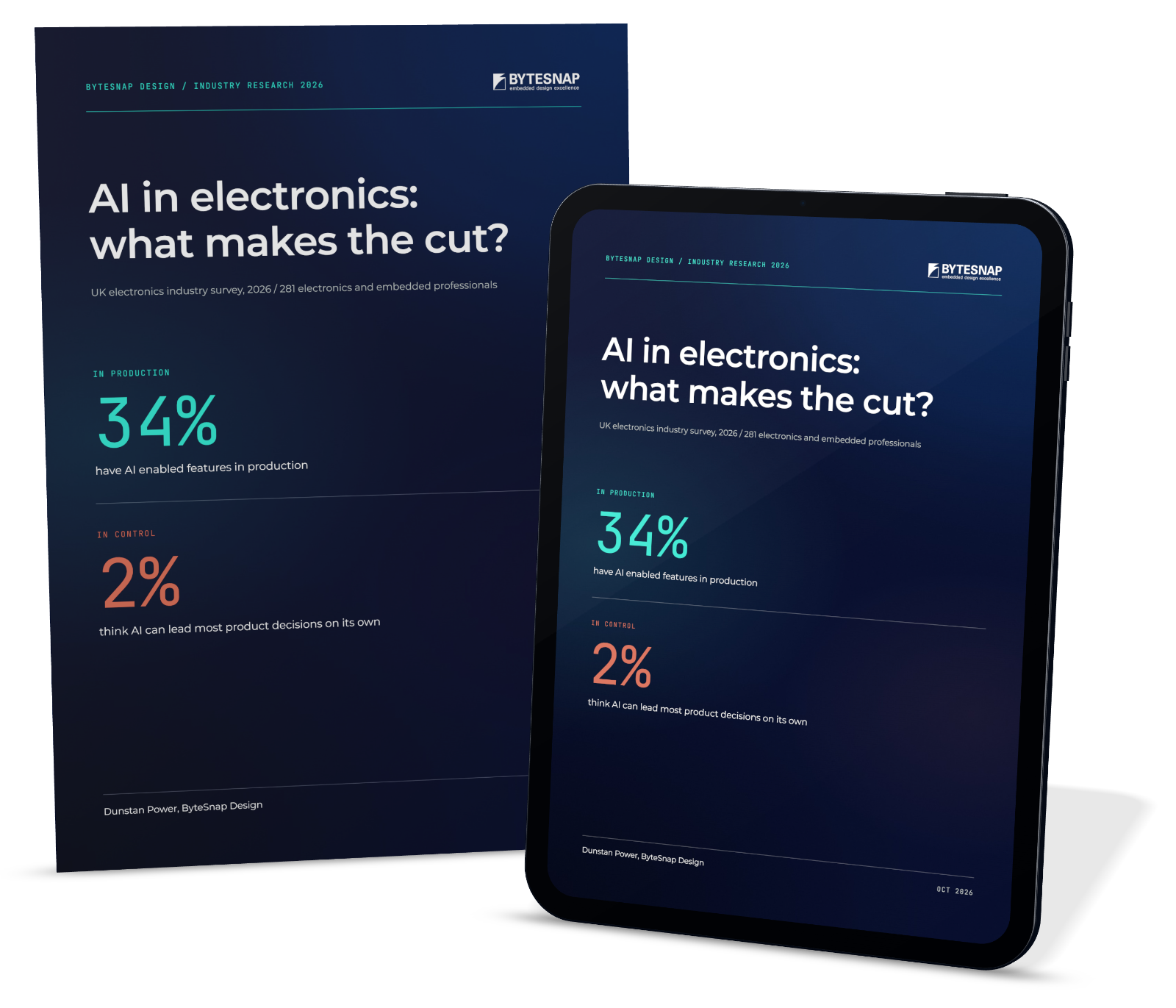
AI-enabled functionality is already present in some products represented by the survey: 34% of respondents said their organisations had features in production, and another 26% reported pilots or limited deployments. At the same time, only 29% expected AI to become standard across most of their organisation’s product portfolio. The difference is consistent with organisations selecting particular applications rather than assuming every device function should use an AI model.
Computer vision and automated quality inspection were among the leading applications identified, cited at 41%; cyber threat detection followed at 39%, and predictive maintenance at 37%. An inspection system typically needs camera or sensor data, a processing pipeline and a decision interface to the equipment it monitors. Its usefulness depends on more than model accuracy in isolation: lighting, vibration, contaminated optics, variable workpieces and the consequences of missed defects all affect the production setting. The survey does not establish that every cited application is already deployed commercially.
Integrating AI with existing electronics, firmware, control logic and legacy hardware was the leading barrier identified by 47% of respondents. Comparable questions produced figures of 34% in the 2024 study and 62% in 2025, but changing respondent groups and operating conditions limit the conclusions that can be drawn from that sequence. A model demonstrated on a workstation may require a different memory footprint, processor, power budget or update mechanism once it is embedded in a machine.
Hardware integration can be especially demanding where a device has limited computing capacity or must respond within a specified time. Engineers need to account for power consumption, timing, sensor accuracy and failure modes alongside the quality of the AI model itself. An inspection system may operate successfully in a laboratory but encounter variations in lighting, contamination, movement or component presentation once fitted to a production line.
Although 56% reported better data analysis and 40% identified less repetitive work, 33% also described increased verification and governance demands. These percentages should not be subtracted from one another: different questions capture different experiences, and the survey does not quantify net engineer-hours per project. A design team can automate initial analysis yet still spend considerable time checking exceptions, recording evidence and deciding who is responsible for the resulting engineering choices.
Quality assurance procedures can include testing against known cases, examining exceptions, assessing model behaviour after software changes and checking performance under conditions not represented in initial development data. Where the AI feature contributes to a safety function, the team may also need to establish what happens when the model produces an uncertain output, a false alarm or a missed detection. The degree of assurance will depend on the product and its regulatory environment.
Delegation of authority attracted particular caution. Only 2% thought AI should independently lead most product development decisions; 57% wanted safety, risk acceptance and accountability to remain human led, while 43% said verification, validation and engineering sign-off should remain with people. Crucially, the 2% response concerns autonomous decision-making, not whether respondents trust AI in every possible application.
Dunstan Power, director of ByteSnap Design, described the corresponding assurance burden: “While AI saves time, someone still has to check the model’s output, judge whether it’s right, and take responsibility for the final decision.” Customer trust was mentioned by 33.5% of respondents, compared with 34% for product safety and liability, 31% for cybersecurity and 25% for regulatory compliance. These are concerns selected by survey participants, not measured defect rates or a mutually exclusive distribution of risks.
Workforce expectations are changing alongside technical requirements. Some 32% of respondents anticipated demand for additional embedded, data and systems skills, compared with 12% uncertain about future roles and 9% reporting little change. Earlier surveys had asked about job displacement concerns, but different questions across years should not be treated as a direct measurement of jobs created or removed by AI deployment.
Data access and commercial return were cited as adoption factors by 42% and 40% of respondents respectively, while 49% expected selective AI deployment during the next three years. The consultancy’s findings leave manufacturers with measurable engineering questions: whether representative data can be collected, whether a model can operate within the device’s constraints and what evidence supports its behaviour when conditions differ from those used to develop it.