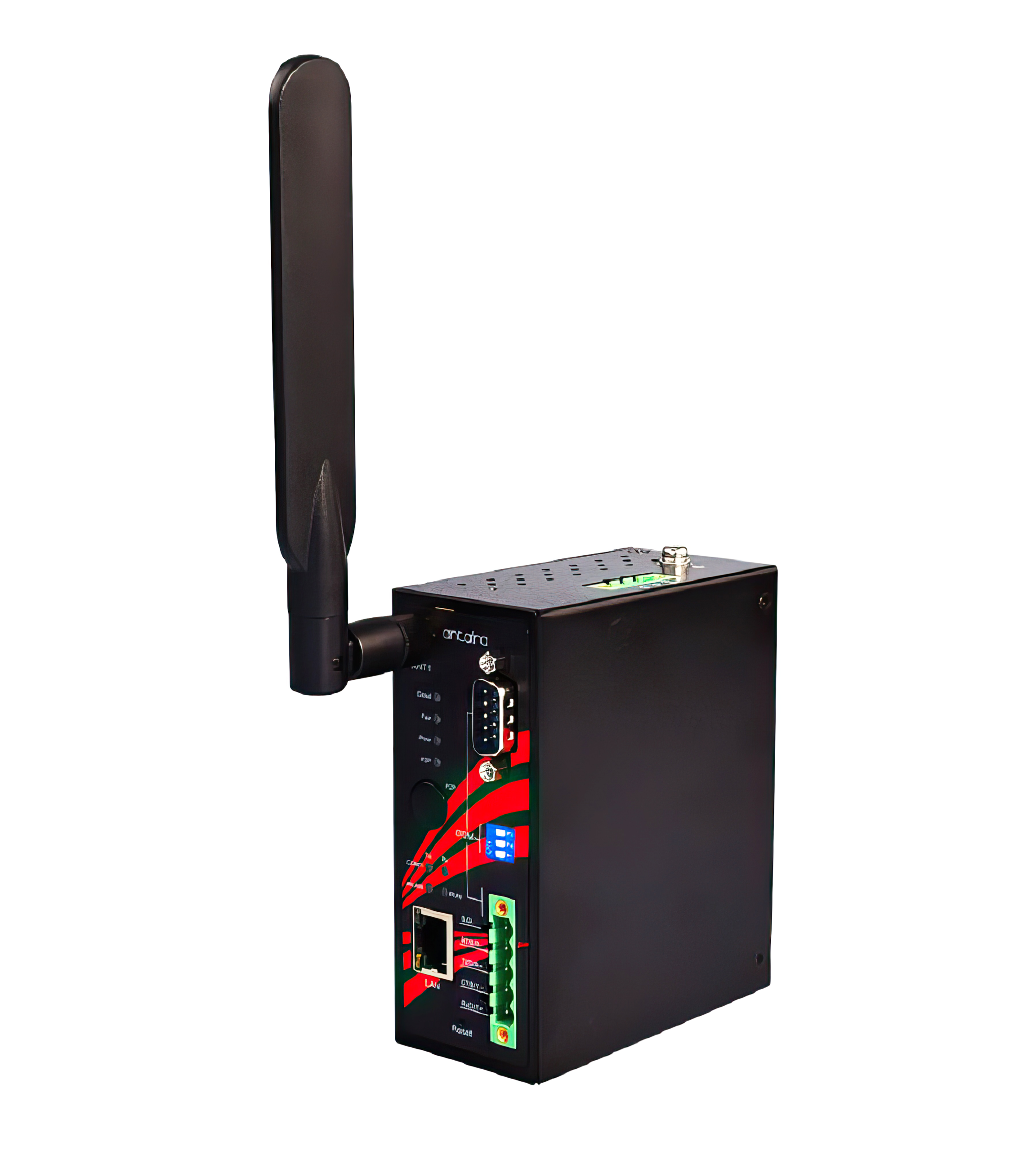
Antaira Technologies has introduced two rugged serial-to-wireless devices designed to connect legacy controllers, sensors, meters, and other serial equipment to industrial IP networks without installing a new Ethernet cable.
The STW-611C provides one software-selectable RS232, RS422, or RS485 serial port, while the STW-612C provides two. Both models also include a 10/100Tx RJ45 Ethernet connection and IEEE 802.11b/g/n wireless communication in the 2.4GHz band.
A bridge mode allows serial equipment and an Ethernet device to communicate across the same wireless network. The arrangement combines serial, wired Ethernet, and Wi-Fi connectivity within one compact device, allowing equipment from different generations to share a common network route.
Both models support Wi-Fi Direct for point-to-point connections. A button-based setup process establishes a direct wireless link without requiring the devices to join an existing access point or depend on a wider plant network.
Serial data rates from 110bps to 921.6Kbps are supported, while network modes include Virtual COM, TCP server or client, UDP server or client, and tunnelling. Those options allow the devices to connect with supervisory systems, data acquisition software, remote maintenance tools, and equipment using conventional serial communications.
Configuration can be completed through an integrated web console or Antaira’s Windows utilities. A browser interface reduces dependence on proprietary programming equipment, although administration still requires controlled credentials and appropriate access restrictions.
Each device is housed in an IP30-rated aluminium enclosure and is designed to operate between -10°C and 60°C. Power is supplied through a 9VDC to 48VDC input with reverse-polarity protection, while installation uses standard DIN rail mounting with optional wall mounting.
Wireless protection includes WPA, WPA2, and 802.1X authentication. Both models are available through Antaira’s distribution network and carry a five-year warranty.
Serial equipment remains embedded throughout industry
Although industrial communications are increasingly based on Ethernet, edge computing, and cloud-connected equipment, large quantities of operational hardware continue to rely on serial interfaces. PLCs, drives, barcode readers, weighing systems, energy meters, building controls, and laboratory instruments can remain in service for decades.
Replacing such equipment solely to obtain a network connection is often difficult to justify. A machine or instrument may continue performing its primary function reliably, while replacement introduces downtime, revalidation, retraining, and the risk that a new device will not communicate correctly with the surrounding process.
A serial server separates the communications upgrade from the operating equipment. Data received through RS232 or RS422/485 can be packaged for transmission across an IP network, allowing software elsewhere in the facility to reach a device originally designed for a local cable connection.
Wireless connectivity extends that approach into areas where pulling Ethernet is expensive or disruptive. Existing plants may contain congested cable routes, inaccessible production areas, temporary installations, rotating equipment zones, or buildings where new containment and civil work cost considerably more than the communications hardware.
The 2.4GHz band offers broad compatibility and generally stronger penetration than higher-frequency Wi-Fi, but factories remain difficult radio environments. Metal machinery, racking, process vessels, moving vehicles, electrical noise, and changing inventory can reflect or absorb signals.
A wireless survey is consequently required before installation. Antenna position, channel selection, interference, network loading, and the movement of equipment or stock can all affect reliability once the plant is in production.
The use of 802.11b/g/n favours compatibility and range over the higher throughput available from newer Wi-Fi generations. Serial applications rarely require substantial bandwidth, although network managers must ensure that support for older wireless modes does not weaken the configuration of shared infrastructure.
Cyber security requires particular care because many serial devices were designed before authentication and encryption became standard industrial requirements. Connecting an older controller to an IP network simplifies remote monitoring while increasing the number of routes through which it can be reached.
WPA2 and 802.1X provide useful wireless protection, but secure deployment also requires network segmentation, restricted administrative access, changed default credentials, and the removal of unnecessary services. Remote access routes should be documented and incorporated into the site’s maintenance procedures.
Point-to-point Wi-Fi Direct can simplify temporary service activity or links between isolated devices. Authentication must still be managed, while commissioning teams need to confirm that temporary connections are removed when work is complete.
The broad voltage input and DIN rail format suit installation in control cabinets, although the IP30 enclosure does not protect against water or fine dust ingress. Equipment used in harsher locations will require a suitably rated cabinet, together with appropriate power, temperature, and antenna arrangements.
Remote troubleshooting can reduce travel to hard-to-reach equipment, particularly where a meter, sensor, or controller already exposes useful diagnostic data through its serial interface. Configuration changes should nevertheless remain subject to the same operational controls used for direct physical access.
Industrial digitalisation rarely replaces every generation of control equipment at once. Engineers instead connect devices designed under several communications standards, preserving reliable machinery while adding the visibility required by newer monitoring and management systems.
The STW-611C and STW-612C provide another bridge between those generations. Their performance will depend less on headline data rate than on stable radio coverage, disciplined network configuration, and the ability to provide access without introducing an unreliable or poorly controlled layer into the production system.