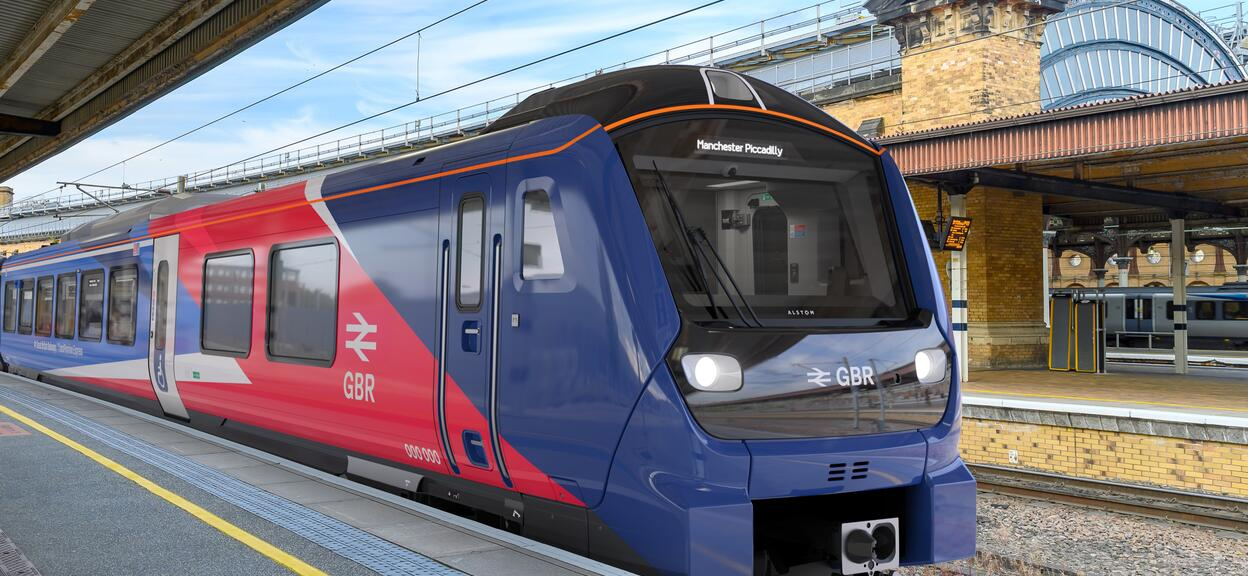
Alstom has signed contracts worth more than €1.2 billion with TransPennine Express for 29 five-car battery-electric trains, long-term maintenance, and charging infrastructure, securing a major manufacturing programme for its Litchurch Lane works in Derby.
The package combines a rolling-stock order valued at about €930 million with maintenance agreements worth around €230 million. The fleet will be the first UK deployment of Alstom’s Adessia Stream platform and is intended to replace part of TransPennine Express’s Class 185 diesel fleet on routes across northern England.
Battery operation is central to the specification because the network mixes electrified and non-electrified sections. Alstom will install charging infrastructure at Hull, Scarborough, and Saltburn so trains can replenish batteries during normal operations rather than depend on continuous overhead electrification. The company says this will be the first such charging deployment on the UK mainline network.
Design, engineering, manufacture, and testing will take place at Derby Litchurch Lane Works. Production is expected to begin in 2028, with deliveries starting from 2032 and passenger service targeted from winter 2034.
The order is expected to support more than 350 skilled jobs in Derby and over 5,500 roles across Alstom’s UK supply chain. The company also expects at least £360 million of spending with British suppliers. More than 100 jobs are linked to the initial eight-year maintenance agreement, which includes an option for a further eight years.
Training forms part of the programme. Alstom says it will support at least 36 apprentices and 36 T Level students over the contract, adding a skills pipeline to work that will run from detailed engineering and industrialisation through assembly, testing, delivery, and fleet support.
Rob Whyte, Managing Director UK at Alstom, said: “The fleet will transform journeys across northern England while showcasing the very best of British engineering, innovation and advanced manufacturing.”
The 121-metre trains will operate at up to 110mph and provide around 300 seats. They will include level boarding at every door, three wheelchair spaces, accessible toilets, luggage and cycle storage, passenger information systems, Wi-Fi, air conditioning, and onboard power and USB-C charging.
Alstom says the full-length level-boarding design should allow unassisted boarding at 85% of existing UK station platforms. Building accessibility into the vehicle geometry can reduce dependence on station-side interventions while shortening boarding and alighting times on routes where timetable performance is already constrained by busy platforms and mixed stopping patterns.
The engineering challenge extends beyond fitting batteries beneath a train. The fleet has to operate across mixed infrastructure, deliver sufficient range for long regional diagrams, recharge within normal operating constraints, and retain the performance needed on heavily used routes. Charging equipment therefore sits inside the same turnkey package as the rolling stock and maintenance rather than being left as a later infrastructure exercise.
Alstom developed the Adessia platform for the UK after a three-year research programme and £35 million of investment. The design evolves from the Aventra family and can be configured for different traction systems, with battery-electric operation aimed at routes where complete electrification is absent or would require substantial additional infrastructure.
The programme also connects with the Transpennine Route Upgrade, where infrastructure work is intended to increase capacity and reduce journey times between major northern cities. The Department for Transport expects the new trains to contribute to capacity growth of around 30% across the Pennines by the early to mid-2030s, with journey-time reductions of up to 10 minutes between Manchester and Leeds and up to 14 minutes between Manchester and York.
Rock Rail will buy the fleet and lease it to TransPennine Express. That financing structure separates ownership from operation while giving Alstom a long production and service pipeline. Continuity between major orders is particularly valuable at rolling-stock plants, where specialist labour, tooling, and suppliers cannot be switched on and off cheaply between programmes.
The contract will be booked in Alstom’s second quarter of the 2026/27 financial year. With manufacturing due to start in 2028, the immediate work now moves into detailed design, supplier mobilisation, and industrial planning well before the first completed train leaves Derby.