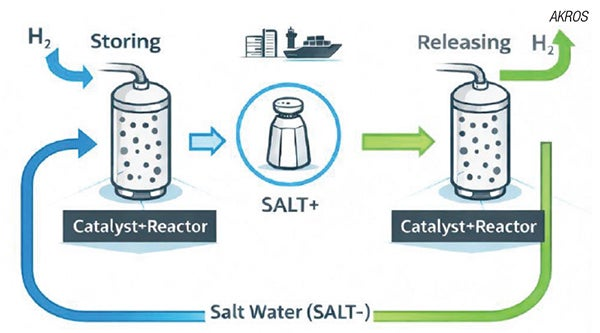
AKROS Energy is demonstrating an integrated hydrogen storage and release process in Germany using an aqueous potassium bicarbonate system that chemically binds hydrogen into potassium formate.
The pilot facility at Laage is designed to show hydrogen uptake, liquid-form storage, and controlled release in one end-to-end system. The process uses hydrogen gas and potassium bicarbonate solution in a proprietary fixed-bed reactor and catalyst system operating below 30 bar. Hydrogen is chemically bound into a liquid potassium formate carrier, then released when the formate is passed back through the reactor at around 60°C.
The system’s carrier is recycled in a closed loop, with the bicarbonate solution regenerated after hydrogen release. AKROS positions the technology as a safer and less complex alternative to high-pressure tanks, cryogenic liquid hydrogen, ammonia, and some liquid organic hydrogen carrier systems. The company says the process uses non-toxic and non-flammable materials and avoids byproducts or waste under the closed-loop design.
The current pilot has a throughput capacity of about 3kg of hydrogen per hour. Engineering work has also begun toward a 100kg per hour plant, indicating that the company is already looking beyond laboratory demonstration toward larger industrial equipment.
The project is part of the FormaPort research and development consortium and includes partners such as Evonik and Siemens. That involvement gives the pilot an industrial process base, because hydrogen storage is not only a chemistry problem. Commercial deployment also requires reactors, catalyst systems, pumps, controls, heat management, safety cases, materials compatibility, maintenance strategies, and integration with electrolysers, industrial users, transport systems, or grid balancing applications.
Hydrogen infrastructure remains constrained by the difficulty of storing and moving the gas economically. Compressed hydrogen requires pressure vessels and associated safety systems. Liquid hydrogen requires cryogenic temperatures. Ammonia has an established logistics base, but introduces toxicity, cracking requirements, and handling constraints. LOHC systems can use liquid logistics, although they typically require higher temperature release and additional process complexity.
AKROS’ salt-based approach is aimed at a different operating window: long-duration storage and transport under milder conditions. The practical challenge is whether the system can combine safety, efficiency, low cost, sufficient hydrogen density, fast response, and scalable equipment. Those variables will decide whether the technology becomes a niche storage option or a wider part of hydrogen infrastructure.
Energy engineering is moving toward more integrated systems, where low-carbon equipment is judged by its connection burden as well as its own performance. Microgrids, storage, hydrogen, and power conversion technologies displayed at The Smarter E Europe showed how industrial energy users are having to manage generation, storage, conversion, control, and demand together. That integrated energy infrastructure context is central to hydrogen: the equipment only has value when it can operate inside a reliable industrial system.
The AKROS pilot is particularly relevant to process engineering because it shifts hydrogen storage into familiar chemical plant territory. Fixed-bed reactors, catalyst performance, liquid handling, thermal management, closed-loop operation, and scale-up all sit within established process disciplines. That does not make the technology simple, but it gives its industrialisation route a recognisable engineering structure.
Safety could influence adoption. Industrial users are cautious around hydrogen because of leakage, flammability, embrittlement, compression, and permitting requirements. A liquid carrier that stores hydrogen without high pressure or cryogenic temperature could reduce some operational barriers, although full validation would still be required at commercial scale.
The technology also addresses the long-duration storage problem. Batteries are effective for short-duration balancing, but seasonal storage, industrial backup, and large-scale energy shifting require different economics. Hydrogen is often proposed for those roles, yet storage and transport remain weak points. Salt-based systems could support renewable integration, industrial supply, and distributed hydrogen logistics if they can deliver low cost over multi-day or longer storage periods.
The planned 100kg per hour plant will be a critical step. A 3kg per hour pilot can prove the chemistry and integrated operation, but commercial users will look for evidence on energy consumption, catalyst life, carrier degradation, maintenance, footprint, control response, purification requirements, and total cost. Hydrogen has no shortage of storage concepts; integrated pilot work is where the engineering trade-offs become visible.