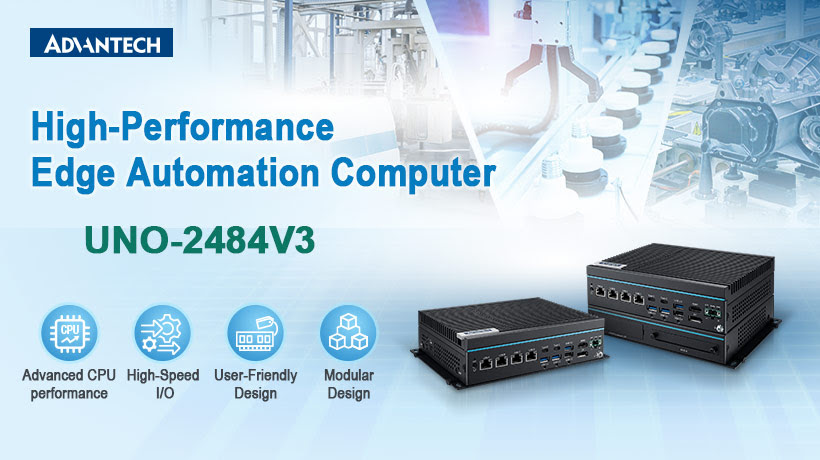
Advantech has launched the UNO-2484V3, a fanless industrial edge computer designed for machine automation, data acquisition, industrial control, and edge analytics. The platform updates the company’s modular UNO-2000 family with Intel Core Ultra processing and a wider mix of industrial I/O.
The system is built around Intel Core Ultra processors and supports up to 64GB of DDR5 memory. Advantech positions the platform for applications requiring greater local compute capability than a conventional embedded controller, including workloads that combine control, data handling, visualisation, and AI-assisted analysis at the edge.
Four Gigabit Ethernet ports provide network connectivity, while serial interfaces support connection to industrial equipment using established protocols. The system also provides multiple display outputs, allowing it to support local human-machine-interface functions alongside data-processing or gateway duties.
Storage expansion is handled through M.2 and 2.5-inch drive options, giving users scope to separate operating-system storage from application data or local logging. That matters in industrial systems where continuous data capture can create larger storage requirements than the control application itself.
The fanless design removes a common maintenance item from the enclosure and is intended to support deployment in dusty or vibration-prone environments where conventional office computing hardware would be unsuitable. Thermal management still depends on enclosure design and installation conditions, but eliminating a cooling fan reduces one mechanical failure mode.
Advantech has retained the modular expansion approach used across the UNO family. That allows system integrators to add interfaces or communications functions without redesigning the entire computing platform, which can be useful where one controller has to support several machine variants or customer-specific fieldbus requirements.
The move to Core Ultra processing also reflects a wider shift in industrial edge computing. More analytics are being moved closer to machines and production lines to reduce latency, limit the amount of data sent to cloud systems, and maintain operation when external connectivity is unavailable.
For automation users, that does not make the industrial PC a replacement for a PLC in every application. Deterministic control, safety functions, and machine interlocking may still remain on dedicated controllers, while the edge computer handles higher-level data processing, visualisation, protocol conversion, or AI workloads alongside them.
That division of labour is particularly relevant where existing production equipment is being upgraded rather than replaced. An edge computer can collect data from legacy serial devices, Ethernet-connected controllers, sensors, and vision systems, then process or forward that information without forcing a complete controls migration.
Advantech lists multiple display and communications interfaces for the UNO-2484V3, although exact configurations vary by model and expansion choice. Buyers therefore need to check the required port mix against the specific SKU rather than treating the platform-level specification as universal across every configuration.
Industrial deployment also places more emphasis on lifecycle and qualification than commercial PCs typically require. Component availability, operating-temperature limits, storage endurance, mounting, electromagnetic compatibility, and long-term support can all affect whether a system remains viable across the service life of the machine it is installed in.
The platform’s storage options allow integrators to choose between compact solid-state configurations and larger local capacity. That can support applications where machine data, images, logs, or AI models need to remain on site for operational or cybersecurity reasons rather than being transferred continuously to external infrastructure.
Advantech is targeting the UNO-2484V3 at factory automation, intelligent equipment, machine vision, and industrial IoT deployments. Its value will depend less on processor specification alone than on whether the combination of networking, serial connectivity, expansion, storage, and thermal design matches the installed environment.
The launch continues a broader move towards more capable industrial edge platforms positioned between dedicated controls and central IT infrastructure. By increasing local compute performance while retaining industrial connectivity and fanless construction, Advantech is aiming to make that middle layer more capable without turning it into a general-purpose office computer.