British robotics software developer Path2 is developing a browser-based engineering platform combining industrial robot cell design with automated programme generation, targeting the cost and complexity associated with introducing robotic automation into smaller manufacturing operations.
Founded by chartered engineer and machinery safety specialist Sam Reynolds, Path2 has demonstrated its software using a KUKA KR 210 R2700 extra industrial robot, progressing from an empty virtual workcell layout to a functioning palletising cycle in 19 minutes.
The demonstration involved recreating the digitally designed cell within a workshop and transferring the generated programme to the physical robot. No manually written KUKA Robot Language (KRL) code, positions taught using the robot’s pendant, or subsequent programme modifications were required, according to Path2.
The software remains under development, with the company recruiting beta testers to assess its performance using physical robots and established simulation environments.
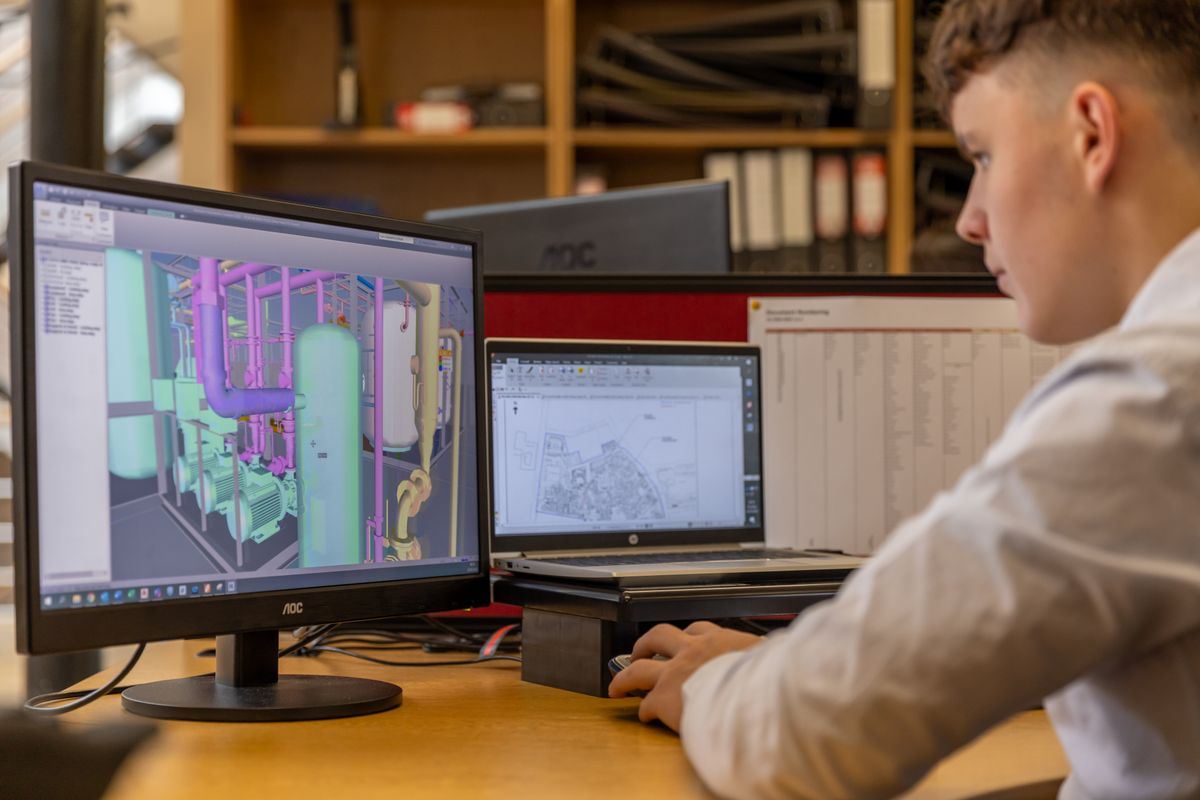
Users can arrange robots, conveyors, pallets, and surrounding equipment within the browser-based design environment, establishing the geometric relationships needed to generate movements and operating sequences.
Palletising applications typically require a robot to collect products from a defined position and place them according to a predetermined stacking arrangement. Product dimensions, orientation, pallet size, and the configuration of successive layers determine the positions the robot must reach throughout the operating cycle.
Translating these requirements into executable code involves establishing the relationship between the robot’s base, its end effector, and the equipment surrounding it. Coordinate systems provide a means of representing those relationships mathematically, allowing movements to be defined relative to the robot itself or another reference within the workcell.
A robot controller calculates the joint configurations needed to position and orient its tooling at a specified location. Several configurations may be geometrically possible, with the appropriate selection depending on joint travel, nearby equipment, and the movements required between consecutive positions.
Generating programmes directly from a virtual cell layout can reduce repetitive engineering work, particularly where an application involves predictable product movements and regular stacking arrangements.
Path2 currently supports KUKA equipment within its three-dimensional cell builder, while its separate palletising programme generator also produces ABB RAPID code tested using RobotStudio. The company intends to extend its cell design environment to ABB equipment before adding further robot manufacturers.
Supporting several robot platforms requires more than translating instructions between programming languages. Controllers can implement coordinate transformations, movement commands, acceleration settings, and communications with external equipment differently.
Individual robots also have different reach envelopes, payload capacities, and joint travel limits. A layout developed around one machine may require substantial changes before another robot can complete the same operating sequence.
The selection of handling equipment introduces further design constraints. Vacuum grippers and mechanical gripping systems have different requirements for controlling and monitoring the transfer of individual products, while the weight of both the end effector and the handled item contributes to the robot’s effective payload.
Acceleration, deceleration, and changes in orientation influence the forces generated during movement. A programme must account for the capabilities of the physical equipment rather than relying solely on whether a particular position falls within the robot’s theoretical reach.
Coordination with conveyors and other production machinery also requires signals establishing when individual operations can proceed. Sensors may confirm that a product has arrived at the collection position, while communications between controllers govern the interaction between robotic handling and adjacent equipment.
Generating the robot programme within the cell design environment allows geometric and operational information to be developed together, reducing the need to transfer those details manually between separate engineering tools.
Path2 intends to provide supporting engineering packages alongside its generated programmes, including layout drawings, component lists, electrical and input/output documentation, safety requirements, and acceptance testing records.
Its reference design package is identified as a concept design rather than documentation approved for construction. Engineers must establish the suitability of the selected equipment and complete the necessary application-specific assessments before proceeding with physical installation.
The distinction is particularly important when defining the protective measures required around industrial robots. Guarding, interlocks, protective devices, and safety-related control functions must correspond to the risks associated with the completed workcell.
Physical installation also requires calibration and verification of the relationships between the robot, its tooling, and surrounding machinery. Differences between actual equipment positions and their digital representations can affect the accuracy of movements generated by the software.
Path2’s 19-minute demonstration therefore represents the time taken to develop and execute a particular palletising cycle, rather than the full engineering and commissioning period for an industrial robot installation.
The beta testing programme will provide further opportunities to establish how reliably its programme generation methods transfer between different cell configurations and operating environments as the company expands support beyond its initial KUKA implementation.