The Munich industrial technology company Vetaion has raised €5.7 million in pre-seed funding to expand production of custom electrical control cabinets using integrated digital design and robotic manufacturing. Its approach converts conventional electrical schematics into spatial manufacturing data, addressing the difficulty of automating products whose layout, components and wiring vary from one order to the next.
The investment was co-led by Visionaries Tomorrow and UVC Partners, with backing from 2100 Ventures, Viessmann Generations Group and angel investors. Vetaion plans to use the money to expand production in Garching near Munich, recruit staff and develop further automation. The company is integrating its manufacturing operation with software and robotics development rather than marketing a standalone design application.
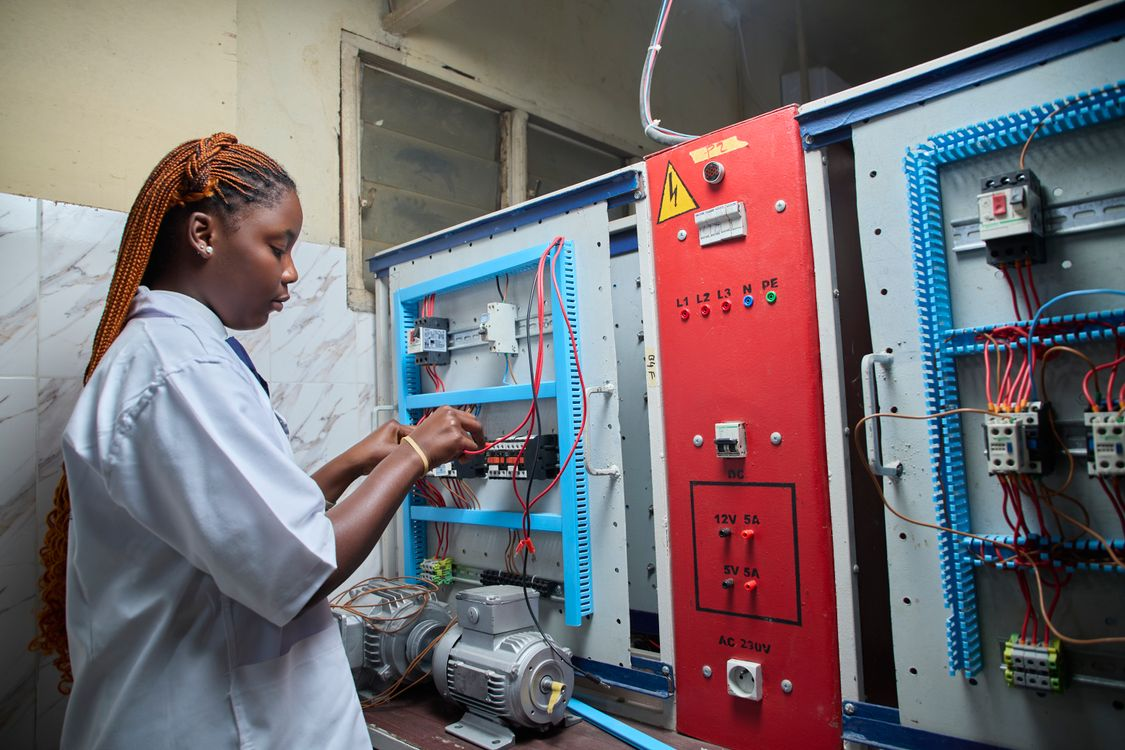
An industrial control cabinet has to accommodate protective devices, power distribution, controllers, drives and terminal connections within the clearances and layout defined by its application. Hundreds of conductors may connect those devices to motors, sensors and control circuits. The combination of electrical requirements, enclosure dimensions and client-specific equipment makes identical production runs unusual even when the underlying functions are similar.
That product variation makes conventional fixed automation difficult. A machine set up for one repetitive assembly sequence can lose its productivity advantage when mounting positions, component types and cable routes change for each new cabinet. Many suppliers therefore use digital electrical design software but retain manual installation, wiring, inspection and documentation steps. The resulting process combines repetitive work with a high requirement for accurate interpretation of drawings.
Vetaion converts two-dimensional electrical schematics into a three-dimensional model that identifies the cabinet layout and component positions. The model is intended to supply the spatial information required for automated assembly and, eventually, wiring, rather than leaving each drawing to be interpreted afresh by a skilled builder. The company is developing the robotics in-house and uses VetaionOS to coordinate work on customised, single-unit production orders.
The proposed production sequence relies on that digital model remaining consistent through each stage. A change to a terminal strip or protective device affects mounting, clearance, wire length and potentially the routing of neighbouring conductors. If the physical build no longer matches the validated model, downstream robotic movements and quality checks can become unreliable. Keeping revisions controlled across engineering and production is consequently as important as the robot hardware itself.
The robotics programme focuses on positioning components and making electrical connections, tasks that present different challenges. Rigid devices can be located against known mounting coordinates, but flexible conductors may bend, move and obstruct neighbouring parts. Vetaion is developing machinery and software to deal with both operations. Its investor account does not establish that every cable and cabinet configuration can already be wired autonomously.
Vetaion says its lead times have fallen from several months to fewer than four weeks and that the manual labour required has been reduced to around one tenth of conventional work. It also claims to provide a firm quotation within 24 hours when a suitable PDF schematic and spreadsheet bill of materials are supplied. These are company-reported operating figures, not independently measured results for every cabinet configuration; parts availability, test requirements and design revisions can still affect delivery.
Electrical compliance documentation must remain consistent with the finished cabinet. When schematics, assembly instructions and inspection results refer to the same design revision, builders can trace the components fitted, terminal connections made and checks completed. This is especially important where a late engineering change alters conductor routes or protective devices. Accurate component placement alone does not establish that the finished assembly meets its required electrical and mechanical specifications.
The production approach depends on translating each new design into machine instructions without recreating the entire assembly programme by hand. That could make small, mixed orders easier to process, but only if the system can handle exceptions when a specified component, conductor route or mounting feature differs from the digital model. Physical inspection and electrical verification remain necessary regardless of how many assembly operations become automated.
Vetaion’s engineering staff work immediately above its Garching production floor, giving the development team access to fabrication, wiring and inspection problems encountered on customer jobs. Those feedback cycles can expose differences between the model and actual components that would otherwise require manual intervention. They also make the company responsible for quality, procurement, delivery and electrical verification while it develops more automated production methods.
Vetaion’s next expansion will test whether a larger volume and wider variety of customer cabinets can be built with the same traceability and electrical compliance. Its Garching factory gives the company direct access to fabrication, wiring and inspection data as the software develops. The €5.7 million round finances that scale-up; the remaining engineering challenge is repeatable machine operation on products whose component and conductor layouts change from order to order.