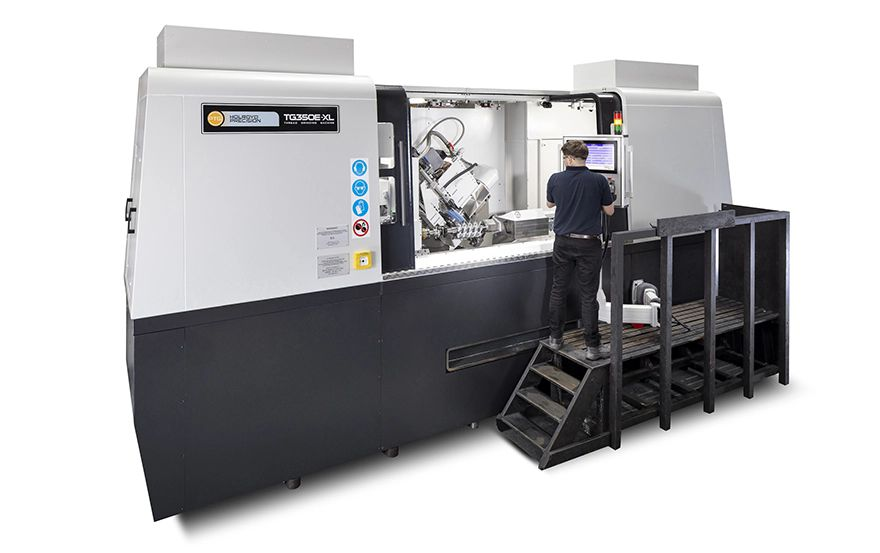
PTG Holroyd Precision Rotors has expanded its manufacturing capabilities in Spartanburg, South Carolina, with the installation of a UK-built TG50E grinding machine for smaller helical rotors and pump screws.
The additional equipment enables the US facility to process a broader range of component sizes while allocating its larger grinding machines to heavier work. PTG has identified increasing demand for smaller precision components used in compressors, pumps and related industrial machinery.
The TG50E was manufactured by PTG Holroyd Precision in the United Kingdom and installed at its sister company’s existing Spartanburg operation. The investment brings another specialist grinding capability into the group’s US component manufacturing business.
Previously, larger equipment was required to accommodate work across a wider range of dimensions. The additional machine allows smaller components to be produced on equipment selected for their size, while leaving greater capacity on the larger machines for workpieces that require their available dimensions and handling capability.
Those larger machines can concentrate on screws measuring 100mm in diameter and above. Depending on the component profile and geometry, the facility can manufacture helical screws up to 420mm in diameter and weighing as much as 700kg.
The range of component sizes reflects the differing requirements of industrial compressor and pumping systems. Small machines may use compact rotors manufactured to demanding tolerances, while larger industrial equipment can require substantial components with correspondingly greater material removal and handling requirements.
Helical rotors have a spiral geometry running along their rotational axis. In a screw compressor, matching rotor profiles operate together within a housing to move and compress the working fluid as the shafts rotate.
The relationship between the profiles is important to the equipment’s performance. Clearances, surface finish and dimensional accuracy influence how the rotors interact with each other and the surrounding housing during operation.
Manufacturing these components requires equipment capable of generating the specified helical form. Unlike a simple cylindrical grinding operation, the process involves controlled relationships between the workpiece’s rotation and the movement of the grinding wheel along its axis.
The machine must maintain that relationship while following the intended profile. Variations in workholding, positioning or grinding conditions can affect the geometry of the finished component, particularly where the required clearances are small.
Grinding may be used during finishing or as part of a wider component manufacturing sequence, depending on material properties and the amount of stock requiring removal. The process must be selected around the component’s specification rather than assuming that every rotor requires identical machining operations.
Smaller helical components introduce their own manufacturing constraints. The relationship between the workpiece, grinding wheel and available machine movements affects tool access, while component dimensions influence workholding arrangements and the suitability of the equipment.
The TG50E provides a dedicated production route for this work. Its installation allows PTG to separate smaller rotor orders from the heavier components produced on existing machines.
That distinction can improve scheduling flexibility where a manufacturing facility handles varied customer orders. When components of several sizes require the same machine, preparation and processing work must be coordinated around the capabilities and availability of that equipment.
Allocating smaller workpieces to a dedicated grinder can reduce competition for larger machines. It may also allow different orders to proceed in parallel, although the resulting increase in output depends on staffing, tooling, machine utilisation and other stages of the manufacturing process.
PTG has not published a quantified throughput improvement or a capital expenditure value for the installation. The confirmed development is an expansion of manufacturing capability and the division of work between different machine sizes.
Mark Curran, sales director at PTG Holroyd Precision, has linked the investment to growing demand for smaller precision components in North America. Applications identified by the company include compact air and refrigeration compressors and positive displacement pumps.
In positive displacement pumping, helical screw components can be used to move liquids or gases through a controlled mechanical arrangement. The geometry and material of a component must be appropriate for the working fluid, operating conditions and intended duty of the equipment.
Refrigeration compressors impose different requirements, including the need to operate with the relevant refrigerant and lubricant under specified pressures and temperatures. Component design and manufacturing accuracy therefore depend on the particular compressor system.
These variations create demand for specialist manufacturers able to produce different screw profiles and dimensions. A single standard component cannot meet every compressor or pump specification, making flexibility in machine setup and process control important for suppliers serving several equipment manufacturers.
PTG’s operations connect machine tool development with the production of precision components. The UK business manufactures specialist grinding technology, while its rotor manufacturing activities use such equipment to produce parts for industrial customers.
This relationship provides a route for applying machine tool capabilities within operating production facilities. Experience gained through the manufacture of customer components can also inform the assessment of equipment requirements, although PTG has not announced a specific new development programme arising from the Spartanburg installation.
The group maintains manufacturing and engineering activities across the UK, US and China. Its American rotor business serves demand in the North American market, where customers require specialist helical components for machinery used across several industrial sectors.
As with other precision manufacturing operations, the finished component must satisfy its drawing and quality requirements regardless of the machine used. Process stability, inspection and accurate setup remain necessary when transferring work between different grinding systems.
The TG50E adds a dedicated capability for smaller rotors while preserving the Spartanburg facility’s existing capacity for large industrial screws. Its contribution to future deliveries will depend on the mix and volume of customer orders processed across the expanded equipment range.