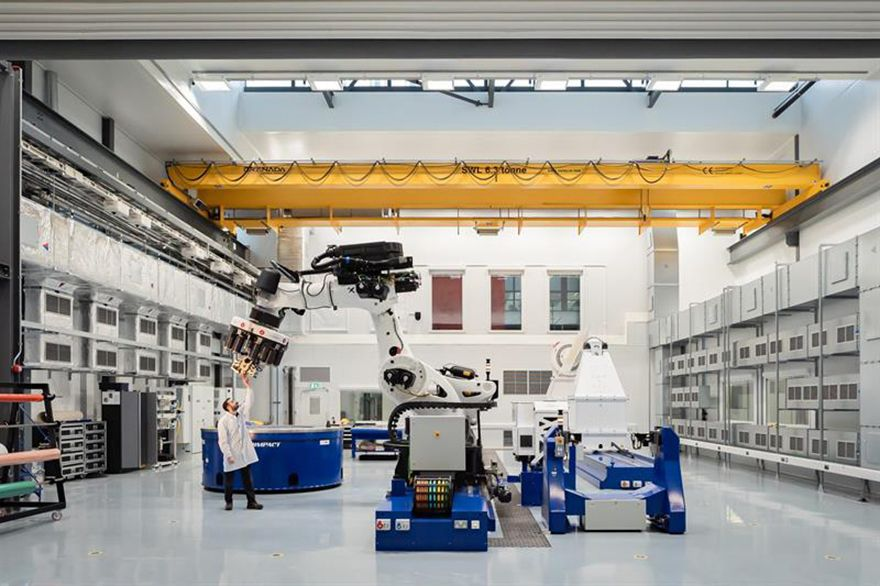
Rapid Fusion is developing a large-format robotic additive manufacturing cell with integrated layer heating technology from German specialist LEAM, targeting improved control of the bonding conditions encountered when printing high-performance engineering polymers.
The companies presented their collaboration at Formnext in Frankfurt on 18 November. Rapid Fusion plans to launch the Prometheus cell in early 2027, incorporating a newly developed extruder, a localised heating nozzle and temperature sensing equipment.
The development follows earlier work between Rapid Fusion and LEAM on retrofitting heating technology to existing robotic printing systems. Prometheus will instead incorporate the heating and sensing arrangement into the machine’s design, allowing the companies to coordinate its physical configuration and control functions from the outset.
Rapid Fusion is based at Skypark in Exeter and supplies additive manufacturing technology and services. The new system is intended for applications in aerospace, maritime engineering, oil and gas, and other industries manufacturing large polymer components and tooling.
Localised heating addresses a central challenge in material extrusion printing: the condition of the interface between a newly deposited bead of polymer and the material already in place. As material leaves the extruder, it begins to lose heat, while the preceding layer may have cooled considerably before the next pass is made.
The temperature at which the two deposits meet influences the opportunity for polymer chains to move and develop bonding across the interface. Insufficient thermal contact can weaken that connection, while poorly controlled heating may affect the shape and stability of the deposited material.
The process becomes more difficult as component dimensions increase. A robotic print head may travel over a large structure, with substantial differences in the time between successive deposits at different positions on the part.
These variations can create changing thermal conditions along the manufacturing path. The geometry of the component, deposition speed and surrounding environment can also affect how quickly material cools before the next layer is applied.
LEAM’s approach applies heat locally near the deposition interface. Temperature sensing provides information intended to help control the heating process as the machine moves through its programmed path.
The objective is to maintain more suitable bonding conditions without depending entirely on heating the surrounding manufacturing environment. Its effectiveness will depend on the material, print geometry, deposition parameters and the responsiveness of the control arrangement.
Rapid Fusion and LEAM have designed a new extruder architecture to accommodate the heating nozzle and its associated equipment. This is a departure from fitting the technology to an existing print head after the principal machine design has already been established.
Integrating the components at the design stage allows attention to be given to tool access, sensor positioning, cabling, control interfaces and the space available around the deposition point. These considerations influence how reliably the heating equipment can operate alongside the extruder during complex robotic movements.
The system is being developed for high-performance thermoplastics including polyether ether ketone (PEEK) and polyetherimide (PEI). These materials offer properties suited to demanding engineering applications, but their processing requirements can be more challenging than those of lower-temperature polymers.
Maintaining the required temperature conditions across large printed structures is particularly important when a component contains long deposition paths or significant changes in wall thickness and geometry. Cooling and contraction can also influence dimensional stability during manufacture.
Local heating provides an additional process control method, although the developers have not published independent comparative data quantifying improvements in tensile strength, interlayer adhesion or dimensional accuracy from the Prometheus arrangement.
Any claims concerning the performance of production components will therefore depend on testing under defined conditions. Results obtained with one material, geometry or deposition strategy cannot automatically be applied to every component manufactured using the machine.
The companies are also exploring production methods that could reduce material consumption, including the manufacture of thinner-walled structures. The suitability of such designs depends on the loads, geometry and service requirements of the finished component.
Wall thickness affects mechanical behaviour, and reductions must be assessed through appropriate design calculations and testing. A change that reduces material consumption in a non-structural tool may not be suitable for a component subject to demanding mechanical or thermal conditions.
Rapid Fusion has also identified the potential to interrupt a build for the insertion of additional elements before printing resumes. Such sequences require the deposition process to accommodate the position of the inserted component and the condition of the surrounding printed material.
Restarting material deposition after an interruption can create a different thermal interface from continuous printing. Managing that interface will be relevant when assessing whether the resulting structure meets its intended requirements.
Prometheus forms part of Rapid Fusion’s wider development of robotic additive manufacturing systems. Earlier in November, the company was covered in connection with a hybrid manufacturing cell installed at Kingston University, a separate project combining additive technology with other manufacturing capabilities.
The LEAM collaboration concentrates on control of the polymer deposition process rather than representing another announcement of that university installation. Both developments reflect different aspects of the engineering required to move robotic additive manufacturing towards broader industrial applications.
Commercial interest has been reported ahead of the new system’s launch. Rapid Fusion says customers have signed up for initial deliveries and expects the partnership to generate more than £2 million in combined revenue over the next two years.
That figure is a forecast based on anticipated business rather than revenue already generated. The company has not disclosed a confirmed installed base, production rate or independent performance assessment for Prometheus.
The planned early 2027 introduction will provide an opportunity to evaluate the integrated extruder and heating arrangement in complete manufacturing operations. Process validation, repeatability and the behaviour of printed parts under their intended service conditions will determine the range of applications suitable for the technology.