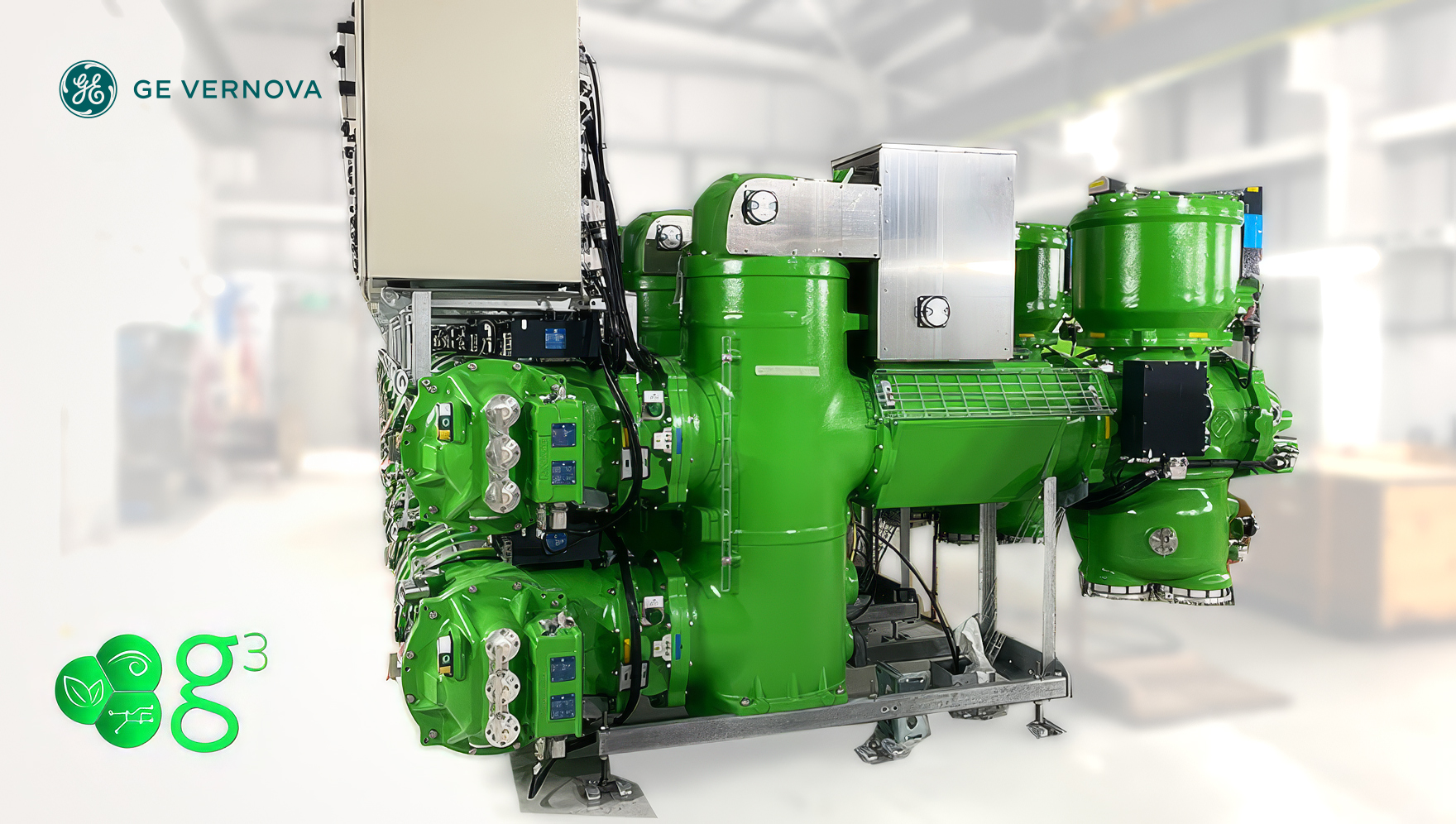
GE Vernova has introduced HYpact-145g, a compact hybrid switchgear system rated for electrical networks up to 145kV and using an alternative insulating gas in place of sulphur hexafluoride (SF₆). Designed for a short-circuit breaking current of 40kA, the unit combines several switching and isolation functions within an integrated assembly intended to use less space than conventional air-insulated equipment.
Unveiled in Cologne on 17 November, the product combines gas-insulated equipment with air-insulated connections. GE Vernova claims the arrangement can reduce the required footprint by at least 50% against a conventional air-insulated substation layout, depending on the installation. The comparison concerns equipment space under specified layout conditions; it does not establish that every site’s total land requirement, construction cost or building area will be halved.
The hybrid assembly incorporates a circuit breaker to interrupt fault current, disconnectors to isolate equipment and earthing switches for the appropriate safe working configuration. It can also accommodate current measurement and optional voltage measurement equipment. Integrating those functions reduces the number of separate components and external connections required between them, while the surrounding design must still preserve electrical clearances, accessible isolation and safe maintenance routes.
SF₆ has been widely used in high-voltage switchgear because it combines strong dielectric insulation with established switching performance. Its global warming potential, however, makes gas loss during handling, maintenance and decommissioning an important environmental concern. Replacing SF₆ requires an alternative insulation system that can meet the same specified fault-interruption, voltage-withstand and thermal duties over the intended operating conditions.
HYpact-145g uses GE Vernova’s g³ mixture of carbon dioxide, oxygen and a fluoronitrile additive, C₄F₇N, at a stated concentration of 3.5%. The supplier says this insulating medium reduces the gas mixture’s contribution to global warming by approximately 99% compared with SF₆. The comparison is between insulating gases, not between the total embodied or operational emissions of two substations. Materials, construction, transport, maintenance and end-of-life treatment remain part of any whole-installation assessment.
The switch to a different insulating medium changes some operating and maintenance considerations even when the main electrical ratings remain familiar. Gas compartments must remain properly sealed, with handling procedures and replacement parts appropriate to the specified mixture. Environmental performance also depends on avoiding losses during installation, service and eventual retirement. These considerations form part of the asset management programme alongside switchgear reliability, protection testing and network availability.
The published technical ratings include 3,150A continuous current, 40kA short-circuit breaking current and 100kA peak withstand current. The equipment has a three-second rated short-circuit duration, 650kV lightning impulse withstand rating and specified ambient operating range from minus 30°C to plus 40°C. Those limits provide a basis for network engineers to determine whether the unit is suited to a particular connection, protection scheme and expected fault level.
Space is often restricted at substations within industrial estates, cities and existing transmission corridors, where additional capacity must fit around live infrastructure. A compact bay can simplify parts of the civil design and reduce external interconnections, but the realised saving depends on busbar arrangements, foundations, access for replacement equipment, adjacent live circuits and provision for future work. Network owners must evaluate the complete layout rather than selecting by nominal equipment dimensions alone.
Optional low-power instrument transformers can provide current and voltage signals for digital protection and monitoring. Integrating these functions may reduce external cabling and equipment, although relay compatibility, communications interfaces, measurement accuracy and the overall protection design still need to be established. The supplier identifies the unit as suitable for modern digital substation configurations; that does not eliminate the need for project-specific engineering and acceptance testing.
GE Vernova plans to deliver the unit with factory-adjusted, tested and sealed gas compartments in a largely assembled form. It quotes installation and commissioning times as short as one to three days per bay under suitable conditions. Site preparation, lifting arrangements, cabling, protection tests and operational clearances can extend that period considerably, particularly when work takes place alongside energised equipment. The stated duration should be treated as a supplier capability rather than a universal project programme.
The development also sits within a broader change in how high-voltage equipment is specified. Network owners must assess prospective insulation-gas restrictions, spare-parts support, the ability to inspect and service sealed compartments and compatibility with their existing protection systems. Factory assembly can reduce on-site work, but it does not replace the design studies and operational procedures needed when a compact bay is integrated with an energised network.
HYpact-145g is available to order, with manufacture planned for GE Vernova’s Kassel plant in Germany. It extends an existing GRiDEA and g³ product portfolio rather than introducing the company’s first SF₆-free technology. Project adoption will depend on the required electrical ratings, network standards, physical layout and utility qualification process, alongside the practical work of integrating new equipment with existing substations.