Pulpex has secured a further £19.6m investment from the National Wealth Fund to accelerate deployment of its fibre bottle manufacturing technology. The 17 November investment follows the opening of the company’s first commercial factory near Glasgow on 8 October and is intended to support growth through international manufacturing licences.
The Scottish National Investment Bank is contributing another £4.4m, while existing investors are also participating. Together the new commitments total £24.6m, according to the National Wealth Fund. They follow the £62m Series D financing completed in February 2025, which helped fund construction of the Scottish factory. Construction financing and the latest licensing investment therefore relate to different stages of the company’s manufacturing expansion.
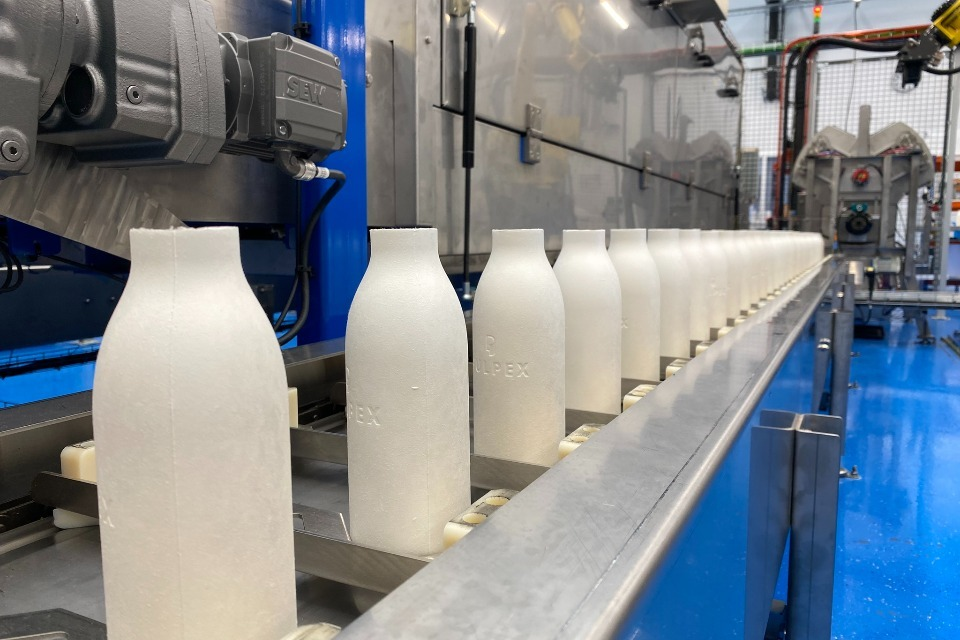
Pulpex’s Glasgow operation is fitted for initial production of up to 40 million bottles a year and has created approximately 39 skilled manufacturing jobs. The facility serves as the company’s first commercial production site and as a reference installation for other manufacturers that may take a licence to make the same packaging format in their own markets.
The bottle platform uses moulded wood pulp rather than conventional glass or plastic as its principal material. Pulpex says the finished container is designed to be recycled through existing paper and cardboard collection streams and engineered to deliver the barrier performance required for the products it contains. It also says the bottles can be used with existing filling infrastructure, an important qualification because a new container material can otherwise require expensive changes to downstream packing equipment.
Glasgow’s role as a licensing reference site depends on consistent bottle production across complete manufacturing and filling cycles. A commercial line has to produce repeatable shapes and dimensions, maintain acceptable material and barrier properties and allow filling, closure, handling and distribution at the required rate. Manufacturing tolerances influence how containers run through established machines, while the fibre structure and any barrier treatment determine whether the finished package is suitable for a particular liquid and shelf-life requirement.
Pulpex’s approach is to establish those production parameters at Glasgow and transfer a validated system to established packaging producers through its Manufacture Under Licence model. Rather than building and operating every factory directly, the company proposes to license its intellectual property and process to manufacturing partners with regional production and customer relationships. Glasgow is intended to provide a working model for the equipment, consumables and quality requirements such partners would need to reproduce.
Swiss packaging group Perlen Industrieholding holds manufacturing rights covering Switzerland, Austria, Italy and southern Germany. In India and Gulf markets, Pulpex has agreed arrangements with packaging producer Alternicq, which it describes as a precursor to a full manufacturing licence. These agreements create routes to new capacity, but the proposed licensed facilities have not been confirmed as operational.
Pulpex has set an ambition to progress from 40 million units annually in Glasgow to one billion units a year across its worldwide network. That figure is a future target for licensed and domestic output combined, not the present capacity of the Scottish site. The company has not provided a confirmed timetable or commissioned partner factory capacities sufficient to treat that target as installed manufacturing capability.
At the October opening, Pulpex said more than 90% of Glasgow’s initial available capacity for the current financial year had been sold, with prospective uses spanning food and non-food products. Early customers identified included Purely Scottish Natural Mineral Water and household cleaning brand smol, which are pursuing different applications for the same underlying bottle technology.
Those uses introduce different operating constraints. Packaging for drinking water must meet the relevant food-contact and product quality requirements, while household cleaning liquids can impose different compatibility demands. The performance of the container and its closure therefore still needs to be established for each application, rather than assumed from the use of a single base material. Environmental claims likewise depend on manufacturing, transport, end-of-life handling and the relevant comparison with conventional packaging.
Pulpex managing director Scott Winston said the additional investment provides a platform for the next phase of growth. The company plans to retain its technology leadership and intellectual property in the UK while extending production through partner facilities overseas.
The £24.6m financing is intended to support manufacturing licences following Glasgow’s transition to commercial production. Pulpex has not identified a commissioning date for its next licensed factory, and its ambition to make one billion bottles a year worldwide remains a target rather than installed manufacturing capacity.