Dowty plans to establish a £19m innovation centre in Gloucestershire, expanding the engineering and preproduction capacity available for next-generation propellers and propulsion systems. GE Aerospace is funding the proposed centre, which Dowty outlined at the Aerospace Technology Institute conference on 17 November.
The proposed centre will concentrate on technology development before full industrial production, including components and manufacturing approaches associated with open fan engines. Dowty already designs, manufactures and supports composite propeller systems, giving the investment a direct connection to its established aerospace engineering and materials operations near Gloucester.
Open fan propulsion differs from conventional ducted turbofan architecture because its large rotating fan is not surrounded by the usual external casing. Removing that enclosure allows engineers to investigate a larger fan diameter and different aerodynamic arrangements, although it also creates demanding requirements for blade structures, attachment mechanisms, pitch control, containment strategy and integration with the aircraft. GE Aerospace and Safran are pursuing the architecture through the CFM RISE technology demonstration programme.
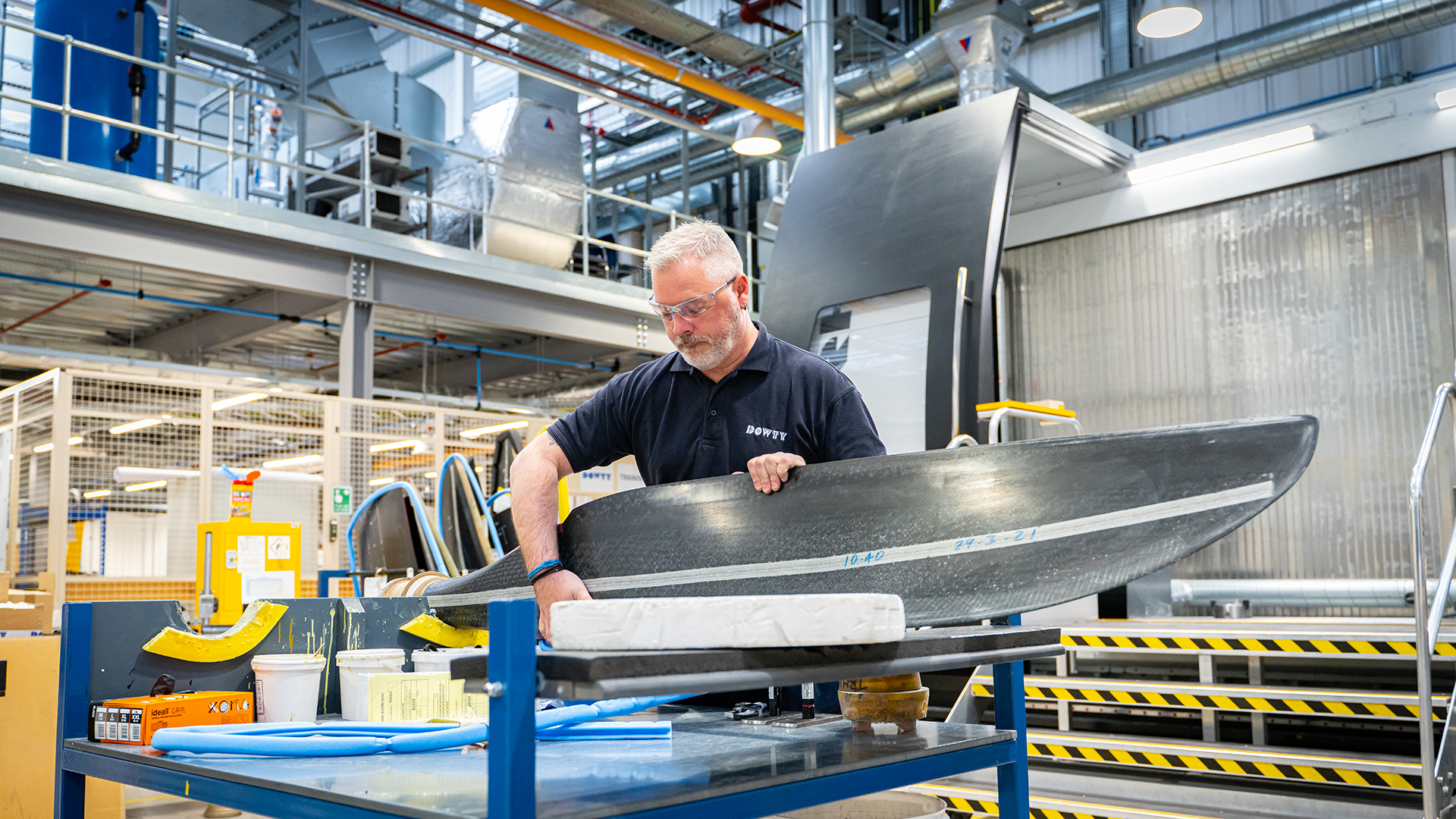
Dowty’s contribution draws on work with composite blades, blade retention, pitch actuation and durable propeller structures. Composite design allows engineers to shape a blade while controlling its mass and stiffness, but a viable production component must also withstand cyclic loading, vibration, environmental exposure and the loads transmitted through its attachment. Those questions become more demanding as a design moves from a laboratory prototype into repeatable hardware for ground and flight tests, when material variability and inspection results need to be recorded consistently.
The £19m project is a new commitment associated with the innovation centre. It follows £12m of previously disclosed investment at Dowty in equipment, testing capability and recruitment for future engine technology. The earlier funding covered equipment, tests and recruitment at existing operations; the £19m commitment is directed towards a dedicated development and preproduction facility.
Composite blade designs must be translated into repeatable manufacturing procedures before an engine programme can assess industrial readiness. Engineers must establish whether a component can be produced consistently with available machinery, inspection methods and material controls, as well as whether it performs as intended. For complex composite parts, decisions about fibre placement, curing, machining, joining and inspection affect both structural behaviour and the eventual production process. A design that performs well in a laboratory must still be supported by a controlled and traceable manufacturing route.
That progression also determines which defects are acceptable, which features require inspection and how the process can be repeated as volumes increase. The company has not yet provided a production rate or output target for the proposed facility. The investment therefore represents additional research, validation and preproduction capability, rather than the opening of a new high-volume engine component line.
Dowty’s experience with composite propeller systems is informing open fan work within the CFM RISE demonstrator programme. The programme also investigates a more compact engine core and hybrid electric systems. These streams have different engineering requirements, but each depends on evidence gathered through testing before choices can be frozen for commercial product development.
Future open fan blades must satisfy structural, fatigue and maintenance requirements alongside aerodynamic targets. Their interaction with the hub, blade retention and actuation systems has to be understood across the operating envelope, while inspection records must connect test results to the materials and processes used to make each component. The new facility is intended to expand Dowty’s scope to develop and prepare such technologies ahead of production decisions.
Gloucestershire remains the centre of Dowty’s UK engineering operations, where it has maintained a presence for almost 90 years. Its existing Brockworth site brings together manufacturing, engineering and repair activities. That established base provides experience with production processes and in-service support, although Dowty has not specified a construction timetable, commissioning date or staffing total for the proposed centre.
Separately, GE Aerospace has outlined investment at its Prestwick maintenance operation and its commercial engine overhaul site in Wales. Those programmes concern existing service and maintenance infrastructure, whereas the Dowty centre is intended to develop future hardware. The programmes have separate purposes within the company’s UK engineering and service footprint.
The proposed centre will support the testing and preproduction work needed before any future open fan design can enter industrial manufacture. No opening date or annual production target has been given for the site. CFM RISE remains a technology demonstration programme, with further propulsion testing needed before manufacturers can commit to a future commercial architecture.