Hy2gen has signed a binding European Hydrogen Bank grant agreement for its planned Albatros renewable hydrogen plant in Kassø, southern Denmark. The agreement provides access to as much as €139.8m in support linked to certified hydrogen production, rather than an upfront payment for construction. The proposed 100MW facility is still in development, with an investment decision targeted for 2028 and operations scheduled to begin towards the end of 2031.
Albatros had already been selected through the European Hydrogen Bank’s competitive auction. The November agreement converts that earlier award into a contractual support arrangement, establishing a fixed premium of €0.97 for each eligible kilogram produced over a period of up to ten years. The total available support depends on production volumes, certification and the conditions of the agreement. It is not funding that Hy2gen can treat as received before its electrolysers are built and operating.
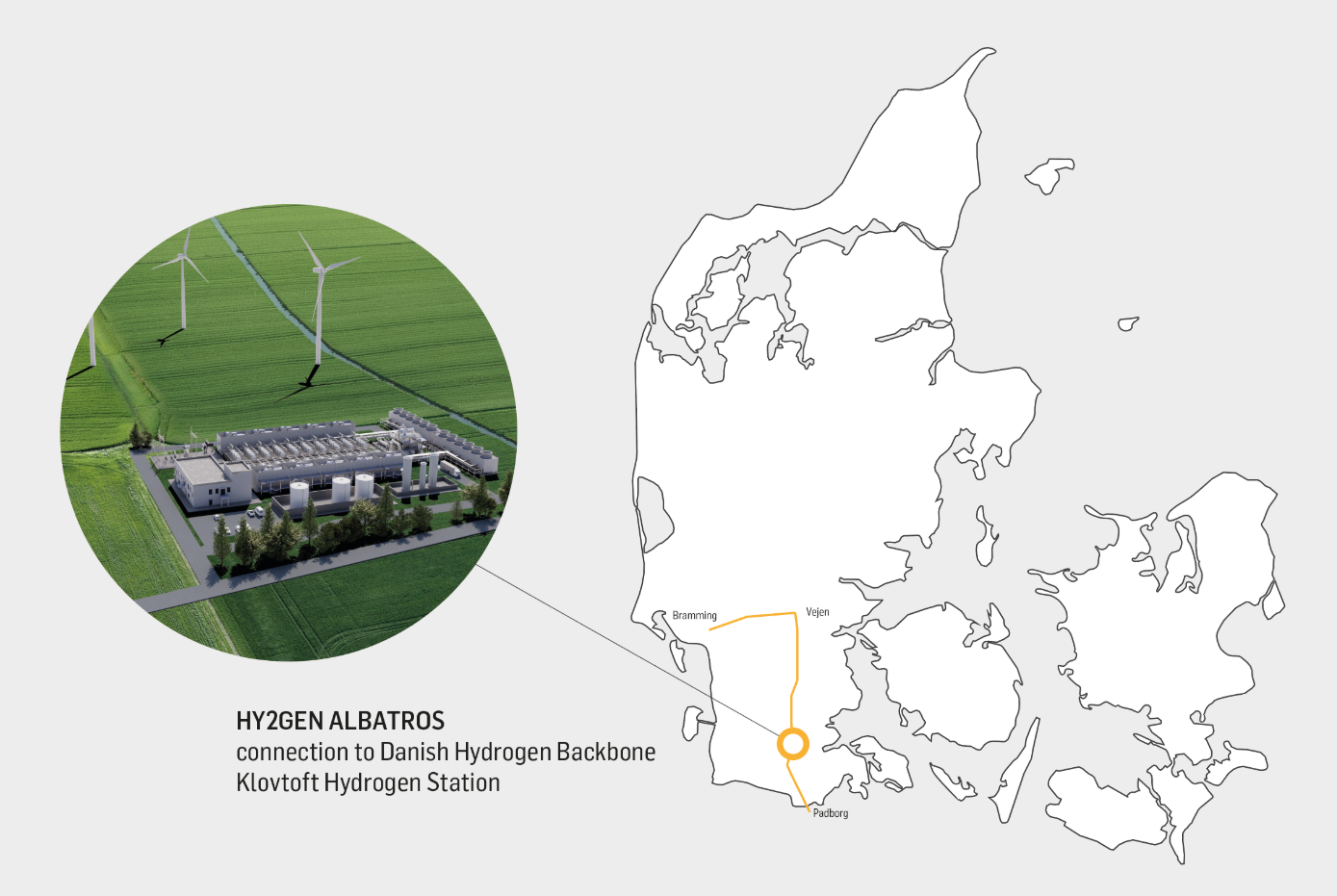
Hy2gen Nordic AS is developing the project at Kassø National Industrial Park in Aabenraa Municipality. The design envisages approximately 14,400 tonnes of renewable hydrogen output a year. At that scale, the plant will require more than 100MW of electrolyser equipment: electrical connection and conversion, treated water, gas separation, compression, metering, process controls and safety systems must operate as an integrated installation. Its eventual energy consumption and delivered hydrogen volume will depend on operating hours and the power supply available.
Electrolysis separates water into hydrogen and oxygen using electrical energy. The carbon characteristics of the hydrogen therefore depend heavily on the electricity used, as well as the plant’s operating efficiency and associated processing requirements. Albatros aims to produce renewable fuel of non-biological origin, or RFNBO, under European rules. That designation brings requirements concerning renewable electricity sourcing and the evidence used to establish the fuel’s greenhouse gas performance. Metering and traceability will have a commercial purpose as well as a compliance function, because subsidy payments apply only to eligible production.
The site has been selected with prospective electricity supply and hydrogen transport infrastructure in mind. Hy2gen intends to connect Albatros to the planned Danish Hydrogen Backbone, providing a route towards industrial users in Germany and other European markets. A physical pipeline connection would allow the project to supply customers beyond its immediate locality, but the relevant capacity, connection timetable and commercial delivery arrangements have to be coordinated with the plant’s construction and commissioning programme.
Hydrogen transport is also a distinct engineering task from producing the gas. Pipeline specifications, delivery pressure, gas quality, compression and control arrangements must match the requirements at both ends of a connection. Industrial customers will need compatible receiving systems and, where hydrogen is replacing an established feedstock or fuel, appropriate adaptations to their own processes. None of those downstream connections can be assumed simply from the planned electrolyser rating or the bank’s approval of production support.
Hy2gen estimates that Albatros could avoid around 986,000 tonnes of carbon dioxide equivalent during its first ten years. This is a forecast for the proposed project, not an emissions reduction measured at a working facility. Actual savings will depend on certified hydrogen output, electricity sourcing, transport and the industrial products or fuels displaced. The figure therefore needs to be assessed against the final operating arrangement rather than treated as a guaranteed environmental outcome.
The fixed premium is intended to narrow the cost gap between renewable hydrogen and conventional alternatives. It can improve the revenue case for production once the plant operates, while leaving substantial decisions unresolved. The project must still secure its remaining finance, equipment supply, grid connection, permits, offtake arrangements and access to transport infrastructure. A production-based subsidy does not remove those capital and delivery requirements, nor does it establish an agreed market price for every kilogram sold.
Hy2gen reports progress on electricity and hydrogen infrastructure coordination alongside technical design and commercial discussions. Its programme allows for a final investment decision in 2028 and a start of operations at the end of 2031, subject to development and construction. The company also estimates approximately 500 construction jobs and 20 to 40 operating roles. Those employment numbers are projections associated with a project that has not yet reached its final investment decision.
Hy2gen must now complete the finance, principal equipment procurement and infrastructure agreements needed before a 2028 investment decision. The signed grant fixes the support available for eligible hydrogen production, while the amount eventually paid will depend on plant performance and certification after the proposed 2031 start-up.