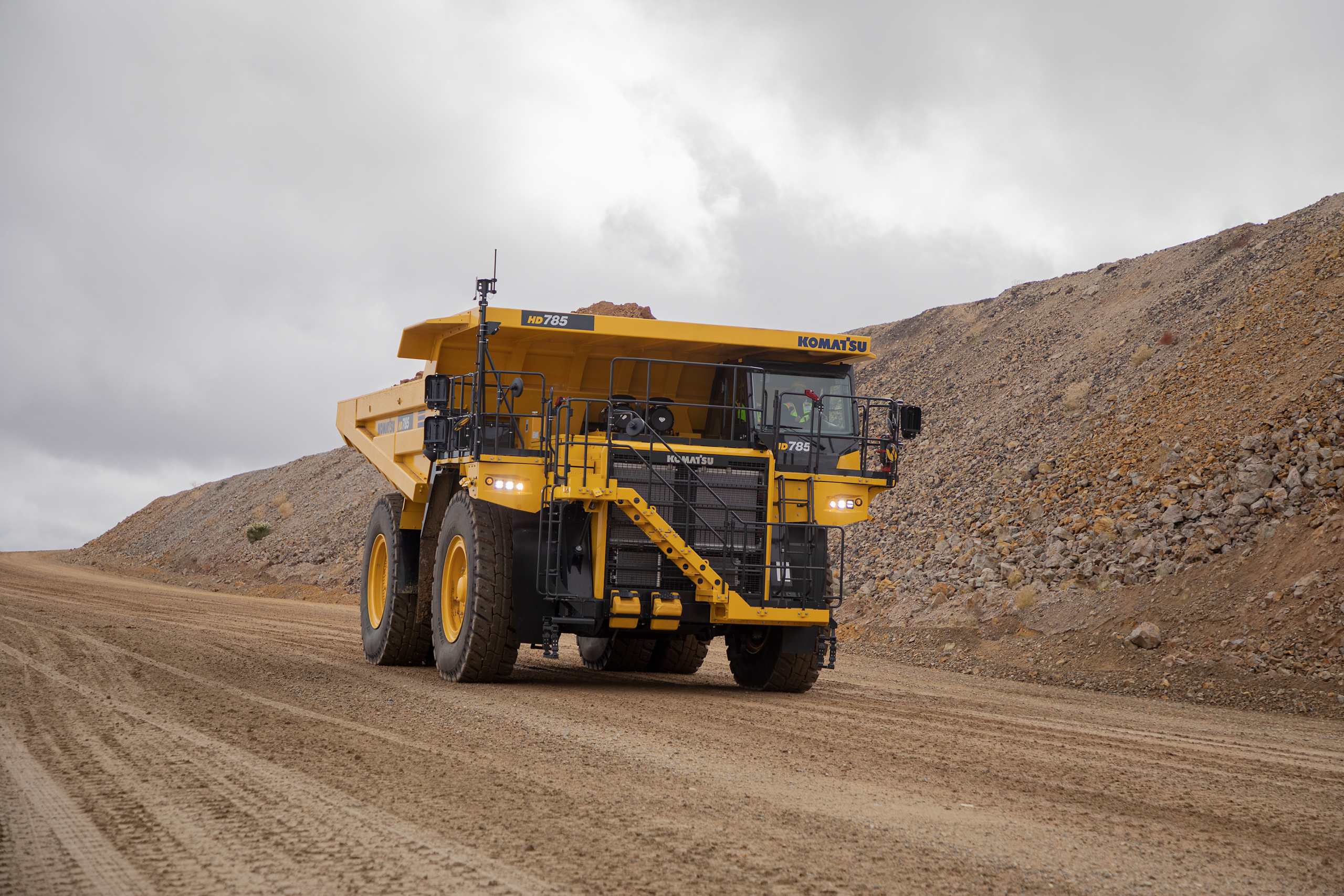
Komatsu and autonomous driving developer TIER IV have begun joint development of control systems for three dump truck models used in quarrying and construction, with deployment planned in Japan and North America during 2027. The programme covers two rigid dump trucks and an articulated machine family, linking autonomous navigation to the loading, hauling and unloading work performed on industrial job sites. It represents a new vehicle development phase within a partnership that began in September 2025, rather than confirmation that all three types are already operating autonomously at customer sites.
The machines identified are Komatsu’s HD785 rigid dump truck, with a stated maximum payload of 93.9 metric tonnes, the HD605 rigid dump truck rated at 64.1 tonnes and the HM400/460 articulated dump truck family with a maximum payload of 42 tonnes. The sizes and configurations cover different hauling requirements. A rigid dump truck is primarily suited to planned haul roads and high payload movement, while articulated machines can negotiate tighter or more variable routes using a chassis joint between the front and rear sections.
TIER IV will contribute its autonomous driving technology while Komatsu supplies vehicle engineering, control and system integration expertise. A third partner, EARTHBRAIN, is a Komatsu subsidiary providing fleet management capability. The partners intend to integrate vehicle autonomy with site-wide fleet coordination, recognising that the productivity of an automated truck depends on the sequence of loading and unloading as well as its ability to travel a route without a human driver. The exact control architecture and communications specifications have not been disclosed.
At a quarry, the truck must work within the sequence of loading, hauling, dumping and returning to collect another load. Travel routes can intersect with loaders, maintenance vehicles and people working in controlled zones. The fleet system needs to account for vehicle availability, loading equipment and dump-point capacity, rather than dispatching every machine as soon as its route is free. Komatsu and its partners intend their development to support those linked tasks, although a detailed dispatch architecture has not yet been disclosed.
Vehicle mass introduces substantial engineering constraints. A heavily loaded truck responds differently from an empty one to braking, cornering and changes in surface traction, so a control system must operate within the limits of the vehicle and the site’s approved conditions. An articulated truck also has distinct steering behaviour from a rigid model. Developing a common autonomous capability across the three identified types therefore requires vehicle-specific integration and verification, even where portions of the underlying software and operating logic can be shared.
The companies describe loading, hauling and dumping as the intended operating tasks. Safe sequencing at each stage involves communication between the truck, the loading machine, any dispatch system and workers who may enter the operating area. The announcement does not identify a final sensor suite or detailed obstacle detection performance, and it does not say which customer site will receive the first deployment. Those aspects will have to be established during verification and jobsite trials rather than inferred from the selection of the truck models alone.
EARTHBRAIN’s fleet management technology will be integrated with the autonomous vehicle systems, extending the work beyond control of one truck. Coordination at the fleet level could help manage queues, changes to haul routes and interruptions in loading, provided the vehicles and site systems exchange accurate status information. The companies have not published a quantified productivity improvement or a demonstrated operating cost saving. Verification testing and subsequent site deployments are expected to establish how reliably the combined system handles routine trips and exceptions.
TIER IV is associated with Autoware, the open-source software platform used in its autonomous driving work. In this programme, its technology will be combined with Komatsu’s knowledge of heavy equipment and controls. Open software components can support development, but a practical mining or construction machine must still meet the applicable site rules, operating limitations and vehicle safety requirements. A claim about autonomous capability cannot establish the intended supervision model or the procedures for restarting a machine after a fault, neither of which is detailed in the initial project information.
The partners began working together in September 2025, but the latest announcement identifies a narrower, measurable engineering programme: autonomous development and verification for three named Komatsu model families and deployment ambitions in two markets. Komatsu has shown an HD785 driving at its test site; that demonstration does not establish that the HD605 and HM400/460 have completed autonomous commissioning or that commercial fleets are operating without drivers. The stated 2027 horizon remains a target for deployment, not an achieved milestone.
The articulated and rigid machines also create different integration problems. A heavy rigid truck follows the steering and stability characteristics of its chassis, while articulated models turn through a joint and may work on more variable ground. Braking, turning and dumping functions must be validated against each machine’s load, geometry and approved operating conditions. The same underlying autonomous software may support several types, but vehicle interfaces, route design and emergency handling cannot be assumed to transfer unchanged between them.
The next phase involves system development, verification testing and experience from jobsite deployment. Neither the initial customer sites nor order volumes, vehicle prices, sensor specifications or full commercial commissioning dates have been disclosed. The confirmed advance is a programme covering the HD785, HD605 and HM400/460 with fleet-management integration, aimed at practical use in quarry and construction operations in Japan and North America during 2027.