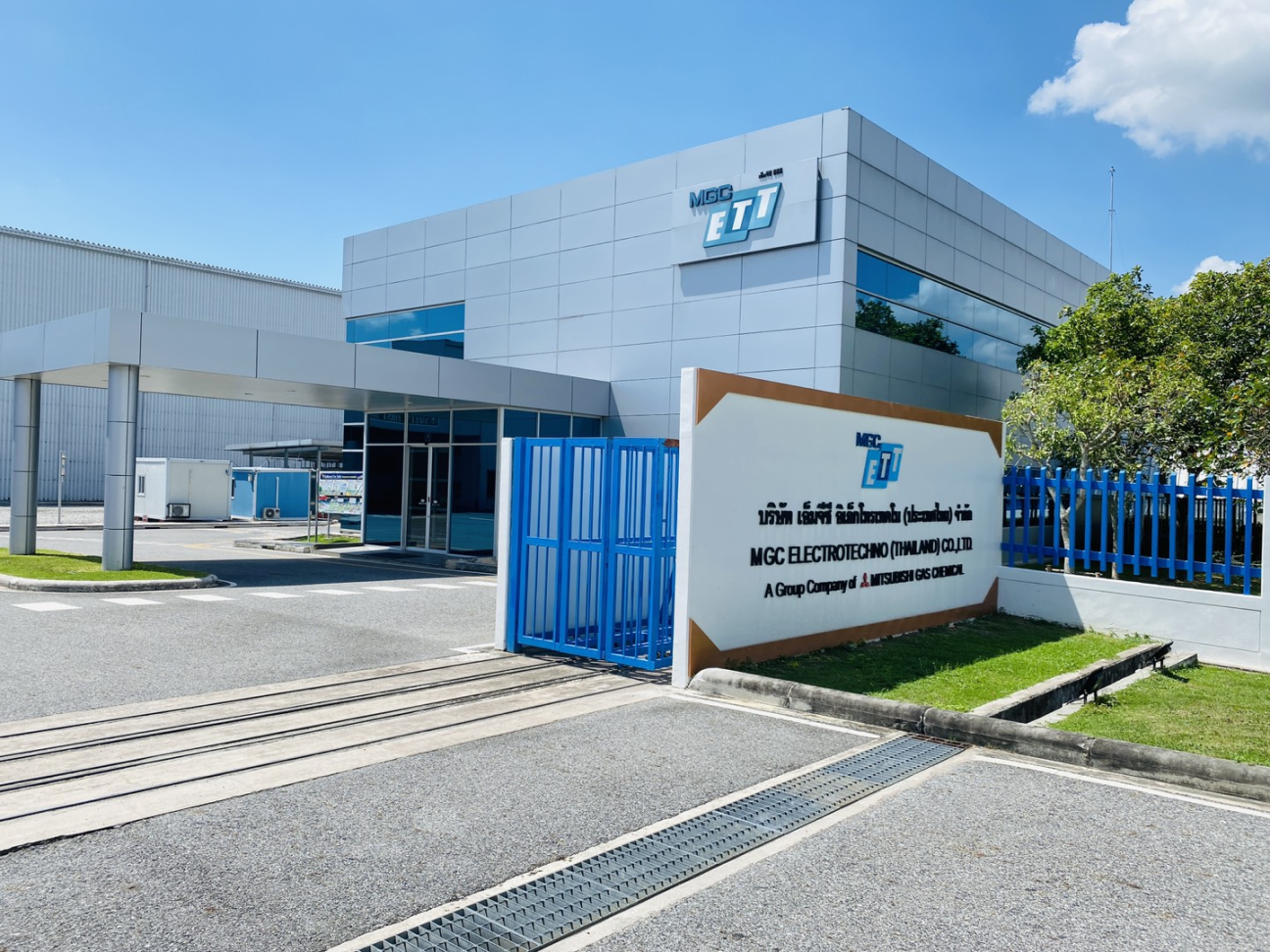
Mitsubishi Gas Chemical plans another expansion of semiconductor packaging materials production at its MGC Electrotechno (Thailand) plant in Rayong, adding prepreg production and shipment inspection capacity. Construction is expected to begin in April 2027 and commercial operation in October 2028. The Japanese chemicals group announced the decision on 10 November, following completion of a separate production expansion at the same factory in 2025. It has not specified the new project’s investment value or additional annual output.
The work will take place at the WHA Eastern Seaboard Industrial Estate, where MGC Electrotechno (Thailand), or MGC-ETT, manufactures BT materials used in semiconductor package substrates. New equipment will make prepreg for copper clad laminates, while the inspection expansion is intended to increase the quantity of material that can be checked and released for shipment. Manufacturing and inspection capacity must be coordinated: an output increase can simply transfer the constraint downstream if product testing and dispatch cannot keep pace.
BT materials are based on bismaleimide-triazine resin chemistry, used in laminate systems that provide electrical insulation and structural support within semiconductor packages. Prepreg consists of reinforcement material impregnated with a resin system before subsequent lamination. The resulting substrate contains layers that support the chip and route its electrical connections towards the finished circuit assembly. Resin properties, reinforcement, dimensional stability and consistent fabrication are important as package designs carry more connections within limited space.
MGC identifies growth in flip-chip ball grid array (FC-BGA) substrates as a principal reason for investment. In an FC-BGA package, connections from the semiconductor die are redistributed through a multilayer substrate before reaching the wider assembly. Material supplied into that production chain must satisfy the relevant dimensional, electrical and quality specifications. Expanding outgoing inspection alongside prepreg manufacture therefore addresses a separate operating stage, although MGC has not disclosed the individual material grades, inspection systems or production rates planned for Rayong.
The previous Rayong expansion reached construction completion in November 2025, with the company saying the additional plant approximately doubled capacity relative to the earlier baseline. Its associated commercial operation was planned from December 2025. The 2026 decision should not be conflated with that project: the new phase has its own April 2027 construction start, October 2028 operating target and explicit emphasis on prepreg equipment and shipment inspection.
The Thai operation is part of a two-site manufacturing structure alongside MGC Electrotechno in Fukushima prefecture, Japan. MGC says it established its Thailand subsidiary in January 2012 as part of a business continuity approach and began operating the two-site supply model in 2013. Within that arrangement, the Japanese plant has concentrated on introducing new products and producing advanced, higher-performance and lower-volume material mixes, while the Thai factory has mainly manufactured a smaller variety of products in larger volumes. The distinction allows the group to allocate different types of production across the sites rather than treating them as interchangeable copies.
MGC’s two-country arrangement is intended to support continuity of supply, but the division of work also reflects different manufacturing requirements. New products and small-volume advanced materials often need different process settings and qualification work from established high-volume grades. A second production location can reduce dependence on one site only to the extent that qualified equipment, materials and logistics can support the required output. MGC has not identified which individual product grades could be transferred between the Japanese and Thai operations.
Demand for data centre and server components is part of MGC’s forecast for semiconductor package growth. Higher-density processors and networking devices rely on package substrates that combine electrical routing, insulation and dimensional control, placing materials production upstream of finished computing equipment. The company’s forecast supports the reason for adding capacity, but it has not connected the project to named customer orders or disclosed committed volumes for the new facilities.
Inspection capacity determines how much finished material can move into the supply chain after production. A batch that has been manufactured but has not completed the necessary quality checks cannot be treated as released product. By adding product inspection facilities alongside prepreg equipment, MGC is addressing both stages of the factory flow. The specific equipment counts, test methods and throughput targets remain undisclosed, so the scale of the intended increase cannot yet be calculated.
MGC-ETT was established in January 2012 and is wholly owned by the group’s MGC Electrotechno subsidiary in Japan. Its stated capital is 710 million Thai baht. The next defined milestones are the April 2027 start of construction and planned October 2028 commercial operation; information on installed equipment, commissioning and qualified output will establish how much additional packaging material the expanded site can supply.