
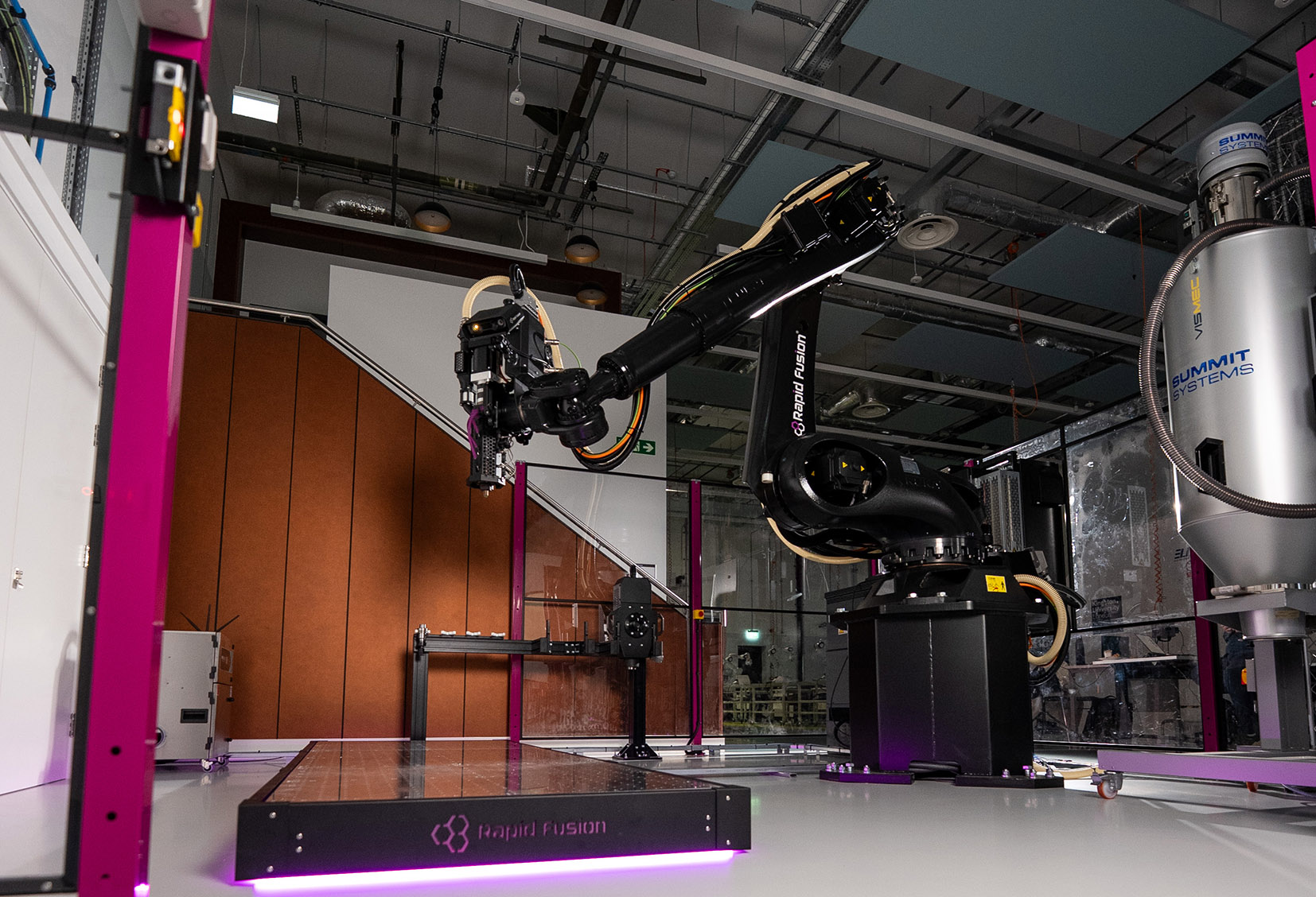
Rapid Fusion has installed a £450,000 robotic manufacturing cell at Kingston University, combining large-format additive manufacturing with integrated CNC milling to support engineering research, industrial projects and student training.
The Zeus system has been installed in the Faculty of Engineering, Computing and the Environment at the university’s Roehampton Vale campus. It provides a manufacturing platform on which printed components can be scanned and machined as part of a coordinated production process.
The installation is the first time the Exeter-based engineering company has placed the Zeus platform at a university. Alongside the equipment, Rapid Fusion has committed to supporting work placements, potential Knowledge Transfer Partnerships and the future development of engineering teaching.
Zeus combines robotic 3D printing with CNC milling, allowing additive and subtractive manufacturing techniques to be used within one modular system. Kingston intends to use the equipment for prototyping, complex components manufactured in low volumes, and projects undertaken with industrial partners.
Large-format additive manufacturing builds components by depositing material in successive layers according to a digital design. The process can be used to produce large or complex structures without removing material from a conventional solid blank, although the finished geometry and surface condition depend on the equipment and printing parameters.
Parts produced using additive methods may require subsequent machining to obtain accurate mating surfaces, mounting features or other dimensions. On conventional production routes, that work can involve transferring a printed component to separate machine tools and establishing a suitable machining setup.
By combining printing and milling functions, Zeus is intended to reduce the number of separate operations required to complete these components. The precise workflow depends on the geometry being manufactured, its material and the surfaces or features that need machining.
The cell also incorporates an industrial scanning camera from Zivid and robot programming software from ENCY. The scanning technology provides geometric information about the manufactured part, while the programming system can use digital models and process information to generate machining operations.
Comparing the actual printed geometry with the intended design is particularly useful when an additive process produces small differences in shape or dimensions. A scan can provide information for planning subsequent machining, reducing the dependence on an operator manually defining every operation from the nominal model.
That integration does not eliminate the need to establish machining tolerances or verify finished components. The achievable accuracy remains dependent on robot positioning, calibration, workholding, tooling, material behaviour and the conditions encountered during processing.
Rapid Fusion says the combination is intended to deliver smoother surfaces, more closely controlled dimensions and machined features without the additional component transfers that would otherwise be required.
Jake Hand, chief executive of Rapid Fusion, said the university installation would provide access to equipment used in emerging industrial manufacturing workflows.
“Zeus will provide staff, partners and grads with the opportunity to ‘print, scan and mill’ in one solution,” Hand said.
Hybrid additive and subtractive manufacturing can be useful when a component’s overall form is suited to printing but particular areas require the precision or surface finish of conventional machining. Selecting the appropriate sequence involves balancing the printing method, material characteristics and the amount of subsequent finishing required.
The system may also reduce the need to outsource work where a research team would otherwise print a component at one facility and arrange machining elsewhere. Kingston expects the installation to support faster iteration during development projects, although the partners have not published measured reductions in production time or cost.
The equipment will be made available for research activities and collaboration with industrial organisations. That capability may allow university engineers and external partners to manufacture and modify experimental components without relying entirely on commercial production facilities.
Access to the cell will also support teaching across several manufacturing disciplines. Students using the equipment will encounter processes involving CAD data, robot programming, additive manufacture, scanning and CNC machining, rather than learning each technology only as an isolated activity.
Preparing a component for hybrid manufacture requires decisions about build orientation, material deposition, machining access and the order in which operations should be completed. Those decisions can affect whether the finished part meets the required geometric and functional specifications.
Rapid Fusion’s educational commitment extends beyond familiarisation with the equipment. The company plans to provide work placement opportunities and contribute to discussions about the curriculum, bringing experience from industrial additive manufacturing projects into the university’s engineering programmes.
The partners will also explore Knowledge Transfer Partnership opportunities. No particular funded KTP project has yet been confirmed, so those discussions remain a potential extension of the collaboration rather than an awarded research programme.
Hand linked the initiative to the need for engineers familiar with both robotics and additive manufacturing. The company intends to work with Kingston staff to identify how the installation can be used in teaching and how its technical specialists might contribute to future course development.
Rapid Fusion has previously developed LFAM systems including Apollo, Medusa and the containerised Cerberus platform, which is intended to support manufacturing in remote locations. Zeus extends the company’s portfolio into integrated printing, scanning and machining operations.
Lesley Stigling, operations manager at Kingston University, helped develop the relationship after a university graduate joined Rapid Fusion and encouraged the two organisations to meet.
“We are always exploring the latest technology and how it can add value to our industrial, research and educational offer,” Stigling said.
The university expects the equipment to strengthen its ability to attract collaborative research projects and provide practical experience relevant to manufacturing employers. These are planned benefits of the installation, with future project activity dependent on the research and industrial work secured.
The combination of manufacturing equipment and education support provides Kingston with a facility for investigating hybrid production processes and training engineers in their operation. The Zeus cell is now installed at Roehampton Vale, where it will be used for teaching, research and potential industry collaborations.

