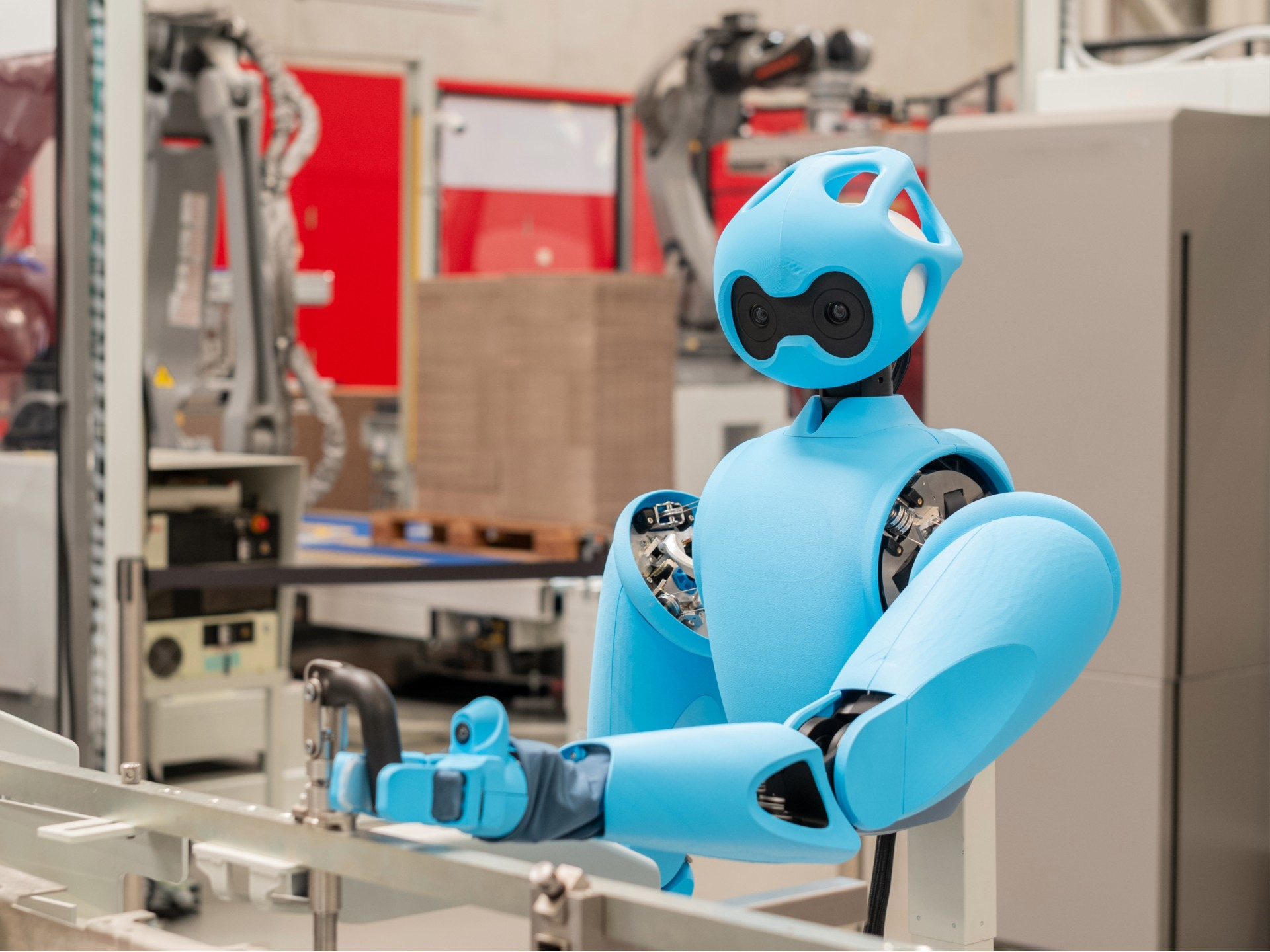
Embodied AI has introduced AIR, a wheeled humanoid robot developed to perform changing industrial tasks alongside factory personnel, using lightweight tendon-driven arms and a learning system based on human demonstrations.
The Swiss company unveiled the robot at Humanoid Europe 2026 in Munich on 6 November. It says the platform is being evaluated by international manufacturers and that planning has begun for scaled production, although customer identities, order quantities and commercial delivery dates have not been disclosed.
AIR has two arms mounted on a torso supported by a wheeled mobile base. Unlike legged humanoid systems, the robot is designed to move across the relatively level surfaces found in many manufacturing facilities while carrying out manipulation tasks at industrial workstations.
Embodied AI developed the system over approximately nine months, building on robotics research and software previously used in its industrial automation activities. The company describes the design as an attempt to automate repetitive manual operations that change too frequently for conventional fixed-purpose equipment to be practical.
The mechanical arrangement is central to that approach. AIR’s motors, gearboxes and electronics are concentrated in its torso rather than distributed throughout the moving arms.
Tendons transmit movement from the drive equipment to the arm mechanisms. By locating heavier components closer to the robot’s main structure, the design reduces the mass carried by the moving limbs.
Lower moving mass can reduce the kinetic energy associated with a given movement and influence the forces generated when the arm comes into contact with another object. The design also incorporates mechanical compliance, allowing the limbs to yield under certain contact conditions.
Embodied AI intends these characteristics to support operation near people without relying exclusively on software restrictions to control the robot’s movements. The company describes physical compliance as a foundation for its approach to collaborative industrial robotics.
The mechanical design does not, however, establish that every application is safe for unrestricted human contact. Risks depend on the complete installation, including the robot’s speed, movement, gripper, workpiece and surrounding equipment.
A lightweight arm can still present hazards if it carries a sharp component, moves towards a fixed surface or creates a trapping point. Suitable safeguards and operating procedures must therefore be determined for the particular manufacturing task.
The company says AIR has been designed with reference to ISO/TS 15066:2016, which addresses collaborative industrial robot applications. CE marking is planned for 2027, indicating that the relevant conformity assessment has not yet been presented as complete.
The proposed safety approach will need to be assessed alongside the operating conditions of each deployment. Mechanical compliance may contribute to the overall risk reduction strategy, but the final application must still satisfy applicable machinery safety requirements.
Wheeled mobility provides a second departure from the mechanical arrangement used by many humanoid robots. Embodied AI selected wheels because conventional factory floors often provide relatively flat routes between workstations.
The arrangement removes the need to control a walking gait and may offer greater stability for some manipulation tasks. It also creates operating limits where the robot encounters steps, floor obstacles, narrow access points or surfaces unsuitable for its mobile base.
The robot’s suitability will depend on the layout of each facility, the reach required at individual workstations and the ability to handle objects within the intended operating area.
Alongside the hardware, AIR uses a learning process that begins with a human operator controlling the robot directly. Teleoperation allows the machine to perform an assigned activity while its movements and results are recorded for subsequent training.
Those demonstrations provide examples of how the task is carried out, including the sequence of movements and the conditions encountered during operation. Embodied AI uses the recorded information to develop task-specific autonomous behaviour.
The company says AIR can typically learn an assigned task within approximately one month, depending on the application. That period is an expectation reported by the developer rather than a guaranteed commissioning time for every manufacturing process.
Once the robot begins performing an activity autonomously, an operator remains available to intervene when it encounters an unfamiliar situation. The company also intends to transfer learned capabilities between compatible robots, reducing the need to repeat every demonstration from the beginning.
The effectiveness of that approach depends on how consistently the training examples represent the conditions encountered during actual production. Changes in component position, material behaviour or the sequence of manufacturing operations can introduce situations outside the robot’s previous experience.
An autonomous system must therefore respond appropriately when a task differs from its training data. Depending on the application, that may require stopping, requesting assistance or returning control to the operator rather than continuing with an uncertain movement.
Francesco Stella, co-founder and chief executive of Embodied AI, said the physical consequences of incorrect actions make reliability essential to the development of industrial robotics.
“Safety and reliability are non-negotiable requirements of physical AI to enter the real world at scale,” Stella said.
The company’s software has already been used in paid industrial deployments involving a separate two-arm robotic cell. Embodied AI reports that this earlier system achieved 98% reliability in a cable-handling evaluation for an unnamed consumer electronics manufacturer, exceeding the customer’s stated 90% target.
According to Embodied AI, the manufacturer had previously tested five funded robotics startups on the same task without any meeting its targets. The reported result is company-provided evidence, and the full test methodology and identity of the customer have not been disclosed.
Crucially, the 98% figure relates to the earlier industrial cell rather than AIR itself. The new wheeled robot uses the company’s wider software technology, but its mechanical configuration and operating environment differ from those of a fixed production cell.
A test result obtained from one cable-handling application cannot establish equivalent reliability across other materials, workstations or manufacturing processes. AIR will require its own operating evidence as the platform progresses through industrial trials.
Stella developed the tendon-driven arm concept through doctoral research at EPFL, the Swiss Federal Institute of Technology in Lausanne, and subsequently conducted research at the Massachusetts Institute of Technology’s Computer Science and Artificial Intelligence Laboratory.
He established Embodied AI with chief technology officer Kai Junge and chief operating officer Max Polzin, both of whom have robotics research backgrounds. The company is based in Lausanne and also operates an office in Rome.
Embodied AI is backed by investors including Faber, TechShop, Look AI Ventures, Plug and Play, and Vento. The company has not disclosed a total development expenditure for AIR or the investment required for its planned production expansion.
It says contracts have been signed with major original equipment manufacturers and that industrial testing is under way. Without published customer identities or contract details, those arrangements cannot yet be translated into a confirmed installed fleet or commercial production volume.
The economic performance of an adaptable robot will also depend on the time required for demonstrations, supervision and intervention. A machine that can perform several different tasks may require additional preparation when moving between them, while the cost of training must be considered alongside its productive operating hours.
Embodied AI has not provided a confirmed selling price, detailed service arrangements or a commercial delivery timetable for AIR. The company’s next development steps include further manufacturer testing, production planning and the conformity assessment targeted for 2027.
The launch establishes a new mobile manipulation platform built around compliant mechanical hardware and human-guided learning. Its performance in sustained industrial operation will depend on the results of the ongoing trials and the ability to reproduce reliable task execution under the conditions encountered in production.